



Processing & manufacturing
Stay informed on food processing and manufacturing advancements, from automation, AI and digitalisation to hygienic design, process scale-up and cold chain operations. Explore technologies and best practices that improve efficiency, product quality, safety and operational performance.
Latest content
 News
NewsFSA issues new regulatory guidance for cell-cultivated food developers
The Food Standards Agency and Food Standards Scotland have released new guidance on regulatory authorisation, growth media assessment and toxicology for businesses developing cell-cultivated food products in Great Britain.
 Article
Plant-based homogenisation starts with the right pre-mix
Steffen Jahnke of GEA explores how the right pre-mix sets the foundation for successful plant-based homogenisation, and what scale-up really tests.
 Article
The Process NIR Readiness Checklist
Successful process NIR starts before installation. This checklist helps manufacturers assess readiness, identify gaps and make the right decisions early to accelerate deployment and results.
Featured
Article
New Food explains: What viable PFAS-free food packaging really requires
With new EU limits on PFAS in food-contact packaging now in force, New Food speaks to VTT experts about balancing product performance requirements with viable PFAS-free alternatives.
Article
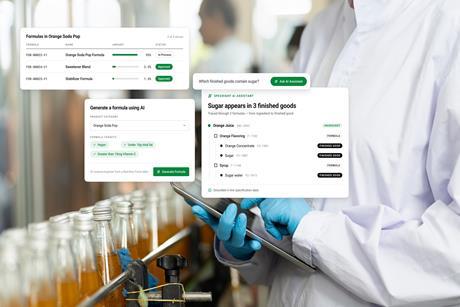
Why fragmented product data raises the cost of food non-compliance
Specright’s Andy Stark explores how fragmented product data can increase compliance risk, slow reformulation and drain R&D capacity – and why trusted data is becoming critical to effective AI adoption.
Webinars
- Previous
- Next






Join now
Unlock exclusive industry insights
- Bookmark articles and resources to access anytime
- Enjoy free access to industry leading resources, webinars and insights
- Stay informed with in-depth coverage of food safety, quality, innovation and regulatory change from across the global food and beverage industry
- Receive updates and recommendations tailored to your professional interests
More Processing & manufacturing
 Article
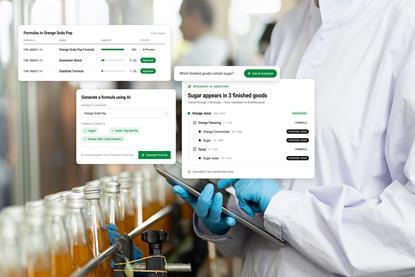
Why fragmented product data raises the cost of food non-compliance
Specright’s Andy Stark explores how fragmented product data can increase compliance risk, slow reformulation and drain R&D capacity – and why trusted data is becoming critical to effective AI adoption.
 Opinion
Imported eggs and Salmonella: the cracks in Britain’s food-safety defences
Recent Salmonella outbreaks have exposed vulnerabilities in UK egg supply chains. Chris Elliott examines their complex routes into food service and where improvements are needed.
 Article
Building food supply chain resilience through data-sharing approaches
As food supply chains face growing disruption, Wageningen University & Research experts explain why better data sharing is becoming critical to building greater agility and resilience.
More Processing & manufacturing
 Article
New Food explains: How FSA national regulation proposals could reshape industry oversight
The UK Government has asked the FSA to develop national oversight of large food businesses. Walker Morris’ Chris McGarvey explains what it could mean for the industry.
 Article
How laboratory AI agents can transform R&D and quality in the food industry
Food and beverage laboratories face growing pressure to innovate without compromising safety. This article explores how agentic AI can connect siloed data, strengthen predictive quality and accelerate R&D.
 Article
Why food laboratories need analytical systems that deliver more than sensitivity
Can laboratories increase sensitivity without compromising routine reliability, workflow efficiency or resource use? The LCMS-8065XE was designed to address these growing analytical demands.
 Article
Designing nutraceuticals around biology, not ingredients
Health claims on nutraceuticals can be limited due to the need for scientific evidence, which traditional products often lack. Here, we introduce a new approach to nutraceutical formulation that marries biology with engineering to address specific health issues – and the results are looking good.
 Article
Setting pass/fail criteria with GENESYS custom method application: Sports drink quality testing
How can beverage manufacturers catch concentration errors and contamination quickly? This study explores how UV-Visible spectroscopy and custom pass/fail criteria can support faster, straightforward quality checks.
 Article
Moving AI beyond pilot: a compliance guide for food businesses
AI can improve forecasting, traceability and customer communications, but food businesses remain accountable when failures create safety or compliance risks. Here is what technical and compliance leaders should consider before moving AI from pilot to production.
 Report
Is your food testing programme a map of current risk or an archive of past concerns?
A practical guide for QA, QC and laboratory leaders navigating rapid reformulation, complex matrices and escalating regulatory scrutiny.
 Article
Why scaling food biotechnology is an engineering challenge, not just a scientific one
As fermentation and microbial production scale up, Food Manufacturing Technologies Europe President Ola Elmqvist explains why reliability, efficiency and economics – not biology alone – will determine commercial success.
 Article
From science to shelf: the rise of pet gut health innovation
Elisabetta Pierangelo, Global Vice President of Research & Development at Mars Pet Nutrition, reveals the latest research that is helping to reshape pet food formulation strategies that prioritise gut health for optimum overall wellness.
 Article
What happens to fresh food when there is no next delivery?
Commercial shipping exposes the limits of fragile food supply chains and the urgent need for resilience. Coby Sella, Chief Executive Officer of Agwa, argues that the lessons now playing out at sea signal where the wider food system is heading.
 Article
What 10 years of advancement mean for Process NIR reliability
Process NIR has a reputation problem. Not because the technology doesn’t work but because for many manufacturers, an earlier experience left a lasting impression.
 Article
How wellbeing will drive food sector’s next phase of growth
Backed by data-driven insight, Sharon Bligh from the Consumer Goods Forum cuts to the heart of how manufacturers can get ahead of the curve by catering to the distinct yet varying needs of today’s consumer.
 Article
Combining modern approaches in food pathogen detection with smarter control strategies
As food safety laboratories strive for faster, reliable, and audit-ready pathogen detection, success depends on more than advanced molecular methods. Robust workflows, contamination control, and compliance are now just as critical as PCR performance.
 Opinion
Cold chains, red-hot risks: the critical infrastructure not talked about enough
Few things spread fear more effectively than mistrust of the food supply. Professor Chris Elliott demonstrates how decisive cold chains are to the safety of food systems and why their protection must be a top priority and collective effort.
 Article
Rebuilding food from air: how Solar Foods is scaling a new production system
Solar Foods is pioneering a new way to produce protein using energy, microbiology and gas fermentation instead of agriculture. New Food Deputy Editor Ben Cornwell speaks to Dr Juha-Pekka Pitkänen about the technical, regulatory and industrial challenges of scaling this novel food technology.
 Opinion
Goodbye barcodes, hello digital labelling
The barcode has underpinned food supply chains for decades, but changing consumer expectations and regulatory requirements are driving a shift towards smarter packaging. Rob Allen, Divisional Manager for Packing Solutions at Interfood Technology, reveals why QR codes are moving from novelty to necessity – filling the information gaps that are now essential in modern food systems.