



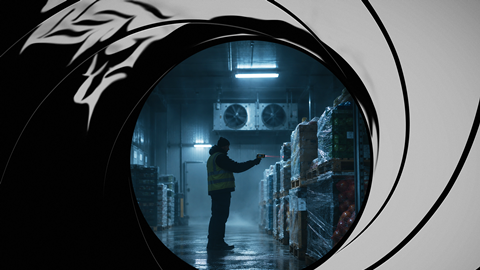

In part two of this series, Dr Darin Detwiler levels the question of responsibility at food industry leaders; noting that cybersecurity has become a critical test of food safety leadership.
On a nuclear submarine, the most dangerous moment is not necessarily when an alarm sounds. It may be when a system appears to be functioning normally, but the crew has reason to question what its instruments are saying.
Beneath the ocean, there is no convenient opportunity to pull over, call for help or wait until tomorrow. The crew must understand its systems, recognise warning signs and act before a manageable problem escalates to an emergency. I learnt that lesson during my service aboard a US Navy submarine and it is a lesson the food industry can no longer afford to ignore.
In Part One of this series, No, Mr Bond, I expect you to dine!, I examined cyberattacks affecting European refrigeration, logistics, supermarket checkout systems and manufacturing. I also referenced unexplained refrigeration disruptions at US military commissaries, without treating those incidents as confirmed cyberattacks. The central finding was unsettling: restoring a digital system does not necessarily prove that the food it protected remains safe.
However, recognising a vulnerability is only the beginning. The greater challenge is ascertaining what must be done with this knowledge. Who takes responsibility? Who pays to reduce the risk? Who decides whether affected products can be released? And who has the authority to stop operations when consumer safety cannot be established?
Cybersecurity may begin with technology but protecting the food supply ultimately depends on leadership.
Compliance establishes an important floor. Leadership is tested by what happens when the rules do not provide an easy answer.”
A supply chain with no secret island
Europe’s food supply moves across borders through refrigerated transport, automated warehouses, shared technology providers, processing facilities and retail networks. An ingredient may be produced in one country, processed in another, stored in a third and sold in several markets. The technology coordinating that movement brings speed and visibility. It also creates dependencies that can extend far beyond any single company’s walls.
The 2021 attack on Sweden’s Coop supermarkets demonstrated how a compromise involving an upstream technology provider can interrupt retail operations. The Bakker Logistiek incident in the Netherlands showed how losing access to warehouse and transport information can interrupt deliveries. France’s October 2026 refrigeration incidents illustrated a different pathway: reported interference with equipment that physically maintains safe storage conditions.1
These distinctions are operationally important. An attack on ordering software is not the same as unauthorised manipulation of refrigeration controls. The first may primarily threaten availability; the second can raise immediate questions about temperature exposure and product safety. Each requires different safeguards, expertise and recovery decisions.
Leaders should know which digital systems are essential to safe food handling, who can access them remotely, which suppliers maintain them and what independent evidence will remain if monitoring data becomes unreliable. They should also know how long the business can operate when those systems are unavailable.
In my 2020 book Building the Future of Food Safety Technology,2 I examine the promise of connected sensors, digital traceability and intelligent systems. That promise remains real. The answer is not to retreat from innovation, but to make security, verification and human accountability part of innovation from the outset.
A system that saves time every day but cannot be trusted during an emergency may have created a new risk alongside its benefits.
Food is more than an inventory category
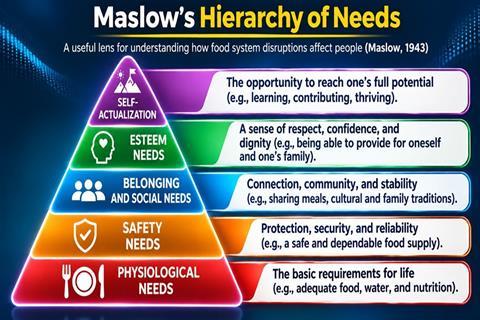
The consequences of food-system disruption do not end at the balance sheet. When a store closes, a delivery fails or a refrigerated warehouse loses its contents, people may lose access to food they rely on. The burden can be especially serious for households with limited transportation, money or nearby alternatives.
Abraham Maslow’s ‘Hierarchy of Needs’ begins with physiological needs such as food and water, followed by safety and security.3 The framework is a useful reminder that dependable access to safe food underpins much of everyday life. Food helps sustain health, stability, family routines and the ability to work and participate in society.
The interruption may begin with a compromised computer. Its consequences arrive at a kitchen table.
This is why a food company cannot evaluate cyber risk solely by asking how much a system outage will cost. The more appropriate question is who depends on that system and what happens to them when it fails.
The leadership test: what does responsibility require?
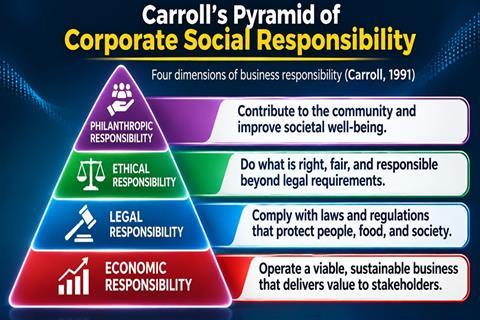
Archie Carroll’s ‘Pyramid of Corporate Social Responsibility’ provides another way to understand the obligation. Carroll identified economic, legal, ethical and philanthropic dimensions of business responsibility.4 Each becomes relevant when digital vulnerabilities threaten the food supply.
Economic responsibility is straightforward. Cyberattacks can destroy inventory, halt production, interrupt deliveries and damage customer relationships. Investing in reliable and secure systems protects continuity and reduces avoidable losses.
Legal responsibility includes applicable food safety and cybersecurity obligations. In the EU, the NIS2 framework brings certain food production, processing and distribution businesses within cybersecurity risk-management requirements, depending on the directive’s criteria and national implementation. Such requirements recognise that digital resilience matters to essential economic and social activity. Yet satisfying a reporting rule does not automatically resolve the question of what should happen to food held under uncertain temperature conditions.
Ethical responsibility is the harder test. If executives know that a critical controller runs outdated software, a remote-access connection is poorly secured, or a supplier has no credible recovery plan, how long can they justify delaying action? When monitoring records are unreliable, will they support a product hold? When protecting consumers means discarding valuable inventory, will they accept the loss?
Philanthropic responsibility can help communities recover after disruption. But donations and public goodwill cannot substitute for reasonable efforts to prevent foreseeable harm in the first place.
Submarine service taught me that a safe mission is not the achievement of one department. Engineers, operators, navigators and commanders have different jobs, but they depend on one another’s judgment. Food businesses need the same shared responsibility among food safety, quality assurance, engineering, cybersecurity, procurement, operations and executive leadership.
Compliance establishes an important floor. Leadership is tested by what happens when the rules do not provide an easy answer.
The next mission: five questions that cannot wait
In previous discussions of food safety leadership, I have emphasised four A’s: awareness, allies, advocacy and activism. Recognise the risk. Bring the right people together. Make the case for protection. Then turn that commitment into action.
For the digital food supply, that progression should begin with five questions:
1. Do we know which systems are essential to keeping food safe?
Identify refrigeration controllers, processing equipment, temperature monitors, electronic records, warehouse platforms and remote-access arrangements that support critical food functions. Assign ownership and understand the consequences of each failure. Equipment once regarded as purely mechanical may now be part of the company’s cybersecurity exposure. Leaders cannot protect dependencies they have never identified.
2. Can we protect consumers when those systems fail or their data becomes unreliable?
Develop independent ways to verify temperatures and other critical conditions. Establish procedures for isolating inventory, maintaining essential operations and deciding whether products can be released. Recovery plans must cover the fate of food – not merely the restoration of software. If digital monitoring is compromised, what evidence can the organisation still trust?
3. Are food safety and cybersecurity teams preparing together?
Conduct realistic exercises that include food safety, engineering, technology specialists, operations, communications and senior leadership. A refrigeration-control incident calls for different technical decisions from a ransomware attack on order processing, but both demand coordination. Test product holds, equipment isolation, regulatory notification, recovery and communication before the first real emergency.
4. Are suppliers protecting the systems on which we depend?
The Swedish Coop disruption demonstrates that a company can suffer major consequences from an attack beyond its direct control. Examine supplier access, software maintenance, vulnerability management, incident reporting and recovery arrangements. Ask how quickly partners can notify the business of a compromise and what they can do to limit the damage. Outsourcing technology does not eliminate responsibility to consumers.
5. Can we prove that consumer protection comes first when doing so becomes costly?
Give qualified personnel clear authority to hold products and escalate concerns. Document the evidence required for release. Make certain that commercial pressure cannot override a defensible food safety decision. When product safety cannot be adequately established, the value of the inventory must not determine the answer.
These questions should produce evidence, not reassuring slogans: documented assessments, assigned responsibilities, tested recovery procedures, independent verification methods and measurable improvements. A plan that has never been exercised is a promise that has never been tested.
Serving aboard a submarine taught me that successful missions depend less on last-minute heroics than on preparation, teamwork, reliable instruments and people who understand their responsibilities.”
The final scene: leadership before crisis
In a James Bond film, somewhere and somehow, the villain will be stopped before the countdown reaches zero. There will be a dramatic intervention, a narrow escape and a final scene in which the danger disappears.
Real food systems offer no such guarantee. There may be no secret agent racing to disconnect a compromised controller, no last-second intervention before a distribution network collapses and no simple way to recover food whose safe handling can no longer be demonstrated.
Serving aboard a submarine taught me that successful missions depend less on last-minute heroics than on preparation, teamwork, reliable instruments and people who understand their responsibilities.
Hollywood celebrates the hero who saves the day at the final second.
Responsible leadership works to make that rescue unnecessary.
Europe’s experiences should be a warning to the wider, global food industry. Digital disruption can spoil refrigerated products, disable distribution, close supermarkets or interrupt manufacturing. The mechanisms differ, but the obligation is consistent: protecting food increasingly requires protecting the systems on which the food supply depends.
The next battlefield may not resemble a battlefield. It may look like a supermarket, processing plant, refrigerated warehouse or military commissary. The people standing between a hostile actor and a food-system catastrophe may be food safety professionals, engineers, cybersecurity specialists, executives and policymakers who recognise that protecting food is a responsibility to the people who depend on it.
Because unlike James Bond, we cannot afford to wait until the final scene to save the day.
Author’s Note
Throughout these two articles, I have borrowed somewhat liberally from the world of James Bond, invoking fictional villains and their elaborate schemes to explore cybersecurity threats to our global food supply.
That contrast is intentional.
More than two decades ago, in the aftermath of September 11, United Nations’ World Health Organization warned that deliberate attacks against food systems could achieve objectives extending far beyond illness and death. In its 2003 report, Terrorist Threats to Food,5 WHO recognised that economic disruption, damaged trade, public fear and political instability could themselves be the intended consequences of an attack. Mass casualties were not necessary.
At the time, WHO was principally addressing deliberate food contamination. Today, cyberattacks introduce additional ways to disrupt the systems that produce, preserve, transport and sell our food. The technology has changed, but the underlying vulnerability remains.
James Bond villains make for entertaining fiction because their ambitions seem extraordinary. Yet the unsettling reality is that disrupting a nation’s food supply does not require a secret island, a sophisticated weapon or a theatrical mastermind. Sometimes, the failure of an ordinary system upon which millions depend is enough to expose extraordinary consequences.
The villains in these stories may be fictional. The vulnerabilities are not. And neither are the consequences.
References
- Leicester J, Corder M. (2026, October 14). French cybersecurity authority warns attack may be ongoing as stores scramble to restock. Associated Press. https://apnews.com/article/france-supermarkets-hacked-cybercrime-81c2d5721f4df77f601f71741ef7c291
- Detwiler D. (2020). Building the Future of Food Safety Technology: Blockchain and Beyond. Elsevier Academic Press.
- Maslow AH. (1943). A theory of human motivation. Psychological Review, 50(4), 370–396. https://doi.org/10.1037/h0054346
- Carroll AB. (1991). The pyramid of corporate social responsibility. Business Horizons, 34(4), 39–48. https://doi.org/10.1016/0007-6813(91)90005-G
- World Health Organization. (2003). Terrorist threats to food: Guidance for establishing and strengthening prevention and response systems. https://www.who.int/publications/i/item/9241545844




Topics
- Automation, AI & digital manufacturing
- Enforcement, policy & governance
- Food safety & integrity
- Logistics, cold chain & disruption
- Processing & manufacturing
- Recalls & incident response
- Refrigeration, freezing & cold chain ops
- Regulation, labelling & compliance
- Sustainability & supply chain resilience
- Trade, economics & market risk








No comments yet