



Tightening regulatory demands are pushing food and beverage operators to treat water quality monitoring as a core compliance function, with auditable, traceable records now an operational necessity rather than a best practice. Electrochemical testing — and Palintest’s Kemio platform in particular — is meeting this need by delivering consistent results across challenging sample types and automatically logging every test against operator, location, and time.
Water is everywhere in food and beverage production — an ingredient, a cleaning agent, a coolant, and a persistent carrier of contamination risk. As regulatory pressure intensifies and traceability demands grow more exacting, operators are increasingly looking at how advances in testing technology can help them stay ahead of evolving compliance requirements. Electrochemical testing is emerging as a compelling option: faster, more resilient to real-world sample conditions, and built for the documentation demands of the modern production environment.
A Tightening Regulatory Environment
The regulatory landscape governing water quality in food and beverage production has never been more demanding. Across the UK, Europe, and internationally, standards around disinfection processes, validation protocols, and environmental discharge are being strengthened — not as a distant horizon, but as present operational reality. Scrutiny of HACCP frameworks and process water management has deepened, with regulatory bodies expecting not just compliance but documented, auditable evidence of it. For operators, water testing is no longer a back-of-house hygiene task. It is a core compliance function with direct implications for product safety, export eligibility, and reputational risk.
Electrochemical testing is emerging as a compelling option: faster, more resilient to real-world sample conditions, and built for the documentation demands of the modern production environment.”
Evolving Demands on Testing Technology
As compliance requirements grow more stringent, the demands placed on water testing technologies are growing with them. Photometry has served the industry well and remains widely used, but operators are increasingly seeking methods that go further: delivering consistent performance across a broader range of sample types, generating traceable results, and removing the procedural complexity that can introduce variability across multi-shift operations. Electrochemical testing addresses each of these requirements directly, and its adoption across food and beverage production is accelerating as a result.
The Electrochemical Advantage
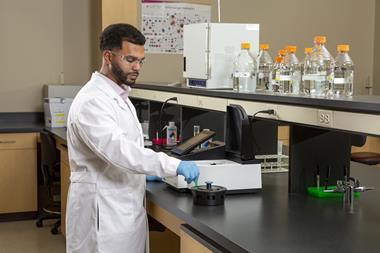
Electrochemical testing detects target analytes through a reaction at a sensor surface rather than relying on optical measurement. The method is inherently resilient to sample variation — turbidity, colour, suspended matter — that can introduce uncertainty into optical techniques, making it well suited to the diverse sample matrices encountered across food and beverage operations. Testing can take place closer to the point of use without pre-treatment steps, results are available in seconds, and with no glassware required, the process is simpler to execute consistently across different operators and shifts.
Kemio: Electrochemical Testing Built for Production
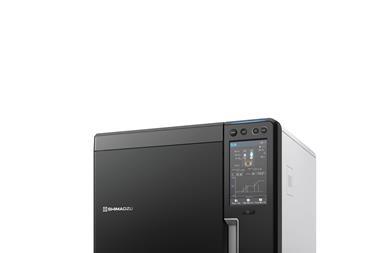
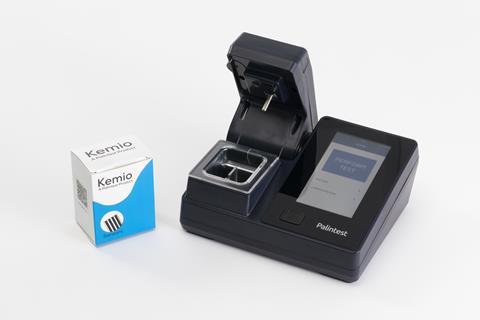
Palintest’s Kemio platform takes the electrochemical approach and puts it directly in the hands of production teams. Where photometric testing typically requires reagent preparation, glassware, and careful technique, Kemio is compact, and designed to deliver consistent results regardless of operator experience. It measures the disinfection parameters most critical to food and beverage operations — free chlorine, total chlorine, chlorine dioxide, and peracetic acid — and logs every result against the operator, location, and time. The outcome is a real-time compliance record that meets the traceability expectations of regulators, auditors, and retail customers alike, with none of the manual data handling that creates risk in traditional workflows.
Where photometric testing typically requires reagent preparation, glassware, and careful technique, Kemio is compact, and designed to deliver consistent results regardless of operator experience.”
An Industry Moving Forward
The growing adoption of electrochemical testing in food and beverage production reflects an industry responding intelligently to a more demanding compliance landscape. As standards continue to tighten and the expectation of full data traceability becomes the norm rather than the exception, technologies that deliver accuracy, simplicity, and a built-in audit trail will define best practice. For operators looking to future-proof their water quality monitoring, the direction of travel is clear.