


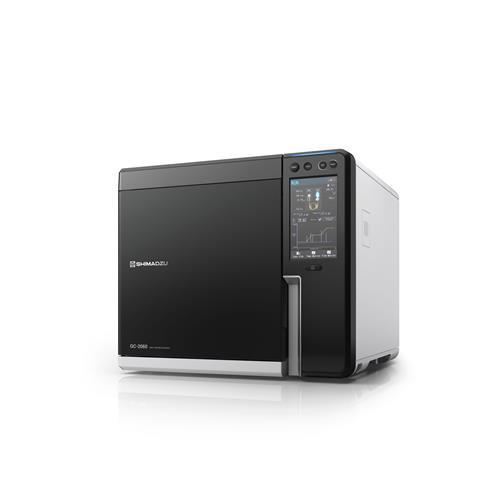
Shimadzu’s new Nexis GC-2060 combines analytical intelligence with innovative hardware to cut gas and energy consumption, reduce manual workload and simplify complex sample analysis. Designed for maximum flexibility and efficiency, it helps laboratories lower operating costs without compromising performance or accuracy.
Innovations Crafted Through Generations
For 70 years, Shimadzu’s Gas Chromatography business unit has been shaping how laboratories analyze the world. What began with the development of Japan’s first gas chromatograph in 1956 has evolved into a decades-long journey of precision, reliability, and scientific advancement.
The new flagship model Nexis GC-2060 is the result of the expertise gained over decades of close collaboration and partnership with our customers. Smart, analytically intelligent features help reduce GC operating costs by significantly lowering gas and electricity consumption. At the same time, automated cleaning and conditioning procedures minimize daily workload for operators.
The innovative hardware of the GC‑2060 also substantially reduces sample preparation effort. Complex sample matrices commonly encountered in food, environmental, and forensic analysis often require extraction with large volumes of solvent. The large‑volume injection (LVI) capability of the new Shimadzu Multi‑Mode Inlet (MMI) allows higher sample volumes to be introduced in a simple and efficient manner. Before transferring onto the column, the solvent is removed by evaporation through the MMI split outlet, preventing capillary column overloading and maintaining excellent chromatographic separation quality.
In addition, the MMI offers full flexibility between several injection techniques: programmable vaporization for thermolabile compounds (PTV), simple on-column injection (OCI), the option for thermal desorption (manual TD), and the commonly used isothermal split/splitless injection mode (SPL).
Benchmark in Analytical Efficiency
The newly designed Multi-Mode Flame Ionization Detector (FID) further enhances flexibility. In standard operation, the FID requires hydrogen, make-up gas, and synthetic air. For highest sensitivity, the GC-2060 typically uses nitrogen or helium as make‑up gas. Alternatively, synthetic air or oxygen can be used as make‑up gas, reducing the number of different gases required for GC operation to just two when hydrogen is also used as carrier gas.
For safe hydrogen operation, the GC-2060 performs automatic leak checks after maintenance and can be equipped with an optional hydrogen sensor. If the hydrogen concentration inside the oven rises above 1% due to a leak or column breakage, the system automatically stops operation to ensure user and instrument safety.
For the GC-2060, Shimadzu offers a wide range of autosamplers, injectors, and detectors, enabling configurations for virtually any GC application your laboratory requires—today and in the future.”
Gas chromatography is a relative analytical technique. Quantification of components after chromatographic separation usually requires calibration for each compound. This involves preparing calibration standards from pure reference materials to determine the detector response factor for every analyte. By combining the FID with the Polyarc microreactor, the GC-2060 offers an additional mode that dramatically reduces this calibration effort.
The Polyarc microreactor quantitatively converts all organic molecules eluting from the capillary column into methane. The downstream FID therefore measures the methane equivalent of each molecule—one methane molecule per carbon atom—providing a true carbon‑number response. Knowing the molecular formula, the compound concentration in mol/g, wt%, µg/mg, or µg/ml can be directly and accurately calculated from the FID signal area proportional to the molar carbon concentration and one universal response factor applied to all measured substances.
Limitless Expanse of Versatility
For the GC-2060, Shimadzu offers a wide range of autosamplers, injectors, and detectors, enabling configurations for virtually any GC application your laboratory requires—today and in the future.
The new Eco Idling function automatically reduces gas and electricity consumption during standby periods. In addition, based on daily GC usage patterns, the instrument learns and recommends an optimized eco schedule over the course of the week, further lowering operating costs without compromising readiness or performance.