




In the first of a two-part series, exploring the breadth of tactics employed in various cyberattacks over recent years, Dr Darin Detwiler elucidates the vulnerabilities of our connected digital food systems and cautions the need for vigilance against pervasive invisible threats.
Imagine a James Bond film in which the villain has no nuclear warhead, no satellite-mounted laser and no secret island fortress. Instead, they sit quietly behind a computer screen, thousands of miles from the intended targets.
With a few keystrokes, refrigeration systems begin to malfunction. Freezers enter defrost cycles, temperatures rise in food warehouses and supermarkets lose their refrigerated inventory. While food manufacturers scramble to protect products, families discover empty shelves. There are no explosions, dramatic car chases or visible countdown clocks – simply the deliberate disruption of systems that keep food safe and available.
As someone who served aboard a US Navy nuclear submarine, I understand the difference between dangers we can see and those we cannot. Thus, while I appreciate a good Hollywood villain, the most consequential threats in the real world rarely announce themselves with dramatic music or flashing warning lights.
In previous articles for New Food, I have explored the parallels between submarine operations and food safety. Both demand vigilance against hazards that can seem invisible until their consequences become unmistakable. Both depend on trustworthy instruments, reliable systems and people prepared to act before a manageable problem becomes an emergency.
Now those parallels have acquired a digital dimension. Recent events in Europe make that dimension impossible to ignore.
For generations, food protection has focused on biological, chemical and physical hazards. Those responsibilities remain. What has changed is the possibility that the technologies designed to control those hazards can themselves become points of vulnerability.”
France: when the cold chain becomes the target
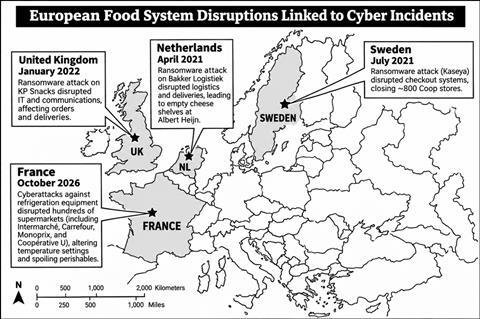
In October 2026, cyberattacks against internet-connected refrigeration equipment disrupted hundreds of French supermarkets. Reporting identified stores associated with Intermarché, Carrefour, Monoprix and Coopérative U, among others. Attackers reportedly changed temperature settings and interfered with refrigeration operations, leaving businesses with spoiled meat, frozen products and other perishables.1
Published estimates varied, from at least 350 affected stores to approximately 700. Investigators had not publicly established responsibility, and French cybersecurity authorities warned that additional vulnerable systems remained exposed. These uncertainties matter. The evidence supports a serious disruption – not speculation about a single mastermind or a coordinated geopolitical campaign.
What makes the incident distinctive is its mechanism. The attackers reportedly exploited equipment intended to preserve food, rather than tampering directly with food or its ingredients.
Commercial refrigeration increasingly relies on connected controllers that monitor temperatures, detect faults, manage defrost cycles and permit remote maintenance. Those capabilities can improve efficiency and oversight. They can also create openings when interfaces are exposed, software is outdated or access is inadequately controlled.
A supermarket operator in Normandy described losing substantial perishable inventory after refrigeration equipment began heating rather than cooling. Behind that technical failure were employees confronting discarded food, managers facing losses and customers unable to purchase products they expected to find.
For food safety professionals, restoring a controller is only the beginning. How warm did the food become? For how long? Are the recorded temperatures reliable? If monitoring data may have been manipulated, what independent evidence remains? Without sufficient answers, products may have to be withheld or discarded even after the equipment is operating again.
There is an important distinction between restoring a refrigeration system and establishing that its contents remain safe.
On a submarine, an unexpected instrument reading demands investigation. So does a reading that looks normal when other evidence suggests something is wrong. The obligation is to understand the system, question unreliable information and act according to the risk. The French incidents bring that principle directly into the food supply.
Four countries, four routes to disruption
France provides an alarming example of direct interference with food-preservation equipment. Earlier European incidents reveal that attackers can disrupt access to food in other ways.
In April 2021, Dutch temperature-controlled logistics provider Bakker Logistiek suffered a ransomware attack that disabled essential information systems.2 Staff struggled to receive orders, locate inventory and organise transport, interrupting deliveries to Albert Heijn supermarkets and leaving customers with empty cheese shelves.
The cheese did not have to become contaminated for consumers to feel the consequences. Products can be safe yet unavailable when the systems needed to identify and move them stop working. A warehouse full of acceptable food offers little reassurance if nobody can reliably locateor deliver it.
In July 2021, a ransomware attack involving software provider Kaseya spread through technology service providers and disrupted checkout systems used by Sweden’s Coop supermarkets. Approximately 800 stores closed because they could not process payments.3 Their shelves were stocked and employees remained in place, but a dependency that shoppers barely noticed had effectively prevented the business from selling food.
In January 2022, UK manufacturer KP Snacks experienced a ransomware attack that disrupted information technology and communications systems, with retailers being warned of possible difficulties with orders and deliveries.4 Here, too, the concern was the movement of products through a digital-dependent supply chain.
These incidents must not be treated as interchangeable. France involved reported interference with refrigeration controls and potential consequences for product safety. The Dutch, Swedish and British examples principally illustrate threats to distribution, retail access and business continuity. Their common lesson is broader: food systems can fail through digital dependencies that traditional food safety plans may overlook.
The weakest link may be outside the food company itself – in a technology provider, a remote maintenance connection or a logistics platform. Outsourcing a system does not outsource the consequences when it fails.
An unsettling parallel at American military commissaries
In August 2026, unusual refrigeration disruptions were also reported at several US military commissaries, including installations at Fort Huachuca, Fort Irwin, FE Warren Air Force Base, Columbus Air Force Base, Naval Station Newport and Travis Air Force Base.5
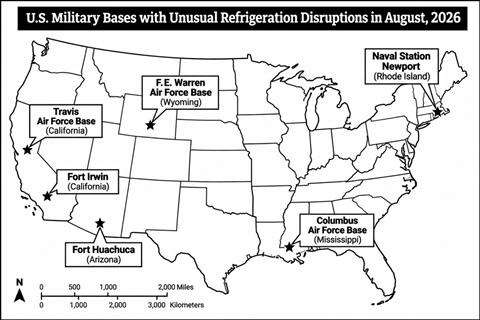
At Fort Huachuca, accounts attributed to the installation described freezers entering defrost mode overnight, despite electrical power reportedly remaining available, resulting in spoiled inventory.6
However, the causes were not conclusively established in the reporting available for this article. These events must not be described as confirmed cyberattacks. Equipment faults, software problems, configuration errors and other explanations remain possible. Their relevance is the need to investigate unusual failures without presuming their cause, while protecting consumers regardless of what the investigation eventually finds.
As a Navy veteran, I know that a commissary is more than another grocery store. It is part of the support network on which military households depend. Food availability also contributes to readiness: people cannot sustain demanding missions without dependable logistics and essential supplies.
The lesson is not to see a hostile actor behind every malfunction. Instead we must recognise that when essential food infrastructure behaves unexpectedly, both the technical cause and the fate of affected food require credible answers.
Five dimensions of food trust
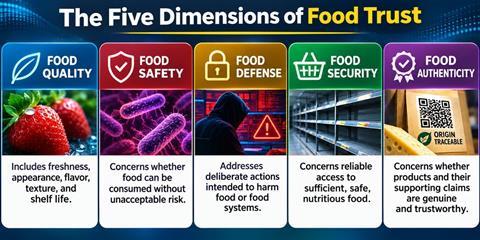
Most consumers do not think about a refrigeration controller when buying milk, meat or frozen vegetables. They expect food to be good, safe, accurately presented and available when needed. The incidents above reveal five interconnected dimensions of that expectation.
Food quality includes freshness, appearance, flavour, texture and shelf life. An altered temperature setting can ruin those characteristics and generate enormous waste – even when illness is not documented.
Food safety concerns whether food can be consumed without unacceptable risk. Temperature abuse can permit harmful microorganisms to grow in susceptible foods. If digital records cannot be trusted, proving safe handling becomes harder.
Food defence addresses deliberate actions intended to harm food or food systems. Physical sabotage and intentional adulteration remain important concerns, but deliberate digital interference with protective equipment deserves attention too. The facts and intent must be established rather than assumed.
Food security concerns reliable access to sufficient, safe, nutritious food. Empty Dutch cheese shelves and closed Swedish supermarkets show how access can disappear without evidence that the food itself is unsafe.
Food authenticity concerns whether products and their supporting claims are genuine and trustworthy. Digital records increasingly substantiate origin, identity and handling. If those records are altered, confidence in product claims can weaken even without proven food fraud.
These are different considerations, but they converge at the consumer. A refrigeration failure may affect quality and safety. A disabled warehouse system can undermine availability. Manipulated records can leave a business unable to establish what happened to its products. When the interference is deliberate, food defence becomes part of the picture.
The villain we failed to recognise
In a James Bond film, the villain’s greatest advantage is often the weapon nobody recognises until it is almost too late.
The food industry may be confronting its own version of that problem. The weapon need not be a missile, poison or explosive device; it may be a compromised controller, a disabled warehouse platform, or a trusted supplier whose failure cascades across hundreds of stores.
The consequences extend beyond lost inventory and interrupted sales. They reach the confidence families place in the food they bring home. Because whilea company can restart a computer, reopen a shop or restore refrigeration, can it confidently establish that the food it protected remains safe? A restored system is not necessarily a restored safeguard.
For generations, food protection has focused on biological, chemical and physical hazards. Those responsibilities remain. What has changed is the possibility that the technologies designed to control those hazards can themselves become points of vulnerability.
Hollywood allows Bond to discover the plot just in time. The food industry has no such guarantee. The threat is no longer theoretical, and its consequences are no longer confined to computer screens.
In Part Two of this series, coming next Monday, we turn from the vulnerabilities to the decisions that matter most: who takes responsibility, what preparation looks like and whether food industry leaders will act before the next crisis demands a last-minute rescue.
References
- Leicester J, Corder M. (2026, October 14). French cybersecurity authority warns attack may be ongoing as stores scramble to restock. Associated Press. https://apnews.com/article/france-supermarkets-hacked-cybercrime-81c2d5721f4df77f601f71741ef7c291
- Muncaster P. (2021, April 13). Food shortages at Dutch supermarkets after ransomware outage. Infosecurity Magazine. https://www.infosecurity-magazine.com/news/food-shortages-dutch-supermarkets/
- Costis A. (2021, July 13). The Kaseya VSA REvil ransomware supply chain attack. AttackIQ. https://www.attackiq.com/2021/07/13/the-kaseya-vsa-revil-ransomware-supply-chain-attack-how-it-happened-how-it-could-have-been-avoided/
- Warren-Kachelein D. (2022, February 3). UK-based KP Snacks hit by ransomware. BankInfoSecurity. https://www.bankinfosecurity.com/snack-attack-uk-based-kp-snacks-limited-hit-by-ransomware-a-18449
- Seck HH. (2026, August 28). DoD confirms refrigeration disruption at military commissaries. Military Times. https://www.militarytimes.com/news/your-military/2026/08/28/dod-confirms-refrigeration-disruption-at-military-commissaries/
- Thayer RL. (2026, August 28). Commissaries across the US affected by refrigeration outages. Stars and Stripes. https://www.stripes.com/theaters/us/2026-08-28/refrigeration-outages-multiple-us-commissaries-22684428.html









No comments yet