

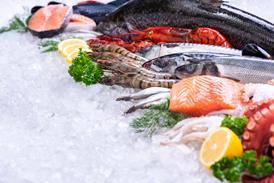

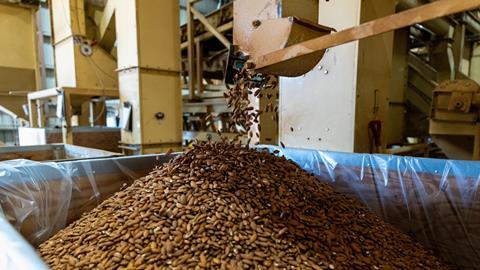

Following a recent trip to California, Ben Cornwell explores how processors are rethinking food byproducts, including almond hulls, whey and broken rice, and whether new applications are commercially worthwhile.
Across California’s food and agricultural industries, the main product is often only part of the story.
At Travaille & Phippen in the Central Valley, almonds arrive from the orchard floor with hulls, shells, sticks, leaves, dirt and rocks. Partner Dave Phippen estimated that the operation handles around 40 million lb of almond kernels in a season, generating roughly two lb of hull material for every lb of kernels handled.
Very little simply disappears. Hulls are sold into dairy feed, woody material can become compost, rejected kernels can enter animal feed or almond-oil production, and even rocks are separated for reuse.
“There’s virtually nothing that comes here that we don’t put to use in some way,” Dave said during a recent New Food visit to California.
I spent a week in the state learning more about its agricultural and food production landscape, with the U.S. Sustainability Alliance (USSA) facilitating access to farmers, processors and industry specialists across several sectors.
Across the businesses I visited, many secondary materials already had established uses. Rice bran, almond hulls, whey, olive pulp and broken grains were rarely treated as simple waste streams.
The harder question was whether moving them into a new application would create more value than the outlet they already had. That same question sits behind work at the University of California, Davis to map agricultural byproducts against potential higher-value uses, reflecting a wider push to match side streams with applications that make technical and commercial sense.
The harder question is whether moving them into a new application creates more value than the outlet they already have.”
When byproducts already have a market
At Sun Valley Rice, hulls can become an energy source, bran enters animal feed and broken or rejected rice has secondary markets.
“We literally sell everything that comes off the kernel, except for the mud balls,” Quality Assurance & Food Safety Manager Carrie Benton said during the mill visit.
Lundberg Family Farms similarly directs bran, hulls and broken rice into other markets. Its Upcycled Rice contains around 40 percent broken kernels that might otherwise enter lower-value channels, while 212,000 lb of broken rice from one harvest was used in rice-cake minis.
“We’re always interested in using our byproducts for better and higher uses,” Brita Lundberg, Chief Storyteller at Lundberg Family Farms, said during the visit. “But our first priority is making a product that consumers love.”
The potential for rice side streams to move further into food applications is also being explored elsewhere, with proteins recovered from rice milling byproducts showing promise in plant-based cheese.
According to Dairy Cares, up to 40 percent of feed ingredients used on California dairies are agricultural byproducts such as almond hulls, citrus pulp and brewer’s grain. That equates to around 5.5 million tons, or 11 billion lb, of byproducts fed to California dairy cows annually, reducing the water, land, energy and fossil fuels that would otherwise be required to grow additional feed crops.
That scale complicates the idea of simply moving a side stream somewhere ‘better’. One industry’s residual material may already be another industry’s raw material.
At Hilmar Cheese Company, the flow moves in another direction. Whey remaining after cheesemaking is processed into protein ingredients, while lactose is recovered and purified from permeate. Those ingredients now serve markets including early-life nutrition, sports nutrition and wider food manufacturing.
Can an almond hull become an ingredient?
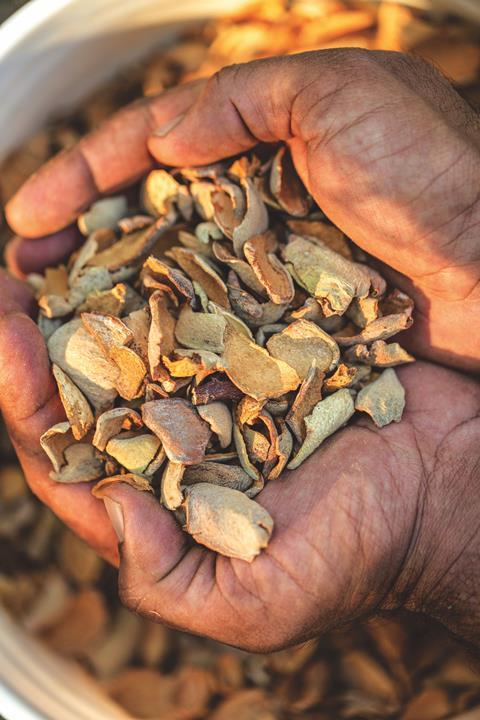
The challenge is that dairy feed already provides almond hulls with an established market. Guangwei Huang, Associate Director of Food Research & Technology at the Almond Board of California, said the opportunity lies in developing additional outlets for suitable material.
“Food applications offer an additional, higher-value pathway for properly selected, food-grade material whose quality and composition are suited to those uses,” he told New Food. “A diversified market would allow each portion of the hull stream to move to its optimal application, whether food, feed or another outlet, based on quality, functionality, economics and environmental performance.”
That brings the question straight into the formulation lab.
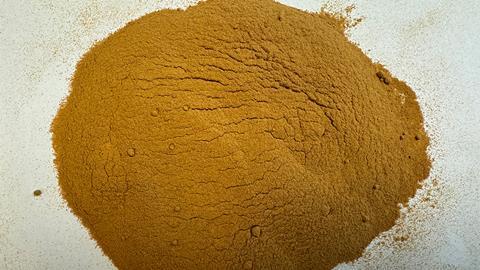
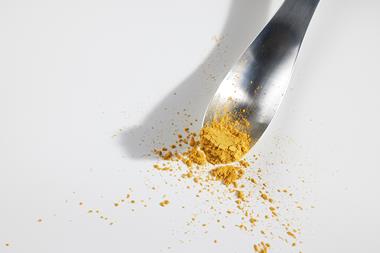
Almond hull powder (AHP) contains dietary fibre, naturally occurring carbohydrates, minerals and phytochemicals. Guangwei said that, depending on application and inclusion level, it can also contribute moisture management, water and oil holding, colour, flavour and texture.
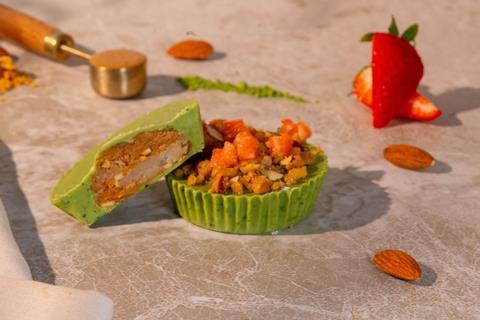
The Almond Board has explored that functionality through products including Hullnola. Two granolas were produced at commercial scale with 10 percent AHP.
Granola, bars and related cereal or bakery applications appear particularly compatible because the ingredient’s fibre, water-binding properties, texture and naturally fruity-toasted flavour can complement the formulation. Its brown colour can also sit naturally alongside cocoa, chocolate, toasted or whole-grain products.
The commercial-scale work also exposed the limits. Guangwei described AHP as ‘not a simple drop-in fibre’, with particle size, flavour, colour, moisture, composition and inclusion level all affecting performance. Repeatable food-grade specifications and scalable sorting, cleaning, pasteurisation and milling would all be needed for wider adoption.
Guangwei also stressed that the value created by AHP would have to justify the additional sorting, cleaning, food-safety controls, processing, testing and distribution required for human food.
Proving that an ingredient can work in a product is only one part of the challenge. The next is producing it consistently enough for a manufacturer to specify.
Turning a crop stream into a specification
An ingredient specification quickly exposes how much has to be controlled.
In Guangwei’s view, an AHP specification would need to address identity and purity, foreign-material limits, moisture and water activity, microbiological criteria, aflatoxin and other relevant contaminants, allergen controls, particle size and storage stability. Fibre, sugars, minerals, colour and selected phytochemical characteristics could also matter depending on the formulation.
Agricultural variability does not conveniently disappear once a material is labelled an ingredient. Variety, crop year and the amount of field or processing debris can affect composition.
Commercialisation, Guangwei explained, depends on ‘defining acceptable operating ranges’ and using sourcing, cleaning, blending and processing controls to create consistent performance rather than trying to eliminate natural variation altogether.
Almond hulls are primarily handled as bulk feed and can contain orchard-derived material such as shells, sticks, stones and soil. Food-grade material would need to be identified and segregated, then moved through defined cleaning, storage and quality controls.
Some upgrading could happen at huller-shellers where existing equipment can be adapted and validated, Guangwei said. In other cases, specialist processors may need to take over further sorting, cleaning, pasteurisation, milling, sieving, standardisation and testing.
Once that material moves into a human-food supply chain, consistency is only part of the requirement. Safety expectations change with it.
Agricultural variability does not conveniently disappear once a material is labelled an ingredient.”
What changes when feed becomes food
According to Guangwei, an independent panel of qualified experts has concluded AHP to be Generally Recognized as Safe (GRAS) for the uses it evaluated. He said the assessment considered manufacturing, composition, anticipated exposure and available safety evidence, including microbiological hazards, foreign material, aflatoxin, pesticide residues, heavy metals, moisture-related risks and allergen controls.
The distinction around GRAS matters. A GRAS conclusion is not the same as approval by the US Food and Drug Administration (FDA). FDA explains that a substance can be considered GRAS under its intended conditions of use through general recognition among qualified experts without going through the conventional food-additive approval process.
One area that particularly reinforces Guangwei’s emphasis on controls is allergenicity. Research published in 2026 identified IgE-reactive proteins in almond hulls, while pilot-scale processed material also contained kernel-derived allergens. For a stream moving from agricultural feed into human food, that puts allergen management and cross-contact firmly on the specification and process-control agenda.
Market access would also have to be considered separately outside the US. A US GRAS conclusion does not determine an ingredient’s status in Great Britain or the EU. The European Food Safety Authority and the Food Standards Agency both set out routes for assessing novel food status and authorisation requirements where applicable.
Those requirements inevitably change the economics of the material. Guangwei’s own assessment is that any higher-value pathway has to be considered across the full system, including sorting and processing, energy and water use, transport, infrastructure, yield, market demand and environmental impacts.
When a higher-value use does not stack up
The same calculation becomes clearer beyond almonds.
At Cobram Estate, Co-CEO Leandro Ravetti said less than 0.5 percent of the company’s outputs go to landfill. He said Cobram principally uses olive pits as biofuel, directs pulp into livestock feed or compost for its orchards, and uses leaves in products including olive-leaf extract and tea.
Asked about further food and ingredient opportunities, Leandro said Cobram had tried several approaches and still saw potential, particularly in extracting natural compounds. For now, however, he said the economics and technology did not justify extracting the nutritional value remaining in the material
Guangwei sees a similar distinction within the almond hull stream. Differences between varieties, crop years, quality grades and handling conditions can affect composition, cleanliness, colour, flavour and functionality. Higher-quality hulls that meet food-grade requirements may be better suited to AHP or other ingredients, while other grades may create greater value through dairy feed, composting, energy or soil applications.
Who captures the value?
Almond hulls are still early in that commercial journey, although byproduct economics already matter at farm level.
At Travaille & Phippen, Dave said co-product income offsets part of the cost growers pay for hulling and shelling. He described the operation’s revenue as broadly split between grower service charges and co-product income, although the balance shifts with market values.
Guangwei noted that a broad market in which huller-shellers routinely sell hulls specifically for AHP production has yet to emerge. It would require reliable food-grade supply, validated processing, competitive economics, ingredient companies capable of consistent manufacturing and distribution, and food businesses willing to formulate and launch products.
Asked where the additional value could ultimately be captured, Guangwei pointed to several parts of the supply chain.
“Hullers may benefit from stronger co-product economics and a lower processing-cost burden; upgraders and ingredient manufacturers would earn value for cleaning, safety processing, standardisation and distribution; food manufacturers would create differentiated products; and growers could ultimately benefit if stronger co-product markets improve the overall economics of handling the almond crop.”
How much reaches each part of the chain will depend on investment, contracts, risk and supply-demand dynamics.
The week in California offered no single answer for what should happen to every byproduct, and that is arguably the point. Hulls feeding cattle, whey becoming nutritional ingredients, broken rice returning to food products and olive pulp going back to the soil all represent different ways of extracting value from the same broader problem.
The harder task is deciding when another step genuinely improves on what already exists.
For some materials, that may open the door to a new food ingredient. For others, the feed truck leaving the huller, the oil extracted from a rejected kernel or the compost returning to an orchard may already be exactly where that material belongs.






No comments yet