



California agriculture is learning to manage water at both extremes. Following a recent visit to the Golden State, Ben Cornwell explores how farms and food businesses are capturing, storing and reusing water to build resilience against drought, flooding and long-term groundwater pressure.
For Craig McNamara, founder of Sierra Orchards near Winters, California, water cuts through almost every other challenge facing the farm. His daughter Emily and son Sean also work in the family business.
“When I talk about climate change, it’s water. Without water, Emily and I don’t have to worry about immigration, regulation, crop, market - it’s game over.”
During the drought around 2017, McNamara recalled the water table dropping below the pumps at five of Sierra’s six pumping stations. Lowering them cost approximately $10,000 per well. Today, the farm uses buried drip irrigation in newer plantings, supported by soil-moisture monitoring and measurements of plant water status rather than a fixed irrigation calendar.
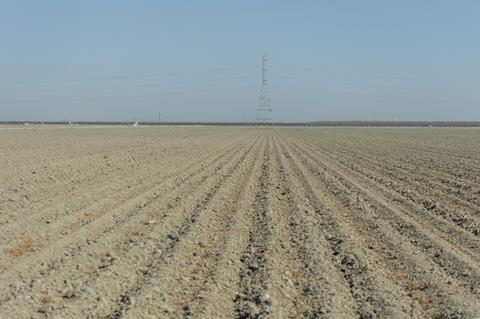
That investment makes more sense once you travel through California’s agricultural interior. Large stretches of cultivated land sit beneath vast, cloudless skies, punctuated by pumps, pipes and irrigation equipment. Water infrastructure is everywhere, even where water itself is not.
Yet drought tells only half of California’s water story.
Wet periods can bring flooding and unusually high flows, while dry years increase pressure on groundwater. In October 2026, the California Department of Water Resources (DWR) reported that recent wetter periods had improved groundwater conditions, but long-term declines remained.
The challenge is increasingly one of timing. California must manage prolonged scarcity while also being ready for periods when water arrives faster than agriculture can use or store it.
During a recent visit facilitated by the U.S. Sustainability Alliance (USSA), New Food saw how producers are responding to that volatility. Across the businesses visited, the same theme kept returning. Resilience depends on having systems in place before conditions change.
Previous reporting from the trip has explored how California businesses are rethinking the value of food byproducts and putting data, AI and automation to work.
When I talk about climate change, it’s water. Without water, Emily and I don’t have to worry about immigration, regulation, crop, market - it’s game over.”
Craig McNamara, founder of Sierra Orchards
A billion acre-feet beneath California
Some of California’s most important water infrastructure cannot be seen from the surface.
DWR’s final California’s Groundwater: Bulletin 118 – Update 2025, released in March 2026, estimates that the state’s groundwater basins have storage capacity exceeding one billion acre-feet, around 25 times the capacity of all California’s surface reservoirs combined. Groundwater supplies around 40 percent of statewide demand in average years and nearly 60 percent in dry years.
Flood-managed aquifer recharge, or Flood-MAR, uses suitable high flows to recharge aquifers through agricultural land, working landscapes and dedicated recharge areas. The scale of the opportunity, however, can change sharply from one year to the next. Groundwater sustainability agencies reported around 4.6 million acre-feet of managed recharge in water year 2023, falling to 1.9 million in 2024 and 1.1 million in 2025.
By the time floodwater arrives, the infrastructure and permissions needed to capture it have to be ready.
Banking a flood at Terranova
That challenge is particularly vivid at Terranova Ranch in the San Joaquin Valley.
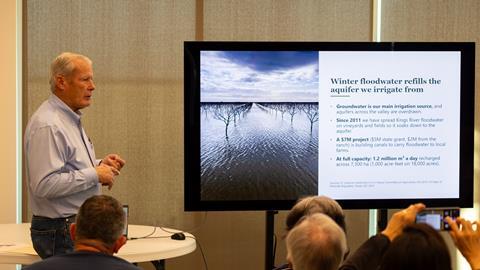
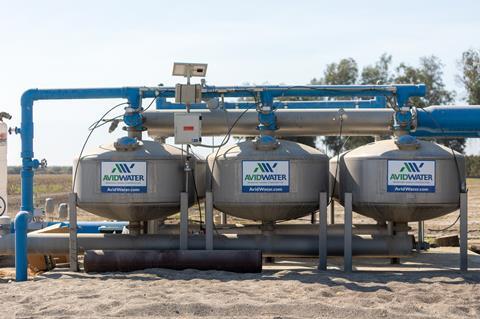
During the visit, the surrounding landscape was dry and dusty, with irrigation filtration equipment, thick pipework and control systems standing beside the fields. Inside, one presentation slide [pictured above] showed an altogether different scene. Rows of vines stood in water under a stormy sky, alongside the words “Winter floodwater refills the aquifer we irrigate from.”
Terranova has been working towards that cycle for decades.
The approximately 8,000-acre operation grows 20–25 crops and depends primarily on groundwater in a critically overdrafted part of the valley. Documented on-farm groundwater recharge trials began in 2011, spreading cold Sierra floodwater across vineyards and other agricultural land so it could infiltrate towards the aquifer below.
Where that water is placed cannot be decided by looking at the surface alone.
“I’ve been working on this for over 30 years,” Don Cameron, Vice President and General Manager of Terranova Ranch, told New Food. “We’ve done borings. We’ve done tests to see what the infiltration rates are in different areas on the ranch.”
The ranch has examined subsurface conditions and now monitors groundwater at multiple locations. DWR guidance also identifies soils, geology, infiltration characteristics and the connection between the land surface and underlying aquifers as factors in determining whether land is suitable for recharge.
Finding suitable ground is only the first step. Water also has to be moved there.
The Kings River Conservation District says the McMullin On-Farm Flood Capture and Recharge Project was conceived in 2012 with a $5 million DWR grant as a collaboration between the district and Terranova Ranch. The project also included $2 million in matching funds from Terranova, while Cameron said the ranch subsequently invested about another $8 million of its own money over roughly a decade of design, engineering, permitting and agreements. Terranova says the wider system was designed ultimately to recharge as much as 1,000 acre-feet of floodwater per day.
Its existing canal network runs for around five miles, while a planned 11-mile extension is intended to bring further farmland within reach of recharge water.
The exceptionally wet winter of 2023 put that investment to use. Cameron said 32 pumps were deployed to distribute floodwater around the ranch, with subsequent monitoring showing the local water table rising approximately 15–20 feet.
For a business whose principal irrigation source sits underground, Cameron sees recharge as part of remaining viable over the long term. Asked whether the approach could scale more widely across California, his answer was immediate.
“Absolutely.”
That 15–20-foot rise is a site-specific result rather than a benchmark for other recharge projects. Groundwater response depends on local hydrogeology, recharge volumes, duration and existing aquifer conditions. Managed aquifer recharge itself is already used more widely across the US, including established projects in states such as Arizona and Idaho.
California’s Sustainable Groundwater Management Act now requires groundwater sustainability agencies in high- and medium-priority basins to develop and implement groundwater sustainability plans or approved alternatives. DWR also cautions that one wet winter cannot resolve groundwater deficits accumulated over much longer periods.
More tomatoes from less applied water
Terranova’s water strategy continues once water reaches the crop.
Processing tomatoes provide one of the clearest examples. Cameron said an early 80-acre subsurface drip trial increased yields from around 42 to 65 tons per acre while using roughly 25 percent less water. The ranch subsequently converted around 2,200 acres of tomatoes.
But the figures also show why agricultural water performance cannot be judged by litres saved alone. DWR separates irrigation efficiency from water productivity. Applying less water at field level does not automatically create an equivalent basin-wide saving because some drainage and return flows may remain available for downstream reuse. Producing more from a given volume of water can therefore be just as important a measure.
Terranova’s tomato trials show what more precise irrigation can achieve once water reaches the crop. At Veenstra Farms, the harder problem is access.
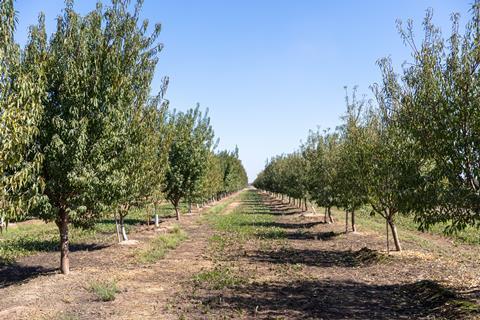
“Water is number one. It’s our limiting resource. It is our most precious resource,” said Danielle Veenstra, a third-generation almond grower and Senior Manager, Global Stewardship + Impact at the Almond Board of California.
She described the almond industry’s response through precision, replenishment and resilience, taking in irrigation accuracy, groundwater recharge and efforts to improve the soil’s ability to retain water. That emphasis on replenishment depends on a side of California’s climate that Veenstra says is often overlooked.
“I have to remind them, California floods, too,” she said.
Research by the University of California’s Giannini Foundation of Agricultural Economics estimated that extended flooding in 2023 affected nearly 79,500 acres of annual crops and 2,500 acres of perennial crops, translating into approximately $270 million in lost gross revenues. The researchers note that floodwater can support groundwater recharge and ecosystem functions, while prolonged inundation can damage crops, delay planting and affect soils.
Veenstra’s own orchard has been designed so it could receive recharge water, but the irrigation district conducts pipeline maintenance during winter and does not currently deliver water then. Connecting the family orchard across the road privately to the district system could require around $1 million in pipeline infrastructure, she estimated.
The land may be ready even when the infrastructure is not.
Water is number one. It’s our limiting resource. It is our most precious resource.”
Danielle Veenstra,Senior Manager, Global Stewardship + Impact, Almond Board of California
One drop, several jobs
At Vander Woude Dairy in Merced County, managing timing has meant both storing water and using it repeatedly once it enters the farm.
Simon Vander Woude described groundwater first helping to cool milk and equipment before being used to clean the milking deck and flush dairy lanes. After collecting nutrients from manure, the same water can eventually be applied to crops.
He has also created somewhere to hold water between seasons. A roughly 30-acre reservoir with capacity of approximately 300 acre-feet captures winter floodwater for later use establishing spring crops.
“I gave up 30 acres of ground and spent over a million dollars to build that because it makes my water impact sustainable,” Vander Woude said.
At Hilmar Cheese Company, reuse continues after milk leaves the farm. Hilmar says its processes capture almost 100 percent of the water originally contained in the milk it receives, while Allison Nunes said around 70 percent of the California site’s overall water intake is recycled and reused. Recovered water is used across equipment washing, heat regeneration and further processing, as well as landscaping and irrigation.
The reclamation system also produces methane through anaerobic digestion of organic material in process water. Hilmar’s 2025 sustainability reporting says the gas is processed and used in on-site boilers, with greater use of biogas at the California facility helping reduce natural-gas consumption by approximately 1 percent.
Following the water out of a rice field
Reuse also complicates how agricultural water use is measured, and rice makes the distinction between water applied and water consumed particularly clear.
According to guidance from the University of California, Davis, around five acre-feet per acre of irrigation water is applied to a California rice field on average during the growing season, while evapotranspiration accounts for roughly 2.4–2.8 acre-feet per acre. The remainder includes tailwater drainage, seepage and percolation.
Water lost through evapotranspiration cannot be reused. Tailwater drainage and seepage, however, can support downstream irrigation, while percolation can contribute to groundwater or streams.
A volume applied to a field and a volume consumed by a crop therefore describe different things. That distinction matters when agricultural water performance is compared.
Before the next wet year
California’s water challenge is shaped by how quickly conditions can shift. DWR’s latest groundwater reporting shows marked improvement during wetter periods, while many basins continue to carry the effects of long-term depletion.
That volatility makes flexibility increasingly important. The value of a wet year depends partly on whether water can be put to use when it arrives, just as resilience in a dry year depends on what has been stored, recovered or conserved beforehand.
The dry fields and images of flooded orchards seen during the trip capture that tension. Both are part of the same system, and California agriculture is having to prepare for each.








No comments yet