



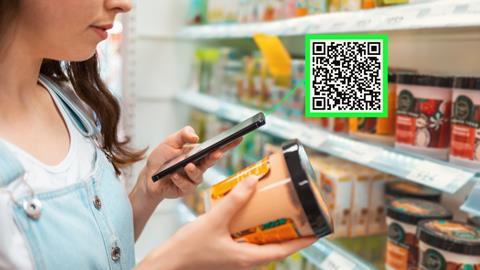

Rob Allen, Divisional Manager for Packing Solutions at Interfood Technology, reveals why QR codes are moving from novelty to necessity – filling the information gaps that are now essential in modern food systems.
For decades, the barcode has been one of the most important innovations in food manufacturing and retail, underpinning the development of the supply chains we recognise today. But as customer needs and regulatory requirements change, the days of the barcode could be numbered. Basic product identification is no longer enough. Consumers, manufacturers and retailers all need more information, traceability and visibility – and that’s where dynamic quick response (QR) codes come in.
The limitations of traditional labelling
Barcodes were created to identify products as they moved through the supply chain, which has been invaluable.
Yet increasing pressure to provide detailed information about ingredients, allergens, sourcing and product history requires food manufacturers and retailers to undertake multiple processes to access key information.
Date coding, batch allocation, label verification and quality checking are all handled separately and often manually, taking up time and resources that businesses can’t afford to waste, while presenting the possibility of potentially dangerous human error. Smarter packaging and labelling solutions could avoid that – and dynamic QR codes could provide the answer.
Bar codes have had their day – and they were transformative. But now we need more.”
The potential of dynamic QR codes
Unlike traditional 1D barcodes, QR codes can store a lot of data. Connected directly to digital systems throughout the product lifecycle, if applied during production, they can contain batch-specific information such as manufacturing and expiry dates, ingredient details, production locations and traceability records. Facilitating greater visibility over production, distribution, stock management and product recalls, this is not only useful for manufacturers and retailers but for consumers too. Instant access to everything you need to know about a product via your smartphone and a QR code makes matters such as allergy management, budgeting and purchasing decisions infinitely easier.
Major retailers, including M&S and Tesco, are already trialling these systems in fresh produce and meat categories in the UK, as part of a wider effort to strengthen traceability and improve supply chain transparency. And with the GS1 Sunrise 2027 initiative encouraging adoption globally, we could soon see smart packaging replace barcodes worldwide.
Packaging as insight
Traditionally, packaging has been viewed primarily as a protective measure. However, the rise of the digital culture is adding a new dimension, with smart packaging solutions – such as the dynamic QR code – allowing information to flow between products, production systems, distribution networks and retailers, helping to generate real-time insights. This capability offers real advantages across the industry, supporting inventory visibility, product movement and shelf-life management, which in turn supports procurement, production planning and logistics decision making. Consumers can also dive deeper into the areas that matter to them, whether that’s nutrition, allergens, sustainability or product origin. The overall impact is one of greater transparency and visibility.
The move into automation
Smarter packaging isn’t a standalone development. It comes as part of a wider digital movement, including the growth of automation across food manufacturing. Too many processes have become too time consuming and prone to human error – problems that have worsened due to increased production speeds to meet demands. When you factor in compliance requirements, the situation becomes untenable. Automated inspection systems address this problem, bringing speed and reliability, and verifying seals, labels, date codes and print quality in real time.
When combined with dynamic coding, this creates a more connected production environment, where products can be checked and traced automatically from production line to consumer. It also helps errors to be identified and dealt with before they cause unnecessary waste, disruption or reputational damage.
Reducing waste
The UK generates approximately 10 million tonnes of food waste annually and addressing that has become one of the industry’s greatest challenges – not just to meet sustainability goals, but to improve the collective bottom line. And a lot of it comes down to visibility. Inaccurate stock information, inefficient rotation practices and overly cautious shelf-life management often result in products being discarded unnecessarily. Dynamic packaging technologies are providing some control over this, affording insights so businesses can monitor stock more effectively and make better decisions around redistribution, discounting or replenishment.
When automated inspection systems are combined with dynamic coding technologies such as QR codes, manufacturers can create a more connected production environment, where products are automatically checked and traced from production line to consumer.”
This improved visibility is also helping with product recall management. Instead of withdrawing large product ranges as a precaution, businesses can target individual batches, avoiding waste, reputational damage and loss of consumer confidence.
Sustainability targets are becoming increasingly important across the food and beverage sector, so any steps that can prevent waste must be seen as an advantage.
The food industry is changing, so it only makes sense that packaging should change too. With technology already enhancing production, it’s time for it to also deliver greater operational and consumer control, through the application of smarter packaging systems.
Bar codes have had their day – and they were transformative. But now we need more. We need a system that can deliver accurate information in real time, sharing communication between manufacturers, retailers and consumers, and ensuring that everyone is informed when they need to be. We also need a system that saves money, reduces waste and maintains a healthier food supply chain for all. QR codes can deliver that.







No comments yet