


A chocolate bar made entirely from British-grown cocoa, sugar and milk is putting global cocoa supply resilience in the spotlight.

The University of Reading has created a chocolate bar entirely from British ingredients, including cocoa grown in Berkshire, in what researchers believe is the first such achievement for nearly a century.
The University produced the Reading 100 Chocolate Bar to mark its 100th anniversary, using cocoa from its International Cocoa Quarantine Centre alongside British-produced sugar and milk.
Beyond its novelty, the project highlights the UK chocolate sector’s reliance on global cocoa supply chains. Despite a domestic chocolate market worth £10.4 billion, the UK depends entirely on imported cocoa.
The Reading bar also marks a rare historical milestone. The last known entirely UK chocolate bar made dates back to 1932, when Rowntree’s used a glasshouse-grown cocoa plant at its York headquarters to produce a bar for six-year-old Princess Elizabeth.
Maha Khan, a food security master’s student at the University of Reading, harvested, fermented and processed the Berkshire-grown cocoa before making the chocolate in the University’s Department of Food and Nutritional Sciences.
She said: “It has been amazing to follow the entire chocolate-making process, from pod to bean to bar, without leaving Reading. This British bar of chocolate highlights the precarious nature of our food supplies. Cocoa plants are very sensitive to changes in temperature and rainfall, and climate change is already causing problems in countries that produce most of the world’s cocoa. Protecting different varieties is vital if farmers need hardier plants that can cope with a changing climate.
“I hope this shows people just how much work goes into the chocolate we enjoy, and how important it is to protect cocoa farmers and communities around the world.”
Protecting cocoa diversity
The cocoa came from the University’s International Cocoa Quarantine Centre, which houses more than 300 types of cocoa plant and handles 97 percent of the world’s international movement of cocoa plants.
The climate-controlled Berkshire facility prevents pests and diseases spreading between cocoa-growing regions while giving scientists access to diverse plant material for research. Preserving that diversity could prove increasingly important as producers face changing temperatures, rainfall patterns and other pressures on cultivation.
This British bar of chocolate highlights the precarious nature of our food supplies.
Cocoa plants are very sensitive to changes in temperature and rainfall, and climate change is already causing problems in countries that produce most of the world’s cocoa.
Protecting different varieties is vital if farmers need hardier plants that can cope with a changing climate.”
Maha Khan, a food security master’s student at the University of Reading
Professor Carol Wagstaff, director of AgriFood Futures at the University of Reading, said: “The UK chocolate industry rests on a supply chain that starts thousands of miles away in the tropics of Africa, South America and Asia. A resilient global market is crucial to the many smallholder farmers who underpin the industry and find themselves farming in some of the regions most exposed to risks from climate change, as well as to chocolate makers and chocolate lovers in the UK.
“While growing and buying local produce often makes sense for your health, and helps the economy and environment, it is not a universal rule. International trade in food can be a good thing, providing economic stability for communities whilst using natural energy resources for production, and we need to invest in research to keep threats at bay.”
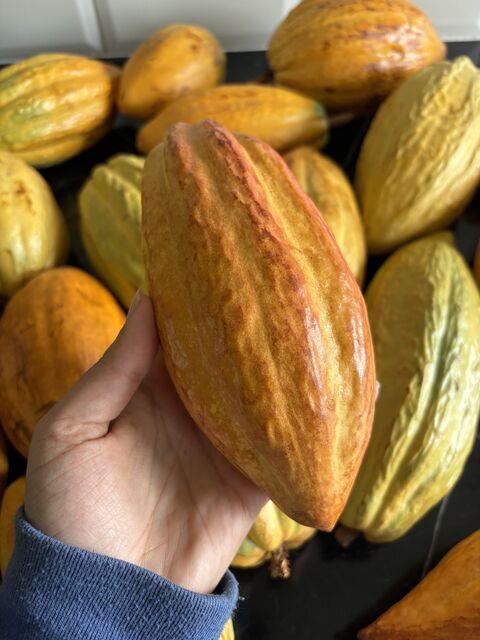
The same collection supplied the cocoa for the bar. Rather than discarding the pods as usual, Khan opened them, fermented, dried and roasted the beans, then crushed and ground them using industry-standard equipment. She combined the cocoa with British-grown sugar and milk before heating and shaping the mixture into the finished bar.
What this means for the industry
The project comes after several turbulent years for cocoa supply. According to the International Cocoa Organization’s May 2026 Quarterly Bulletin of Cocoa Statistics, the global market recorded a 492,000-tonne deficit in 2023/24 before shifting to an estimated 48,000-tonne surplus in 2024/25. Although supply has improved, structural risks remain in West Africa, keeping attention on efforts to build more resilient cocoa supply chains.
The Reading bar also connects to a wider debate over how much food the UK can produce domestically. Defra figures show home production accounted for 56 percent of UK vegetable supply but only 14 percent of fruit supply in 2025, while the NFU has urged greater protection for domestic food production as drought and water constraints intensify.
British-grown cocoa is unlikely to become a commercial alternative to tropical production, but the experiment points to a broader question of resilience. For the UK food industry, that means increasing domestic production where conditions allow, while protecting crop diversity and strengthening international supply chains for ingredients that cannot be grown at scale in Britain.




No comments yet