

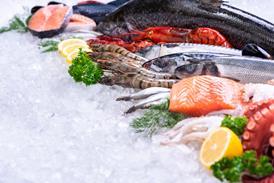



The UK’s food and drink trade deficit is at its highest level this century, adding urgency to the need to increase domestic food production. Chris Elliott reveals encouraging signs that the persistent warnings are finally being heeded, while stressing the need for consistent government policies to support coordinated industry efforts.
For more than a few years I have been arguing that food security should be regarded as an integral part of national security. At times this may have sounded overdramatic, particularly when supermarket shelves have remained well stocked with consumers continuing to enjoy a delightful range of foods from across the world. But beneath this apparent full shopping basket, the warning signs have been steadily building. What concerns me most is not one particular threat, but the growing number of pressures converging at the same time and their potential to intensify through interaction – just as I wrote nearly three years ago.
Climate change and increasingly extreme weather are affecting agricultural production. Wars and geopolitical tensions are disrupting international trade. Maritime chokepoints have demonstrated how quickly supposedly reliable supply routes can become vulnerable. Energy, fertiliser and labour costs continue to challenge primary production and food manufacturing. At the same time, the UK remains heavily dependent – too dependent in my opinion – on international markets for many of the foods and ingredients we consume.
I recently described the signs of this growing vulnerability as the “canaries in the coal mine” of our food system – early warnings that pressures are building that would be unwise to ignore. Multiple supply chains we rely upon extend into regions increasingly exposed to the ever-growing risks I mentioned. There are also much less obvious vulnerabilities buried deep within supply chains; ingredients, packaging materials and other inputs that consumers rarely think about, but without which food production can rapidly grind to a halt.
Individually, most of these problems are manageable and our food industry has responded amazingly well to them over recent years. But the danger comes when they occur simultaneously – a ‘cascading crisis’. Modern food systems are extraordinarily interconnected, which means a relatively localised shock can spread through international supply chains with remarkable speed. By the time supermarket shelves begin to look empty, the warning lights may have been flashing for months.
Against this background, the latest figures for the UK’s food and drink trade deserve serious attention. Having risen to more than £21 billion, the UK’s food and drink trade deficit is at its highest level since 2000. Food and drink export volumes fell by 11.7 percent in the first half of 2026, while imports reached 19.1 billion kg – the second-highest first-half level recorded. These figures have understandably generated yet more calls for the Government to give more serious consideration to protecting domestic productive capacity.
Having risen to more than £21 billion, the UK’s food and drink trade deficit is at its highest level since 2000.”
International trade is essential to UK food security and will remain so, as diverse international sourcing can increase resilience when poor harvests or other problems affect domestic production. But there is an important distinction between strategic trade and strategic dependency.
The UK will never be self-sufficient in food, and I do not believe it should attempt to try. But we cannot allow our domestic productive capacity to decline in the belief that international markets will always be there, providing whatever food we require, in whatever quantity we require, at a price we can afford.
Importantly, these concerns are no longer being raised predominantly by academics like myself and farming organisations. Some of the strongest warnings are now coming from within the food industry itself. Ranjit Boparan, President of 2 Sisters Food Group, recently described the UK food sector as facing a “perfect storm” created by extreme weather, continuing geopolitical conflict and persistent cost pressures. With warnings now coming from numerous different quarters, it feels less like a single canary in the coal mine and more like a chorus of canaries, united in singing the same troubling tune. Encouragingly, that tune is now being heard and heeded – and increasingly acted upon by a new wave of leadership emerging across the UK food industry.
This is one of the reasons why, despite all the challenges I have outlined, I find myself becoming slightly more optimistic about the future of UK food security. My friend and colleague Dr Clive Black recently wrote in New Food about what we believe is a major opportunity for the UK to develop a more coherent approach to food policy. For too long we have tended to treat agriculture, food safety, nutrition, public health, international trade, sustainability, climate change and national resilience as individual policy challenges. They are not.
For this reason I have been particularly interested in the emergence of IGD’s Food Nation 2040 initiative. What appeals to me is that it starts from a very sensible premise. Britain does not suffer from a shortage of reports about what is wrong with our food system. There have been strategies, reviews, advisory groups, consultations and studies – many containing excellent analysis and sensible recommendations. The problem, rather, has too often been converting that knowledge into sustained action. I believe Food Nation 2040 represents an attempt to move this debate towards delivery, uniting organisations from farming, manufacturing, retail, wholesale, foodservice and hospitality, while also involving government, investors, academics, trade associations and civil society.
Of some concern are hints at emerging tensions and shifting power dynamics between industry and Defra, as the private sector appears increasingly willing to move forwards at a pace that government has struggled to match.
From my own experience I observe that the private sector understands our food supply chains in extraordinary detail because businesses operate them every day. They know where the vulnerabilities lie, they know which ingredients have few alternative suppliers, where processing capacity is concentrated, which transport routes are critical and where an apparently insignificant ingredient or component can become a single point of failure. The value of this knowledge was evident during COVID-19. Britain’s food system proved remarkably adaptable, supply chains were changed, product ranges simplified and logistics reorganised.
Surely we should not wait for another crisis before mobilising that capability again? But clearly industry cannot do this alone. There are some things only government can deliver: long-term policy stability that enables businesses to invest is top of my own list – as well as many others I have spoken to. Furthermore, agricultural, environmental and trade policies must work together rather than in parallel – or actually against each other, which seems to be the case sometimes. Governments can prioritise support for infrastructure, research, innovation, skills and technology. It can ensure food is properly incorporated into national resilience and emergency planning. And importantly, it can create the economic and regulatory environment to facilitate commercially viable food production in Britain. Let’s not shy away from the biggest hurdle: building resilience requires investment against risks that may not materialise for several years and the nation is not in a strong fiscal position due to many confounding factors.
What we now need are clear priorities, defined responsibilities, investment commitments, timelines and measurable outcomes. While this strategy might seem defensive, there is also a much bigger opportunity here. Food security is not just about protecting ourselves against shortages. Building a more resilient food system will stimulate innovation across agriculture, food manufacturing, biotechnology, artificial intelligence and many other sectors. A solid strategy rolled out effectively will bring massive investment with it.
What we now need are clear priorities, defined responsibilities, investment commitments, timelines and measurable outcomes.”
The chorus of canaries is becoming louder, but the encouraging news is that the adults in the room are listening and the leadership we need is beginning to emerge. This is no time, however, for a turf war over who owns the food security agenda. What Britain needs now is government and industry working together around a cohesive, detailed and deliverable plan, with clear responsibilities, investment commitments and measurable outcomes. Food security is national security, and safeguarding it must now become a shared national endeavour.
I often finish my articles with what I consider a suitable quotation. This one is no different! President John F Kennedy once said: “The time to repair the roof is when the sun is shining.” Worryingly, the UK food-security roof is already leaking; the question is whether we fix it now or wait for the perfect storm to rip it off completely.










No comments yet