



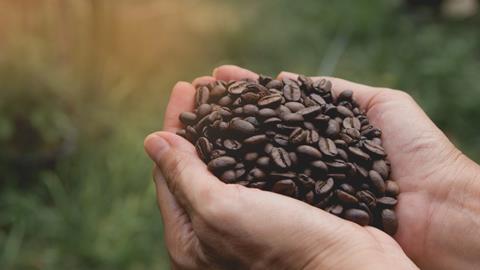

The world wants and needs sustainable food production, but who’s to pay for it? Chris Elliott reflects on the need to level the cost burden of assuring the prized cup of joe lives on responsibly.
A little over two years ago, I wrote an article for New Food entitled A few things to consider over your next cup of coffee. In this piece, I explored the environmental impacts of one of the world’s (and my own) favourite beverages – coffee. Chief among these were the greenhouse gas emissions associated with its production and consumption; thus I questioned whether we were doing enough to enhance the sustainability of this enormous global industry. Now, two years on, I find myself asking a rather different set of equally pressing questions around sustainability. In our determination to make coffee environmentally sustainable, are we unwittingly pushing the industry towards economic unsustainability for the millions of farmers who produce it?
Two important aspects of this dilemma have recently come to my attention, bringing this question into sharp focus. The first concerns a major international initiative to change how coffee is purchased. The second raises some uncomfortable questions about the unintended consequences of European environmental regulations. Together, they suggest that the future of coffee may depend as much on how we treat its producers as on how successfully we reduce its environmental footprint.
Farmers are pushed to invest time and money in meeting ever-growing sustainability standards, with no guarantee that the market will purchase their coffee under those schemes or reward their efforts in a fair way.”
The sustainability paradox
Coffee is an extraordinary global commodity. According to the International Institute for Sustainable Development (IISD), approximately 25 million farmers depend on its production for their livelihoods, while millions more work throughout its complex international supply chains. Yet what strikes me most is the fundamental unfairness at the heart of this industry: those who grow the coffee shoulder much of the burden of sustainability while receiving far too little of the value it creates. Yet elsewhere in the chain, traders, roasters, retailers and coffee shop owners benefit enormously from the revenue it generates. How can such a lucrative industry rely on farmers who often struggle to earn sufficient income to support their families, let alone invest in more sustainable production?
Climate change is making matters substantially worse. Increasing temperatures, unpredictable rainfall, droughts and changing pest and disease pressures threaten production in many important coffee-growing regions. At the same time, farmers face rising production costs, volatile prices and increasingly demanding environmental standards. The IISD’s August 2026 report provides some particularly revealing statistics. Coffee produced in compliance with voluntary sustainability standards represented an estimated 24–42 percent of global production in 2023, yet only just over half of certified coffee was actually sold as certified. Think about that for a moment; I certainly had to. Farmers are pushed to invest time and money in meeting ever-growing sustainability standards, with no guarantee that the market will purchase their coffee under those schemes or reward their efforts in a fair way. I suggest that there is something fundamentally wrong with that model.
An important change in how coffee is purchased
At the end of September this year, Daily Coffee News reported that four influential organisations – the Global Coffee Platform, GIZ, IDH and Solidaridad – were joining forces to develop common guidance for responsible coffee procurement. This initiative is supported by 18 leading companies and aims to change purchasing practices right across the industry. It builds on principles developed earlier this year, emphasising longer-term commercial relationships, better recognition of sustainable production costs and fairer sharing of financial risks. The significance of this development should not be underestimated. For many years, the sustainability debate has focused heavily on what farmers must do differently. They have been pushed to reduce pesticide use, protect biodiversity, prevent deforestation, improve working conditions and demonstrate compliance with a host of standards. Yet while these are all worthy objectives, the missing piece of the jigsaw has been ascertaining who must pay to deliver them The new initiative recognises that sustainability cannot simply be imposed through purchasing specifications and certification requirements. The fundamentals of the commercial relationships between buyers and producers must also change. The Global Coffee Platform’s announcement clearly acknowledges that the way coffee is purchased adversely affects farmers’ livelihoods, investment capacity and long-term resilience. I believe this to be a very encouraging step forwards, although the guidance is still under development. The real test will come if their actions translate into better prices and fairer contracts for farmers.
Could European environmental regulation make matters worse?
This brings me to a second, potentially more controversial, development. This month, a coalition of organisations, including Fairtrade International, Oxfam, Rainforest Alliance and Solidaridad, published a briefing entitled Towards smallholder-inclusive risk mitigation under the EU Deforestation Regulation. The EU Deforestation Regulation (EUDR) is designed to prevent products associated with recent deforestation from entering the European market – and coffee is one of the commodities covered. Its environmental objectives are entirely understandable and important for protecting our planetary health. Deforestation is a major contributor to biodiversity loss and climate change, and international agricultural trade has played a significant role in driving it.
However, the briefing highlights yet another serious potential unintended consequence of driving sustainability. European buyers must demonstrate that their products meet the regulation’s requirements, including traceability and appropriate due diligence. For companies purchasing coffee from thousands of smallholder farmers, gathering and verifying this information can be extremely difficult and expensive. Faced with these challenges, some businesses may well decide that sourcing from larger, better-resourced producers is commercially easier than helping smaller farmers demonstrate compliance. The result could be that farmers who have not actually contributed to deforestation lose access to European markets simply because they cannot meet the administrative and technical requirements. An example from Peru is given, where coffee and cocoa cooperatives have absorbed substantial compliance costs, potentially diverting scarce resources away from improving livelihoods and production.
There is an important distinction to draw here. Removing deforestation-linked products from a company’s supply chain does not necessarily mean that deforestation itself has been reduced. With complex global supply chains, production may simply be redirected towards markets with less demanding requirements and there will be increased opportunities for fraud – ie, country-of-origin misrepresentation in falsified documentation. I also think there is a broader food security issue here. If environmental compliance requirements and commercial pressures encourage major buyers to concentrate purchasing from fewer, larger suppliers, global coffee supply chains may become less diverse. We have learnt repeatedly in recent years that highly concentrated supply chains can be remarkably efficient during ‘normal’ conditions but dangerously fragile when something goes wrong. Coffee production is already exposed to significant climatic risks. The IISD’s 2026 report highlights the combination of relatively stagnant production, growing consumption and increasing price volatility. Reducing the diversity of the producer base will only serve to compound these vulnerabilities. Surely supporting smaller farmers through longer-term contracts, investment in agricultural practices and fair access to markets could improve both environmental outcomes and supply resilience. This is why the procurement initiative and the Fairtrade briefing should not be viewed as separate developments – they are actually addressing two sides of the same problem.
Farmers who have not actually contributed to deforestation lose access to European markets simply because they cannot meet the administrative and technical requirements.”
So the burning question: who should really pay for sustainable coffee?
I believe we need a fundamental change in how sustainability is understood and delivered within global food supply chains – not only for coffee but for many commodities. First, thinking about sustainability must include economic viability. Farmers cannot reasonably be expected to protect forests, reduce emissions and invest in traceability systems if their income does not allow them to meet their basic household needs. Second, compliance costs must be shared fairly along supply chains up to and including us consumers. Third, traceability systems must be practical, interoperable and independently verifiable. And finally, sustainability must be measured by real-world outcomes rather than nice corporate commitments that can be pushed to later timeframes without any real push back. I’m of the opinion that the International Coffee Organization’s work on living and prosperous incomes provides an important foundation for developing real measures of progress. None of this diminishes the importance of environmental regulation; quite the opposite, in fact. Effective environmental protection is essential to the long-term future of coffee production, but this must be matched by economic fairness and practical implementation.
When I sit down with my morning coffee, I want to enjoy it, not wonder whether farmers struggling to make a living have been shafted by a system that expects them to shoulder the burden of making it environmentally sustainable. That really would be a bitter coffee to swallow.




Topics
- Decarbonisation, energy & utilities
- Enforcement, policy & governance
- Food fraud & authenticity
- Food safety & integrity
- Process design & scale-up
- Processing & manufacturing
- Regulation, labelling & compliance
- Sustainability & supply chain resilience
- Traceability, transparency & compliance
- Trade, economics & market risk








No comments yet