



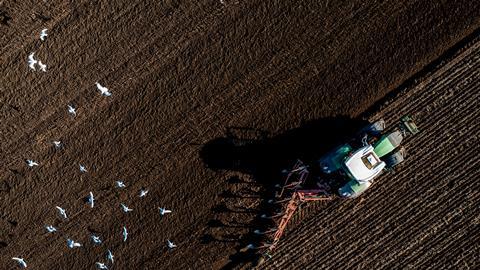

Clive Black lays out potential scenarios governing the health of the UK’s food system – maintaining that securing its resilience is within grasp, if only government will but reach for it.
The UK food system is the largest industrial sector in these Isles embracing sheep farmers in County Antrim across and through to motorway service stations in South Yorkshire. It is a fine, if not perfect, system – one of which to be generally proud, one that feeds the nation without a second breath, one lauded in the pandemic, but since once again, one that has been forgotten by the political class. Indeed, one suspects, in truth, that elements of the UK Civil Service see it as a play thing – often for their own personal agendas and those of their close mates. Such a position is not acceptable and the consequences of no change, no material policy pivot and much great coordination, could be profoundly bad.
Andy Burnham, the coronated UK Prime Minister of 2026, has a job that goes up a notch after a summer of little scrutiny, while always dealing with ‘events’. Alas, as he admitted in his opening speech in Downing Street, with seven British Prime Ministers in just a decade, the domestic political system is, unlike our farming and food system, not one to be proud of – far from it.
The fact remains that there is great scope to structurally raise UK food self-sufficiency from the current under-60 percent level to over 75 percent by 2050 with the wider economic growth impact that should follow.”
It presents a slight problem when a high performing and meritocratic system like the UK food industry comes up against a political elite that is stuffed with mediocrity, to put it kindly. Indeed, the language of the National Audit Office (NAO) in its report, Resilience of the food supply chains to disruptions, was suitably scathing in the language of bureaucrats on the position, role and performance of UK Department for Environment, Food and Rural Affairs (DEFRA).
Cue the horrible question for DEFRA’s management class, as an administrative entity – so not a reason to criticise elected ministers – on behalf of the whole UK food system: are you surprised by the NAO’s evisceration of your own department’s stance on resilience? The truth, regrettably and disgracefully, is that DEFRA lost the UK food industry dressing room years ago. While possibly forlorn, one has to hope, for the state of the nation, that DEFRA under Burnham will yet be different; second cue, don’t hold your breath.
In terms of seeking to be constructive – since criticising DEFRA is easy given its awfulness but that does not tend to progress matters –maybe sit down at this point because there may be some grounds for a smidgeon of optimism when it comes to the Burnham approach to the UK food system, while noting that it is still very early days with much scope to revert back to underwhelming mediocrity. Cue, a chance for you to get back up, after falling down.
The grounds for the more positive assertion emerge from the early speech of the then newly appointed Prime Minister, who, in effect, spoke to the need to defend the nation, implying a prioritisation on building the British industrial system behind it, while also stating the need to enhance agri-food security and resilience. No indication of supporting the British food system around resilience and self-sufficiency followed, it should be said, but maybe there is something to build upon.
And here lies a major opportunity, not just to structurally improve resilience – noting that in a holistic sense the NAO also spoke to the risks to the resilience of the food system from climate change, cyber attack and disease, including antimicrobial resistance (AMR) – but also for UK economic growth, a key mantra of Labour before and after its 2024 Election. I should add that my good and hugely respected friend Professor Chris Elliott, a world leader on risk in the food system, has been endlessly calling out global challenges and the ineptitude of DEFRA for years, and while it is probable that the NAO may yet garner some response, his work should be central to Whitehall thinking.
So why does the UK agrifood system lightbulb not come on in Whitehall, or the other devolved administration headquarters for that matter? The fact remains that there is great scope to structurally raise UK food self-sufficiency from the current under-60 percent level to over 75 percent by 2050 with the wider economic growth impact that should follow. Put another way, that assertion, that ambition, is to increase the output of the domestic food system by over c20 percent in a generation, which by implication means producing much more food from the same, if not less, land acreage.
Stating this objective, which is a useful focal point, will incite a changed sense of policy priorities and pace – an approach that probably needs a sea-change of personnel in public policy to see through, sadly – not least because some narrow nice-to-haves of minority sports must be replaced by big decisions embracing major games. For example, biodiversity is important within the food policy agenda but it must be set within a wider context as part of a structural adjustment in UK food production, not be the end in itself. Hence, it feels like madness to permit fields of wild flowers and solar panels, when we could be growing compliant local food. I shall return to the subject of biodiversity, because it is important.
The reason for this assertion? One need only take a cursory glance at global politics and note the impact on UK food resilience of the UK leaving the EU, the COVID-19 pandemic, the impact of current wars in the Middle East and Ukraine, US tariffs, more extreme weather patterns and the potential for elevated international agri-based bio-insecurity plus that of a cyber nature – the latter of which hit two UK grocers in 2025 with a combined 10 percent market share. Indeed, such a list of challenges and risks is a big wake up call for a country with c70 million people, expected to be 70-75m by 2050, and not much over 50 percent domestic food self-sufficiency.
More broadly – and to repeat as it is something that persistently causes a head itch: why do politicians not foresee the opportunity to expand the domestic food system by building resilience?
Returning to biosecurity – because, to be clear, it is important – there is a responsibility on the UK food system to explore ways to structurally expand food production but in forms that embrace progressive policy attitudes and outputs.
So, that means an industry where a framework emerges that raises yields through a matrix of world-leading animal welfare, enhanced biosecurity, less carbon alongside a structurally improved chemical condition of the land, air and water (lower ammonia, nitrates, phosphates etc) and so with a strong labour process, an industry of which to be truly proud.
Why do politicians not foresee the opportunity to expand the domestic food system by building resilience?”
Upfront and central to the delivery of more milk, animal protein and crops (especially soft fruit, top fruit, salads and vegetables) – a structural increase in arable output is more land restricted, albeit vertical farming may yet be a pathway to progress – is the creation and implementation of a data-rich 2050 UK soil strategy. Fortunately, in Professor John Gilliland in Northern Ireland, we have a national treasure who should, with such similar great brains, be at the centre of policy formation.
Mr Burnham’s opening remarks on technical versus academic skills resourcing could be a boon to increasing and elevating the human capital of the UK food system from farm to hospitality. So too could devolution if, on the ground, authorities have more scope to prioritise and fund their local food systems – one thinks of say Cornwall or East Yorkshire in this respect, rather than having targets filtered through Whitehall.
Should such real devolution rest alongside planning reform for the better – restrictions on egg, pig and poultry investment in the UK are a national scandal – then the ingredients of a hugely successful economic growth plan could not only take shape, but be implemented to beneficial economic impact.
Such an outcome could happen in a remarkable twist of fate by osmosis, though this is highly unlikely, over proper multi-department coordination – something Whitehall is so bad at due to the little England fiefdoms of permanent secretaries alongside a fair dollop of incapability; discoordination being a key reason for the NAO’s necessary involvement.
Hence, this vision for the UK food system also requires upfront and central proper coordination, where Westminster can be an aid, which, like AI, defence and energy, requires a Minister for the Food System.
Andy Burnham has created a policy framework around agrifood security and resilience, devolution, and technical over academic skills, that with a Minister of the Food System in tow, plus the great brains of the UK’s research institutes, could be a structural engine for growth from the country’s too-often overlooked but largest industrial sector. Let us hope that the opportunity is seized and that he succeeds in growing the UK economy through the next decade.
Alas, there is another scenario – one purported by one of the most respected retail executives I know in a talk in Belfast in mid-September 2026: the UK ignores the warning signs and remains discoordinated. It fails to take the steps necessary to generate much greater resilience and so, one day, a new challenge emerges that once again consumes the centre, Whitehall, which the hard work and goodwill of the industry may not be able to handle. Meanwhile, as a sideshow of this multi-decade Whitehall mismanagement, an amazing economic opportunity is foregone.
Let us hope and pray for option one!









No comments yet