




Tufts University has launched a food innovation hub giving companies shared facilities to develop, test and scale emerging food technologies.
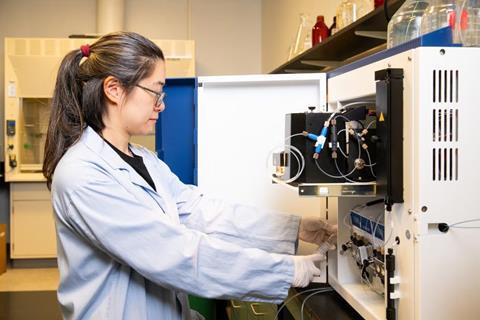
Tufts University has launched a new research and development hub to help food companies, startups and researchers take emerging technologies from early-stage concepts through testing and scale-up.
Based in Medford, Massachusetts, the Innovation Hub for Food and Materials aims to address a lack of access to specialist R&D infrastructure that can hold back product development, particularly for smaller businesses and researchers.
The facility combines cell culture, bioprocessing, food formulation and scale-up capabilities with a test kitchen and sensory testing, bringing several stages of product development into one shared setting. It will support work including novel ingredients, food processing technologies and more sustainable production methods.
Commercial companies, academic researchers and nonprofit organisations can use the Hub, from startups without their own development facilities to established businesses exploring new products or technologies.
From prototype to consumer testing
For food developers, the Hub is designed to bridge the gap between early laboratory work and the practical testing needed to move a product closer to market. Its facilities cover cell culture and bioprocessing through to formulation and early scale-up production.
That technical work can then feed into a test kitchen and sensory analysis suite, where developers can assess how foods perform in conditions closer to real-world use through chef and consumer testing.
The facility also houses animal and insect cell banks alongside a plant cell repository containing more than 2,000 species. It connects with the Tufts University Center for Cellular Agriculture, which researches cultivated meat, alternative proteins and plant- and cell-derived materials.
That focus on shared access is not new. Earlier this year, Tufts and the Good Food Institute preserved cultivated meat cell lines for open industry use, with the repository planned as part of the university’s future foods innovation hub.
David Kaplan, Stern Family Endowed Professor of Engineering at Tufts University, said the need for shared infrastructure has become a recurring issue for both researchers and industry.
“We’ve consistently heard from both researchers and industry that there is a need for shared infrastructure to move ideas forward,” said Kaplan.
“The Innovation Hub for Food and Materials is designed to meet the needs of academics looking to commercialise a new innovation, small companies that may not have the resources to test manufacturing capabilities, larger companies focused on production that would like to explore new products or technologies, or anyone that might be missing even a small part of the process to bring a product from idea to market,” he said.
Why shared infrastructure matters
The challenge for emerging food technologies does not end when a product works in the laboratory. Moving towards commercial production means proving that processes can work beyond small-scale trials while maintaining consistency, efficiency and cost control.
That transition is particularly difficult in food biotechnology, where manufacturing systems, sterilisation, media preparation and utilities can all become barriers as technologies move from pilot to industrial production.
Shared facilities such as the Tufts Hub could lower one part of that barrier by allowing businesses to test processes and products before committing to their own manufacturing infrastructure. Combining technical development with formulation and sensory testing could also help companies identify problems earlier, before making larger commercial investments.
We’ve consistently heard from both researchers and industry that there is a need for shared infrastructure to move ideas forward.
The Innovation Hub for Food and Materials is designed to meet the needs of academics looking to commercialise a new innovation, small companies that may not have the resources to test manufacturing capabilities, larger companies focused on production that would like to explore new products or technologies, or anyone that might be missing even a small part of the process to bring a product from idea to market.”
David Kaplan, Stern Family Endowed Professor of Engineering at Tufts University
The Hub also connects with a wider question Kaplan has raised about how emerging food technologies should scale. Speaking separately at the Bezos Centre for Sustainable Protein 2026 conference, he suggested the industry should also explore “scaling out”, distributing production across smaller facilities located closer to where food is consumed.
Shared R&D infrastructure does not solve that manufacturing challenge, but it could help more organisations test and develop technologies without first needing access to large, capital-intensive facilities.
That same principle of shared access extends to the Hub’s “technology sandbox”, where equipment suppliers can test technologies such as bioreactors, extrusion systems and materials-characterisation tools alongside other parts of the development process.
The food and materials technology core facility received support from a $2.1 million grant from the Massachusetts Technology Collaborative, while Tufts has invested a further $4.6 million in shared research infrastructure and product development capabilities.
By bringing technical development, scale-up and consumer testing into one shared environment, the Hub could lower one of the practical barriers separating promising food technologies from commercial deployment.




Topics
- Decarbonisation, energy & utilities
- Ingredients & formulation
- Novel foods & approvals
- Process design & scale-up
- Processing & manufacturing
- Proteins & alternative proteins
- Sustainability & supply chain resilience
- Trade, economics & market risk
- Tufts University
- Tufts University Center for Cellular Agriculture (TUCCA)







1 Reader's comment