




Cultivated meat may be advancing towards commercial production, but proving its safety presents complex scientific challenges. Ben Cornwell explores the evidence regulators require, with expert insights from Dr Thomas Vincent, Deputy Director of Innovation at the Food Standards Agency.
A cultivated-food developer could perfect its cell line, refine its growth media and produce a promising batch of meat, only to face a new set of challenges when moving towards commercial production.
Increasing bioreactor capacity, changing production inputs or modifying processing conditions can affect the finished food and the evidence needed to demonstrate its safety. What worked during development may need to be reassessed before the product can reach consumers.
Regulators must understand precisely what is being grown, which hazards could arise during production and whether the supporting evidence accurately represents the food intended for market. The technology involves growing animal cells under controlled conditions, using specialised growth media to support multiplication and, where required, differentiation into particular cell types. Every stage – from sourcing the original cells to harvesting and processing the final material – is evaluated in the safety assessment.
As of October 2026, three cell-cultivated product (CCP) applications had been validated in the UK and were undergoing risk assessment by the Food Standards Agency (FSA) and Food Standards Scotland (FSS).
Despite the unfamiliar production methods, the emerging regulatory picture is becoming clearer. Dr Thomas Vincent, Deputy Director of Innovation at the FSA, says the the agencies’ regulatory sandbox programme has shown that existing novel food safety principles can largely accommodate cultivated products.
“An important conclusion from the programme is that, for the most part, CCPs can be regulated using the same framework and established safety principles that apply to other novel foods,” he says. “This was not necessarily clear at the outset, given the novelty of the technology and its production methods. However, the work undertaken to date has shown that CCPs do not require a separate regulatory system.”
The overall lesson is that the volume of information submitted is less important than whether the evidence is complete, clearly structured and connected through a coherent safety narrative.”
From the laboratory to the supermarket shelf
Before a cultivated food can be marketed in Great Britain, it generally requires authorisation under novel food regulations.Developers must submit a scientific dossier describing the food, its composition, manufacturing process, intended uses and potential hazards.
Crucially, the dossier must define the form of the food for consumption, including its final formulation, rather than describing only the cells or biomass produced during cultivation.
Under the FSA’s regulatory authorisation guidance, applications undergo validation followed by scientific risk assessment, potentially involving the Advisory Committee on Novel Foods and Processes (ACNFP). Regulators may request further evidence before proceeding to risk management and authorisation decisions.
Validation establishes whether an application can proceed to assessment. It does not establish that the food is safe.
Missing datasets, insufficient production descriptions and poorly supported conclusions can delay assessment, as highlighted in the FSA’s guidance on improving applications. The amount of information submitted is not necessarily the best indicator of a strong application. Vincent argues that the evidence must be “complete, clearly structured and connected through a coherent safety narrative”.
Running from February 2025 to February 2027, the FSA and FSS’s regulatory sandbox programme aims to improve understanding of cultivated-food hazards to support a typical assessment and authorisation timeframe of approximately 2.5 years for routine, non-complex applications, according to its September 2026 progress report.
What should a cultivated-food safety dossier demonstrate?
- Product identity: the cells used, their characteristics and differentiation status, and the composition of the finished food
- Production process: cell sourcing, production inputs, cultivation, harvesting and downstream processing
- Safety evidence: assessment of relevant microbiological hazards, allergenicity, nutritional composition, potential residues and toxicological concerns
- Reliable data: appropriately validated methods, supporting raw datasets and scientific justification for testing decisions
- Commercial consistency: evidence representative of the intended manufacturing process and scale, supported by an appropriate food safety management plan.
Evidence requirements depend on the product, its intended uses and identified hazards.
How do you know what you’re growing?
Cultivated meat developers select cells for their ability to multiply and develop characteristics required in the finished food. Muscle and fat cells, for example, contribute different properties to meat-like products.
However, cell characteristics can change during cultivation. As cells divide or undergo differentiation, genetic or physiological changes may affect their growth behaviour, protein expression or the composition of the harvested material. These changes do not automatically indicate a safety problem, but developers must evaluate their potential significance.
The FSA’s July 2026 guidance on identity, production and microbiology identifies approaches to assessing genomic stability, including monitoring cell passages, examining chromosomal structure through karyotyping and evaluating changes in cellular characteristics.
Genetic modification introduces additional regulatory considerations. Under the FSA’s interpretation, certain genetically modified cell lines that cannot survive and replicate outside the bioreactor do not meet the definition of a genetically modified organism (GMO) and are assessed under novel food regulations.
However, where production inputs are derived from GMOs and residues of those organisms remain in the finished food, GM food legislation may also apply. The FSA recommends that developers using genetic modification consult the regulator before submitting an application.
Contamination, allergens and nutrition
Understanding the cells is only part of the assessment. Their production environment also requires scrutiny. Potential contamination sources include the original animal, biological materials, growth media and equipment. The FSA identifies mycoplasma, viruses and other biological agents among the hazards requiring consideration.
A 2025 assessment by Food Standards Australia New Zealand (FSANZ) illustrates how these risks can be evaluated. In examining cell-cultured quail, the regulator identified a particularly vulnerable stage when cells leave the closed cultivation system during harvesting and subsequent handling, potentially exposing them to microbiological contamination.
Its published assessment emphasised the importance of appropriate production controls, including a Hazard Analysis and Critical Control Point (HACCP)-based food safety management system.
Other familiar food safety questions remain. Cultivated seafood may contain proteins associated with fish or shellfish allergies, while cultivation materials could introduce additional allergenicity considerations.
In terms of nourishment, a cultivated product that resembles conventional meat may have a different nutritional composition. Applicants must consider whether its intended consumption, including use as a replacement for conventional meat, could be nutritionally disadvantageous.
The FSA and FSS’s allergenicity and nutrition guidance recommends analysing at least five independent, representative production batches for nutritional composition, unless fewer can be scientifically justified. These results help establish the food’s nutritional profile and reveal how much its composition varies between batches.
What’s left behind when the cells are harvested?
Understanding the composition of the finished food is essential, but the safety assessment must also account for substances used during cultivation that may remain after harvesting.
Growth media can contain amino acids, vitamins, minerals, sugars, lipids, hormones and growth factors. Some have established histories of dietary exposure, while others, including certain recombinant proteins, have more limited histories of consumption.
Consider a growth factor used to stimulate cell multiplication. Assessors must establish whether any of it remains in the harvested material, at what concentration and whether it retains biological activity. They must also consider whether it could accumulate within cells or be altered during processing and digestion.
The FSA’s September 2026 guidance on toxicology and growth media addresses these issues, including the characterisation of production inputs, potential residues and consumer exposure.
Detecting a residue does not automatically establish a health risk. Assessors must consider its toxicological properties, concentration and estimated dietary exposure. The FSA’s guidance sets out a stepwise genotoxicity assessment – including in vitro testing unless a different approach is scientifically justified. Additional investigations, such as repeated-dose toxicity studies, depend on the hazards identified, potential exposure and available evidence.
Assessors must judge whether the available evidence adequately addresses the identified risks, particularly when unfamiliar production methods introduce new questions.
“The central question is whether the applicant has provided evidence of sufficient quality to support the conclusions drawn and has explained clearly why particular testing was, or was not, undertaken,” Vincent says. “Critically, this is fundamentally no different to the assessment of any other novel food.”
Establishing the safety of a product under one set of manufacturing conditions, however, does not necessarily mean the same evidence will remain applicable at commercial scale.
The scale-up dilemma
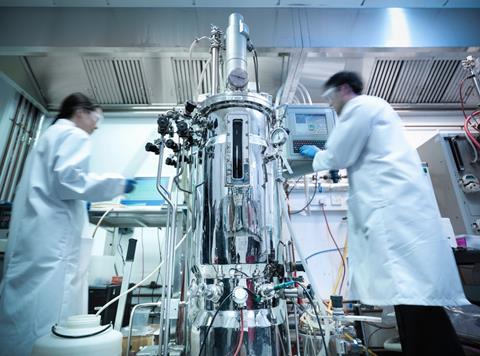
Consider a hypothetical developer producing consistent batches of cultivated meat in a 50-litre bioreactor. Its cells have been characterised, relevant residues measured and the finished product shown to meet defined specifications. The company now intends to manufacture the same food in a 5,000-litre system. What happens to its original safety evidence?
Larger bioreactors may involve different mixing conditions, oxygen availability, nutrient distribution and physical stresses on cells. Changes in growth media, harvesting or downstream processing could also affect the finished product.
“The application should accurately reflect the current intended commercial scale of production and describe a sufficiently finalised process and product,” Vincent explains. “The assessment is based on the process, production scale and final food described in the application, so these should not change significantly while the risk assessment is underway.”
Applications should include detailed manufacturing descriptions and food safety management plans appropriate to the intended scale, preferably following HACCP principles. Businesses must also comply with applicable food hygiene obligations.
Changes intended to improve yields, reduce costs or simplify production may also affect the evidence supporting a safety assessment. For products already authorised, the FSA distinguishes modifications that may require a new risk assessment from more significant changes that are highly likely to do so, particularly where they introduce new risks.
During an ongoing application, substantial changes may instead affect whether the product and process under assessment remain representative of the intended commercial operation.
Developers still refining their production processes must therefore consider when to submit an application.
“Businesses whose product or process remains under active development should consider whether to wait until it has been sufficiently finalised or submit a separate follow-up application once the change is ready,” Vincent advises.
The FSA and FSS’s Business Support Service also provides pre- and post-submission advice, allowing applicants to seek clarification on product-specific requirements before committing to a regulatory strategy.
The assessment is based on the process, production scale and final food described in the application, so these should not change significantly while the risk assessment is underway.”
Where does the science still fall short?
With cell lines, growth media and manufacturing processes varying considerably between developers, establishing common analytical methods and evidence standards remains challenging. Vincent identifies areas where “internationally recognised analytical methods or common standards are still developing”, including methods for characterising production processes, evaluating novel inputs and residues, establishing the relevance of evidence across production scales and authenticating cell-cultivated products.
Without internationally recognised methods, developers must demonstrate that their own analytical approaches are sufficiently reliable to support a safety assessment.
“The absence of a single internationally recognised method does not prevent an application from being assessed,” Vincent says. “Applicants may use fully validated internal methods with appropriate controls where these are scientifically justified.”
However, applicants must also provide information about the method, its validation and limitations, alongside supporting raw data and a clear interpretation of the findings, he explains.
The FSA and FSS are addressing wider evidence gaps through live assessments, commissioned research, scientific experts and their regulatory sandbox. The challenge of establishing reliable evidence extends beyond Great Britain. As more countries assess cultivated-food applications, regulators face similar questions about analytical methods, manufacturing controls and the interpretation of safety data.
This creates opportunities to share scientific knowledge and reduce unnecessary duplication, even where national regulatory frameworks differ.
What can regulators learn from each other?
Cultivated food: international regulatory snapshot
- Singapore: First cultivated-meat product authorised for sale in 2020.
- US: Five completed FDA pre-market consultations recorded in February 2026; commercial sales of cultivated chicken began in 2023.
- Australia and New Zealand: Cell-cultured quail permitted in June 2025. A cultivated-duck proposal received FSANZ Board approval in October 2026, with statutory consideration ongoing.
- EU: Cultivated duck-cell application received in September 2024; no animal-cell-cultivated food yet authorised for sale.
- Great Britain: Three validated cell-cultivated product applications undergoing risk assessment as of October 2026.
These milestones involve different regulatory procedures. Completion of an FDA pre-market consultation is not equivalent to final market authorisation.
Although regulatory frameworks differ, Vincent sees opportunities to improve the consistency of scientific evidence submitted across jurisdictions.
“Greater consistency in dossier structure and data expectations could also help businesses generate evidence that is useful across jurisdictions, reducing unnecessary duplication,” he says. “Sharing non-confidential scientific evidence, research findings and experience gained from completed assessments could help regulators develop their knowledge and capability more quickly.”
Importantly, alignment does not necessarily require identical legislation, procedures or authorisation decisions. Vincent argues that the greatest opportunity lies in “greater alignment around robust scientific principles, transparent evidence standards and compatible approaches to risk assessment”, while preserving each regulator’s ability to request product-specific information and protect consumers within its jurisdiction.
The final hurdle
As more cultivated-food applications progress through regulatory assessment, both developers and regulators will gain a clearer understanding of how these products can be evaluated and manufactured safely.
That experience could help address uncertainties around production methods, analytical standards and commercial scale, while giving future applicants a clearer understanding of the evidence expected of them.
The regulatory framework is already in place. The first assessments will help establish how it operates in practice for an industry still developing its manufacturing processes.









No comments yet