



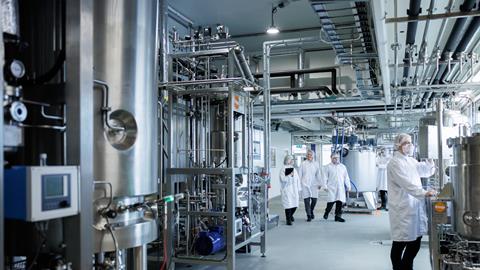


As new fermentation and microbial production platforms move towards industrial deployment, the question is no longer simply whether the biology works. Ola Elmqvist, President of Food Manufacturing Technologies Europe (FMTE), argues that the real test of novel food technologies lies in whether they can operate reliably, efficiently and economically at industrial scale.
Food biotechnology may begin with scientific discovery; its success, however, is often determined by what happens on the factory floor.
For Ola Elmqvist, the transition from pilot systems to industrial production marks the point where many promising technologies encounter their greatest test.
“The biggest shift is moving from equipment designed for precision to systems designed for performance,” Elmqvist explains. “Industrial food production needs fit-for-food solutions that run safely, efficiently and cost-effectively every day. When you move from pilot facilities into industrial scale, the rules change. Pilot systems are built for control and experimentation, not for high utilisation or low operating cost.”
This distinction highlights a central challenge: translating promising biotechnology into reliable industrial production.
In research environments, processes are designed for experimentation. Parameters can be adjusted, systems can be stopped and experiments repeated. Food manufacturing operates under very different constraints.
Factories must run continuously. Equipment must withstand repeated cleaning and sterilisation cycles. Downtime carries real operational and financial consequences.
“Companies often underestimate the shift from pilot runs to industrial food production,” Elmqvist says. “At pilot scale, standstill is manageable. At commercial scale, any downtime in cleaning, sterilisation or equipment turnaround becomes extremely costly.”
Scaling biotechnology therefore requires production systems capable of operating efficiently under industrial conditions.
The scale of the challenge is becoming clearer across the sector. Analysts estimate that $10–17 billion in investment may be required to build the manufacturing infrastructure needed for alternative proteins to reach even modest market share by 2030, according to the Good Food Institute Europe report Innovative financing mechanisms for alternative proteins in Europe.
At scale, the real bottlenecks are the ones that quietly add risk, eat into profitability and undermine process efficiency.”
Ola Elmqvist, President of Food Manufacturing Technologies Europe (FMTE)
Where scale really breaks down
When food biotechnology is discussed, attention often centres on microbial strains, fermentation yields or novel production platforms. Yet the factors that determine whether these technologies succeed at industrial scale often lie within the wider manufacturing system.
In many cases, the constraints emerge from the surrounding system rather than the biology itself.
“At scale, the real bottlenecks are the ones that quietly add risk, eat into profitability and undermine process efficiency,” Elmqvist explains. “In particular, seed-train design, sterilisation, media preparation and utilities consumption are all bottlenecks to either production or profit.”
Among these, seed-train design can have a significant impact on how efficiently a fermentation facility operates.
“If the seed strategy isn’t optimised, companies end up with too much equipment, too much downtime and too much capital tied up,” he says. “Moving to fed-batch or continuous seed trains maintains output with less equipment and lowers financial risk.”
Utilities can quickly become limiting factors as production scales. Large fermentation systems require substantial utilities, including steam generation, cooling capacity and cleaning-in-place (CIP) infrastructure to maintain hygiene standards.
“Steam, cooling and CIP can quickly become the real ceiling for scale and profit.”
Water management presents another layer of complexity. Fermentation processes can generate significant volumes of wastewater, requiring treatment systems that must be carefully integrated into facility design.
Why food biotech cannot simply copy pharma
Part of the difficulty stems from where many biotechnology platforms originate.
Many fermentation processes begin their development in pharmaceutical environments, where the technical priorities are very different from those of the food industry. In pharma production, purity is paramount and the economics are shaped by small volumes and extremely high-value products.
Food manufacturing operates under a very different set of constraints.
“A further challenge is that biotechnologies often begin life in environments designed to remove every impurity at almost any cost,” Elmqvist explains. “That works in pharmaceutical production where volumes are low and the value of the product is extremely high. In food production, the reality is different. Food production must deliver high volumes at far lower unit value.”
Processes designed with pharmaceutical assumptions in mind can quickly become prohibitively expensive when applied to food production.
Engineers must therefore rethink how processes are designed, identifying where efficiencies can be introduced without compromising safety or functionality.
“The real engineering challenge is finding the right balance: deciding what must be removed for food safety and product functionality, what can be left in without compromising quality, and how to achieve that efficiently at scale.”
In practice, this requires redesigning fermentation and downstream processes so they remain economically viable for food production.
Designing systems that actually run
As fermentation processes move into industrial production, the focus quickly shifts from experimentation to consistent performance.
“Reliable industrial operation starts with designing for repeatability,” Elmqvist says. “Making sure the process behaves consistently over long runs, not just in a controlled pilot.”
That requires identifying critical process parameters early and validating them under realistic production conditions.
Equipment design also plays a central role.
“When equipment matches the organism, the process flow and the production goals, companies achieve higher utilisation, lower total cost of operations and smoother day-to-day performance,” Elmqvist says.
Maintenance and serviceability are equally important. Industrial plants operate around the clock, and even minor disruptions can cascade through production schedules.
He adds that easy-to-maintain equipment, consistent monitoring and round-the-clock operational support are essential for preventing downtime and protecting both product quality and margins.
Europe’s industrial base for food biotechnology
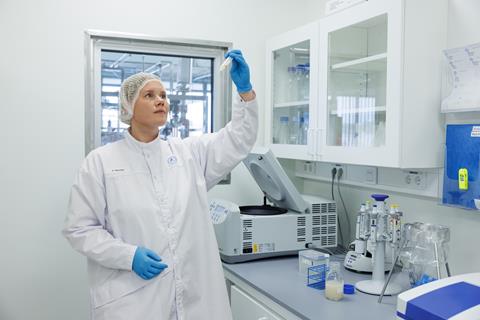
Addressing these issues also depends on the industrial capabilities surrounding the sector. In this respect, Europe enters the transition with a significant advantage – a strong food manufacturing technology base.
According to the FMTE Policy Manifesto, around 9,000 companies across Europe’s largest markets develop equipment, automation systems and process technologies for the food industry, employing roughly 82,000 people and generating €19 billion in turnover in 2023. It also cites that the sector is projected to grow to €41 billion by 2030.
These companies provide much of the infrastructure that underpins global food production. Technologies such as water recycling and reuse could reduce water abstraction in food production by 30–50 percent, equivalent to 750–1,250 million cubic metres annually, also cited in the FMTE Policy Manifesto.
For emerging biotechnology platforms, this industrial ecosystem provides a crucial foundation.
“Food biotech is a sensitive topic that tends to generate polarised policy discussions,” Elmqvist says. “But whether for sustainability, decarbonisation or food security reasons, protein diversification is a necessity. Alternative proteins are part of Europe’s future food production – not to replace traditional farming but to complement it so that our needs are fulfilled in the long run.”
Where the real breakthroughs will happen
As fermentation-driven food production expands – from precision fermentation to mycoprotein systems – the demands placed on manufacturing infrastructure will only increase.
These processes involve higher cell densities, tighter process control and more complex downstream operations than traditional fermentation systems.
Some projections suggest fermentation-derived proteins alone could represent a market worth $100–150 billion annually by 2050, according to McKinsey’s report Ingredients for the future: Bringing the biotech revolution to food.
“What makes them demanding is that they push every part of the production line, from upstream control to resource-efficient operations,” Elmqvist says.
Meeting those demands will require not only scientific progress but also industrial capability – engineering expertise, manufacturing infrastructure and sustained investment in production capacity.
Because once biotechnology leaves the laboratory, the decisive question is no longer whether the biology works. It is whether the factory does.










No comments yet