

A new machine learning approach combining statistical physics and AI has identified nearly 800 candidate plant proteins from tens of millions of options – offering a fast, cost-effective route to sustainable natural emulsifiers.
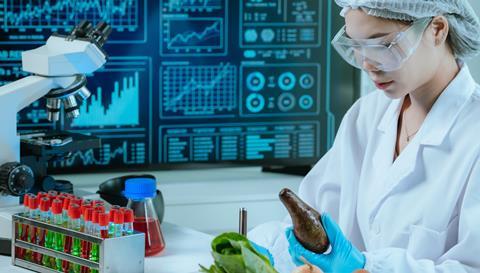
Scientists at the University of Leeds have developed an artificial intelligence process capable of rapidly identifying plant proteins that could be used as natural emulsifiers, potentially cutting years of costly trial-and-error research.
The new approach has already identified nearly 800 plant proteins from tens of millions of potential candidates. Researchers say the discovery could accelerate the development of more sustainable plant-based foods.
A faster way to find natural emulsifiers
Emulsifiers combine oil and water into stable, homogeneous mixtures and are widely used in products such as sauces, ice creams and mayonnaise.
Due to their wide usage, there is growing interest in replacing synthetic or animal-derived emulsifiers with natural alternatives that have a lower environmental impact. Animal-based emulsifiers such as milk proteins, including caseins and whey, are commonly used in many different food products.
“As we want to shift towards more sustainable, plant-based ingredients, scientists face a major challenge: There are millions of potential plant proteins but testing them all to identify the right emulsifier is expensive and involves a time-consuming trial-and-error approach. Until now, there has been no reliable way to predict which plant proteins are likely to behave as emulsifiers like animal proteins.”
Dr Simha Sridharan, Postdoctoral Researcher, the University of Leeds.
The research was led by Dr Sridharan and supervised by Professor Anwesha Sarkar at the University’s Sarkar Lab. The team worked with AI researchers at Leeds’ School of Food Science and Nutrition and Dr Rik Sarkar, a machine learning expert at the University of Edinburgh.
Combining AI with physics
The team used simulation models to examine how proteins attach themselves at the boundary between oil and water, which determines whether they can function as emulsifiers.
They then used machine learning to identify specific sections of proteins that influence this attachment behaviour. By combining machine learning with statistical physics, the researchers were able to screen huge numbers of plant proteins much faster than conventional laboratory testing.
“Emulsfiers often have a characteristic chemical structure called di-blocks,” said Dr Rik Sarkar. ”We were able to model this structure mathematically for plant proteins. Using machine learning based on features obtained from statistical physics simulations, we can predict which plant proteins are most likely to work best as natural emulsifiers.”
Potential for industry
Several commercially available proteins were tested after their model identified potential candidates. Proteins derived from peas and potatoes were very effective, matching the model’s predictions.
“The model identified nearly 800 plant proteins that could potentially act as emulsifiers, many of which had never previously been considered for this purpose,” said Professor Sarkar. ”We then tested several commercially available proteins and found the results matched the model’s predictions, with proteins from peas and potatoes proving effective. This shows how AI could help researchers find promising new ingredients much faster than before.”
Although still at an early stage, the researchers say the technology could help reduce the time and expense involved in discovering new sustainable ingredients while opening up new possibilities for plant-based products in the future.








No comments yet