




Specright has expanded its AI offering with four platform advances targeting faster formulation, stronger specification control and smarter packaging decisions.
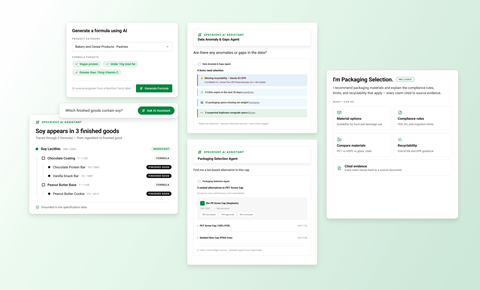
Specright has launched four AI-focused platform advances aimed at bringing artificial intelligence deeper into food formulation, specification management and packaging decisions.
The update expands the R&D Workbench for Food & Beverage, enhances the Specright AI Assistant and adds two agents designed to identify specification data gaps and rank packaging options.
The developments reflect a wider push to move AI beyond standalone applications and into the data-heavy workflows that underpin product development, compliance and sourcing.
Mike Boese, CEO of Specright, said: “This release is the clearest proof yet of what Specification Intelligence means in practice: an AI Assistant that plans and executes multi-step work, agents that catch problems before they become recalls or write-offs, and R&D Workbenches that let product developers move at the speed of AI without sacrificing the compliance rigor their business depends on.
”We are not bolting AI features onto our platform – we are building AI into the spec-first foundation itself.”
AI moves deeper into formulation workflows
At the centre of the release is the R&D Workbench for Food & Beverage, which allows teams to create or modify formulations using natural-language prompts, recreate formulas from reference products and assess ingredient substitutions.
The system also covers regulatory tasks around formulation. Specright says it can generate nutrition panels and validate nutrient content claims against requirements including those of the US Food and Drug Administration (FDA), EU Regulation 1169/2011, Health Canada and the US Department of Agriculture (USDA).
Rather than operating as a standalone formulation tool, the workbench feeds data into Specright’s wider product lifecycle management system, connecting product development with specification and manufacturing records.
Every agent we ship has to pass the same test: does it make a real decision easier without taking control away from the person who owns that decision.”
Karthik Rajagopal, Chief Product Officer at Specright
Specright says early customers reported up to 10 times faster formula creation, 50 percent time savings across non-laboratory tasks and up to a 90 percent reduction in label creation time using AI-powered templates.
The release comes as food and beverage manufacturers increasingly assess how product lifecycle management systems can handle growing volumes of product and regulatory data. Specright pointed to a recently published Gartner report on PLM software in food and beverage manufacturing, which it says puts current adoption at 32 percent and projects growth of 134 percent by 2030.
Specright first outlined the broader strategy behind the release at its Spec Summit in New Orleans in February, describing an AI layer built on structured specification data as “Specification Intelligence”.
WATCH ON-DEMAND | From ingredients to intelligence: building the data foundation for AI-driven food innovation

What does it take to turn food product data into a foundation that AI can actually use?
New Food’s on-demand webinar, sponsored by Specright, From ingredients to intelligence: building the data foundation for AI-driven food innovation, explores the practical steps food businesses can take to make their data more usable for R&D, product development and emerging AI applications.
Andy Stark, General Manager of Specright’s R&D Workbench, joins Rachel Zemser, Food Science Industry Consultant and dual-certified Food Scientist and Culinary Scientist, to discuss how structured product and specification data can support formulation, product development and wider AI adoption across food businesses.
Agents target data gaps and packaging choices
Beyond formulation, Specright is extending AI into the specification and sourcing decisions that follow product development.
The expanded Specright AI Assistant allows users to ask questions about ingredients, formulations, packaging and finished products using natural language. It can also carry out actions within the platform, including updating a specification’s status or routing it for approval.
One of the new specialist tools, the Data Anomaly and Gaps Agent, flags missing, incorrect or potentially suspicious specification data while taking account of product hierarchies, business rules and regulatory requirements.
For food manufacturers, those gaps can affect more than data quality alone. Inaccurate specification information can feed into compliance, sourcing and production decisions, increasing the value of identifying problems before they move further downstream.
The Packaging Selection Agent tackles a different part of the workflow, ranking material options against criteria including cost, performance and sustainability. It combines internal specification data with supplier catalogues and material databases, while Specright says source attribution allows users to review how recommendations were reached.
Karthik Rajagopal, Chief Product Officer at Specright, explained: “Every agent we ship has to pass the same test: does it make a real decision easier without taking control away from the person who owns that decision.
”The Data Anomaly and Gaps Agent and the Packaging Selection Agent are built exactly that way – they do the heavy lifting of finding problems and ranking options, then handing the decision back to the packaging engineer, the quality manager, or the sourcing lead.”
For more information, visit www.specright.com.

















No comments yet