




How laboratories can manage contamination, matrix effects, expanding analyte lists and regulatory change – while reducing the environmental cost of high-throughput LC–MS/MS.
Per- and polyfluoroalkyl substances (PFAS) have become one of analytical chemistry’s defining challenges. The difficulty is not simply achieving a low detection limit. Laboratories must measure very small concentrations across a chemically diverse family, prevent contamination from materials used throughout the workflow, control severe and matrix-dependent bias, distinguish target compounds from interferences, and produce results that remain defensible as regulation evolves.
The scope is formidable. The OECD’s structural definition encompasses a very broad universe of fluorinated substances, often described as numbering in the thousands. Yet most routine targeted methods quantify only a few dozen compounds. This creates a fundamental gap: a result of “non-detect” for a target list does not demonstrate the absence of all PFAS, and a low sum of regulated PFAS does not necessarily represent total organofluorine burden.
At the same time, expectations are rising. In Europe, monitoring under the recast Drinking Water Directive became applicable by 12 January 2026, with parametric values of 0.10 µg/L for the “Sum of PFAS” and 0.50 µg/L for “PFAS Total.” In the United States, the regulatory position continues to develop: EPA’s 2024 rule established limits for several PFAS, while proposals announced in 2026 retain the PFOA and PFOS limits but would modify implementation timelines and reconsider provisions for other compounds. For laboratories, the lesson is clear: methods must be technically robust, but they must also be adaptable.
PFAS performance should be judged by the reliability and resource cost of each valid reportable result – not by instrumental sensitivity alone.”
Why PFAS remain exceptionally difficult to measure
The laboratory can become part of the sample
PFAS are present in many fluoropolymer-containing components and everyday laboratory materials. Tubing, seals, solvent-line accessories, caps, filters, waterproof clothing and even some notebooks or markers can contribute background. At part-per-trillion levels, a small and intermittent laboratory contribution can look like a genuine environmental signal.
NIST describes PFAS metrology as a formidable problem because infinitesimal detection requirements meet complex samples and ubiquitous fluorinated materials. This observation reframes contamination control: it is not a preliminary housekeeping exercise but a continuous measurement process.
Good practice begins with a documented contamination map. Laboratories should evaluate every material that contacts the sample, replace avoidable PTFE-containing components, install an appropriate delay column where needed to separate system-derived background from sample peaks, and monitor laboratory air and cleaning practices. Field blanks, equipment blanks, procedural blanks and solvent blanks answer different questions and should not be treated as interchangeable. Blank trends should be reviewed over time rather than judged only batch by batch.
“PFAS” is not one analytical behaviour
Short-chain acids, long-chain sulfonates, ether PFAS, precursors and neutral species differ in polarity, adsorption, volatility, ionisation and fragmentation. A preparation that recovers long-chain compounds well may lose short-chain analytes; an effective cleanup can remove co-extractives but also sacrifice the compounds of interest. Branched and linear isomers add another reporting challenge, while bile acids and other endogenous species can interfere with transitions used for certain PFAS.
This diversity makes a universal method unrealistic. Drinking water, wastewater, soil, biosolids, food, serum and firefighting foam require different decisions about extraction, cleanup, dilution and calibration. EPA Method 1633A, for example, addresses 40 PFAS across aqueous, solid, biosolid and tissue matrices using LC–MS/MS, but its complexity is precisely a response to matrix diversity – not evidence that sample preparation can be ignored.
Matrix effects can create convincing but wrong numbers
Electrospray ionisation is vulnerable to suppression or enhancement from co-eluting matrix components. The effect can vary between samples from the same category, so a clean calibration curve in solvent does not establish trueness in a real matrix. Adsorption losses, incomplete extraction and contamination can occur simultaneously, making a seemingly acceptable recovery difficult to interpret.
Isotope-dilution strategies are therefore central. EPA Method 1633A notes that isotopically labelled analogues can compensate for losses during preparation and for matrix effects in LC–MS/MS. The strongest approach is to add extracted internal standards as early as the method permits, use the closest appropriate labelled analogue for each target, and evaluate labelled-standard recovery – not simply the final target concentration. Where no exact analogue exists, the surrogate assignment and its limitations should be documented.
Standards lag behind the chemical universe
Targeted LC–MS/MS is the routine workhorse because it offers sensitivity, selectivity and quantitative reliability. Its boundary, however, is the availability of authentic and isotopically labelled standards. Emerging PFAS, transformation products and proprietary replacements may be present before validated standards or reference materials exist.
This is why targeted analysis, high-resolution non-target screening, suspect screening and aggregate techniques should be seen as complementary. NIST’s PFAS non-target analysis interlaboratory work highlights that comparability for unknown identification is still developing. Total oxidisable precursor assays, extractable organic fluorine and adsorbable organic fluorine can help reveal fluorine not explained by the target list, but each operationally defines a different fraction and should not be described as a direct measurement of “all PFAS.”
Practical priorities for a defensible routine workflow
The first priority is to define the decision the data must support. Regulatory compliance, source tracking, treatment monitoring, food surveillance and exploratory research do not require identical analyte lists or evidence. Method scope should specify the matrix, compounds, reporting limits, isomer policy and how results below the limit of quantification are handled.
Second, laboratories should treat blanks and quality controls as diagnostic tools. A useful batch design includes method blanks, matrix spikes or appropriate matrix controls, continuing calibration checks, labelled-recovery criteria and, where relevant, duplicate samples. EPA drinking-water guidance requires stringent blank performance because background can otherwise be mistaken for sample contamination. Control charts for blank concentration, internal-standard response, retention time and ion ratio can reveal slow deterioration before a batch fails.
Third, chromatographic separation should not be sacrificed merely to shorten runtime. Co-eluting matrix components increase ion suppression and can compromise selectivity. At least two suitable MRM transitions should be used when method and analyte chemistry allow, with retention-time and ion-ratio tolerances defined in advance. Analysts should inspect integration and qualifier behaviour, especially close to the reporting limit, rather than relying exclusively on automated acceptance.
Fourth, laboratories need matrix-specific validation. Recovery, precision, selectivity, linearity, carryover, robustness and measurement uncertainty should be demonstrated at concentrations relevant to the intended decision. Proficiency testing and certified or well-characterised reference materials provide evidence that internal performance translates into interlaboratory comparability. The EURL network’s guidance and proficiency-testing activities for food and feed are particularly valuable because they expose matrix-related differences that instrument-only comparisons cannot show.
Finally, robustness must be evaluated as a long-term property. High sensitivity on a newly cleaned source is not enough for a production laboratory. Response stability, maintenance frequency, calibration drift and reinjection rates determine real sample capacity and cost. A system that produces fewer invalid runs may deliver a lower practical environmental footprint even if its headline detection limit is similar to that of another platform.
The next development: broader coverage with better evidence
PFAS analysis is moving in three connected directions. The first is expansion from legacy targets toward short-chain compounds, ether PFAS, precursors and transformation products. The second is integration of targeted quantification with high-resolution suspect and non-target workflows. The third is stronger metrology: more reference materials, harmonised reporting rules, transparent uncertainty and better interlaboratory data.
These developments will not eliminate targeted triple-quadrupole LC–MS/MS. Rather, they will make it the quantitative anchor in a tiered strategy. High-resolution MS can flag an unknown feature; structural investigation can establish confidence; an authentic standard and a validated MRM method can then move the compound into routine surveillance. The result is a living target list rather than a static panel.
The greener method is not automatically the shortest method; it is the one that delivers the required confidence with the least total consumption and rework.”
Making PFAS analysis greener without weakening it
There is an unavoidable tension in PFAS testing: the work protects the environment, yet large monitoring programmes consume organic solvents, gases, cartridges, polypropylene ware and electricity. “Green analysis” should therefore be measured across the complete result – not by solvent volume alone.
The most effective strategy follows a hierarchy. Avoid unnecessary repeats through robust sample preparation and automated quality checks. Reduce extract and injection volumes where sensitivity permits. Shorten gradients only after demonstrating resolution and matrix tolerance. Consolidate compatible analytes into a single validated method. Use smaller-volume SPE formats or online enrichment when fit for purpose. Schedule batches efficiently and use standby or ecology functions between runs. Track solvent use, waste, energy, maintenance and failed batches per reportable result.
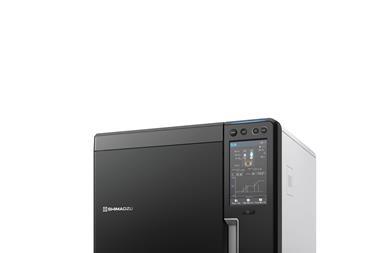
This is where modern high-sensitivity instrumentation can act as an enabler. The Shimadzu LCMS-8065XE, coupled with a Nexera UHPLC system, can support low-level PFAS quantification while allowing laboratories to investigate faster separations, smaller injection volumes or reduced sample concentration – provided each change is validated against the applicable method. Shimadzu reports that the platform maintained more than 85 percent of its initial PFAS response after 10,000 injections of treated wastewater under deliberately challenging conditions. Such stability matters environmentally because fewer cleanings, reruns and aborted batches consume fewer resources.
The instrument’s ecology mode is reported to reduce electricity consumption by approximately 31 percent by automatically shutting down an idle system, while high-throughput LC can reduce solvent, gas and electricity use per sample. These features should not be treated as substitutes for lifecycle assessment or method validation. Their value is practical: they give laboratory managers additional levers to reduce resource consumption without making sustainability compete with analytical quality.
For regulated methods, laboratories must remain within prescribed requirements. The greener method is not automatically the shortest method; it is the one that delivers the required confidence with the least total consumption and rework. A ten-minute run that frequently fails may be less sustainable than a twelve-minute method with stable chromatography and clean quality-control performance.
From detection capability to decision capability
The next phase of PFAS analysis will be defined less by who can produce the lowest instrumental detection limit and more by who can produce comparable, explainable and actionable data at scale. That requires contamination discipline, isotope dilution, matrix-specific validation, complementary screening tools, trained analysts and quality systems capable of learning from trends.
Sensitive and robust LC–MS/MS platforms such as the LCMS-8065XE fit naturally into this framework. Their role is not to solve the entire PFAS problem, but to make demanding quantitative workflows more reliable and to create room for lower-volume, higher-throughput and lower-energy operation. When instrumentation, sample preparation, quality assurance and sustainability are designed together, laboratories can move beyond detecting “forever chemicals” toward producing evidence that regulators, industry and communities can trust.