




Farm leaders urge ministers to prioritise agricultural water access as drought restrictions intensify pressure on crops, livestock and domestic supplies.
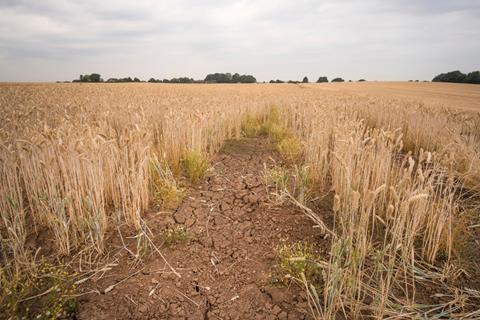
The National Farmers’ Union (NFU) has urged the UK Government to prioritise water for food production as drought hits crop yields and strains irrigation and livestock feed supplies in parts of England.
The call comes after the Environment Agency declared half of England in drought on 29 July. It reported that 78 percent of rivers were below normal levels or lower, while 1,506 abstraction licence restrictions were in force and farm reservoir storage was declining rapidly.
The NFU wants ministers to introduce more flexible abstraction licences, accelerate planning decisions for on-farm water storage and support reservoir investment through the Water Management Grant or an expanded Annual Investment Allowance.
It also wants the Government, Environment Agency and water companies to create a risk register for vulnerable business users, protecting water access for livestock, poultry and high-value horticulture where shortages could threaten animal welfare and business viability.
“This is one of the most severe droughts many farmers and growers have lived through. Harvest yields are looking poor, farmers are struggling to access water to irrigate fruit and vegetables, and livestock farmers are having to use grass they cut this spring for their stores of winter feed for cattle as there’s very little grass growing now,” said NFU President Tom Bradshaw.
“The picture is even worse when we look across Europe to many of the countries we import food from, with huge wildfires across France and Spain. While retailers are used to managing variations in global supply, we’re not going to be able to trade our way through this potential crisis.”
Pressure beyond the farm gate
The NFU’s warning comes just over a month after a Royal Agricultural University expert warned that heatwaves could reduce crop potential, damage soils and intensify risks to UK food security, calling for coordinated action from policymakers, industry and farmers to strengthen farm resilience.
Lower and less predictable farm output could leave manufacturers and retailers facing tighter raw material supplies, inconsistent quality, higher sourcing costs and greater production-planning challenges.
This is one of the most severe droughts many farmers and growers have lived through.”
NFU President Tom Bradshaw
The NFU also wants clearer local communication about water levels, abstraction restrictions, cessation notices and when supplies may become available again.
Bradshaw added: “If this summer teaches us anything, it is that we must prioritise food production. We have taken food production for granted for too long; we must create a more resilient food system to feed the 29 million households across the country, and we can’t produce food without water. This means urgent action to bolster our water security and ensuring our food security is treated as a vital part of our nation’s critical infrastructure.”
While the Government has outlined investment in nine new reservoirs, the NFU argues that immediate changes to farm-level storage, abstraction licensing and priority access during shortages are needed to protect food production.

















No comments yet