


Following a recent visit to California, Ben Cornwell explores how producers are using data, automation and AI to tackle labour pressures, protect quality and make better-informed decisions.
“When I started in this business, half of my decision making was with my eyes. Now 90 percent of my decision-making process is looking up the numbers.”
Simon Vander Woude was standing in the middle of his dairy farm when he described himself as a “data manager”. It was an apt description.
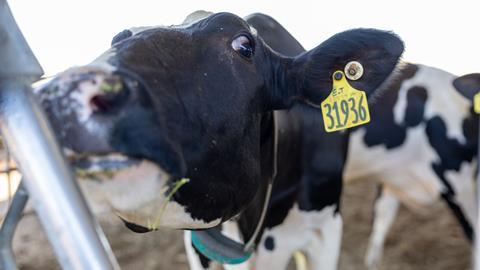
At Vander Woude Dairy in California’s Central Valley, around 3,200 milking cows are managed through a system that can identify an individual animal, record how much milk she produces and track how long milking takes. Green monitoring collars, which Vander Woude likened to a “Fitbit”, track behaviours including eating and rumination, while radio frequency identification (RFID) technology identifies each cow as she enters the milking parlour. If an animal has been flagged, an automated gate can separate her from the herd after milking.
A business built around managing thousands of animals can increasingly see what is happening one cow at a time.
It was one of the more striking examples I encountered during a week travelling through California with the U.S. Sustainability Alliance (USSA). Several of the same businesses that were finding value in side streams and resource efficiency were also making increasingly data-led decisions about how they farmed and processed food.
Over the course of the trip, the technology changed almost as quickly as the landscape. Some of it was relatively familiar, including dairy monitoring and optical sorting. Elsewhere, producers were testing AI weeders and electric tractors, while Cobram Estate had invested in a vast olive harvester worth around $1 million.
The tech price tags varied just as widely, alongside the problems producers were trying to solve.
California’s Agricultural Research & Innovation Roadmap, launched in March 2026, reflects this observation. While technology and data-driven farming feature prominently, the roadmap also treats the economics and practicalities of adoption as a research priority.
Performance in a demonstration is but one factor in determining whether a technology earns its place in a commercial operation.
When I started in this business, half of my decision making was with my eyes. Now 90 percent of my decision-making process is looking up the numbers.”
Simon Vander Woude, owner of Vander Woude Dairy
When the herd becomes data
Vander Woude offered the clearest starting point for understanding how that looks in practice. At the dairy, data extend far beyond the milking parlour.
Production, health and reproductive information can increasingly be combined for individual animals. The farm has used genomic selection since around 2012, typically drawing on genetics from 15 to 20 bulls at a time to improve milk components, health and efficiency while managing inbreeding. Embryo technology allows eggs to be collected from promising young females, to produce embryos in a laboratory before being implanted into recipient cows.
Over time, those decisions change the shape of the herd. Vander Woude said the farm now carries roughly 0.7 young replacement animals for every milking cow, compared with a historical requirement closer to one.
The wider economics of precision dairy are also emerging. Research published by the US Department of Agriculture (USDA) Economic Research Service in January 2026 found that farms using two or more classes of precision dairy technology had, on average, 13 percent higher dairy net returns than non-adopters.
Earlier in the trip, California Secretary of Food and Agriculture Karen Ross had summed up the importance of measurement: “If you can’t measure it, you can’t manage it, let alone verify it.”
A $250,000 machine chasing a $600,000 problem
If the dairy showed how data can reshape decisions, Park Farming Organics offered a more immediate calculation.
Weeds are expensive.
Owner Brian Park estimated that hand hoeing can cost around 300–700 dollars per acre. Across the business, that can turn into an annual bill of $300,000 to $600,000.
The farm already uses two electric weeders. A tractor-mounted generator produces around 24,000 volts, with an electrode system targeting weeds growing above the crop. Park is now preparing to add AI.
After testing several systems, the farm has made a down payment on an AI-enabled in-row weeder. On its first pass, the machine identifies individual crop plants and records their global positioning system (GPS) coordinates. When it returns later, that information helps it distinguish the crop from weeds, even as plants grow and the field becomes harder to read visually.
The numbers quickly bring the technology back down to earth. The machine may cost around $250,000 and needs to cover roughly 30 acres a day to keep pace with tomato planting. That could require it to operate through both day and night.
For Park, the value of the machine will ultimately depend on how much of that annual hand-hoeing cost it can realistically replace.
USDA data published in August 2026 show that labour accounted for around 40 cents of every dollar of cash expenses on US specialty-crop farms in 2024 – almost three times the average across all US farms.
There is another layer of uncertainty. Park said the business can have seven figures invested in a crop before the final paperwork confirming its destination has been completed. His final tomato contract that season was reportedly signed only around two weeks before harvest.
The machine may be able to record the position of individual tomato plants. The commercial picture surrounding them can be considerably harder to map.
What the machine misses
At Park Farming, the value of technology is measured largely in labour saved. Further along the supply chain, the value instead becomes one of speed, consistency and what gets caught before a product reaches the customer.
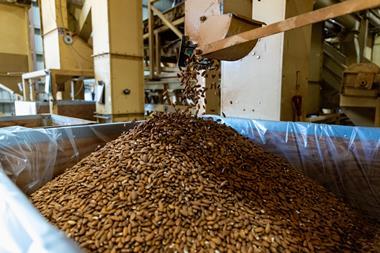
At Travaille & Phippen, almonds arrive with information identifying the grower, orchard or lot, variety and destination. Samples capture moisture, weight, quality and defects, allowing individual loads to be tracked through processing.
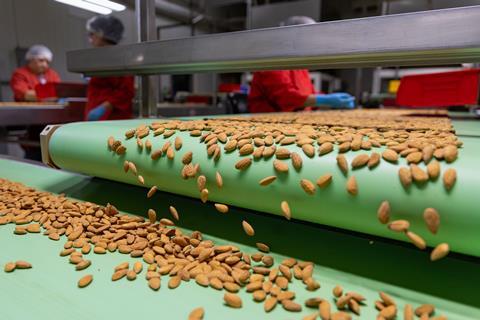
Then the cameras take over.
Electronic sorters inspect kernels at speed, and during my visit they were targeting insect-damaged almonds. Founding partner Dave Phippen linked their removal directly with aflatoxin management, helping prevent potentially affected kernels from continuing into the human-food stream.
The US Food and Drug Administration’s (FDA) current mycotoxin compliance programme identifies almonds among tree nuts susceptible to aflatoxin and potentially ochratoxin A contamination, and continues to monitor whether industry controls are preventing contaminated product reaching consumers.
At Travaille & Phippen, rejected quantities are recorded and their eventual destination tracked. During the visit, workers were also stationed further along the line, watching the almonds pass and removing anything that still failed to meet the required standard.
That detail stayed with me. The machine handled volume and repetition, but people were still there to catch what slipped through.
Technology was also monitoring the almonds before they reached the line. Loads entering temporary stockpiles were sampled for moisture, while a drone was flown over the piles roughly once a week. If excessive heat started building, that pile could be moved up the processing schedule before conditions increased the risk of mould or product loss.
At Sun Valley Rice, optical sorters similarly inspect grains from several angles and reject blemished kernels. Automated systems handle packing, coding, check-weighing, metal detection and palletising.
Yet one of the company’s most revealing uses of data was almost invisible. Rice milling consumes significant amounts of electricity, and the team said exceeding the site’s peak-demand threshold can trigger a charge of around $30,000, on top of higher energy rates. High-energy milling is therefore stopped before that expensive window and restarted later, while lower-energy packaging can continue.
Sometimes the value of better operational data is knowing when to turn something off.
When the answer is we don’t know yet
Sun Valley’s operating schedule shows what happens once the data are understood and acted on. At Terranova Ranch, Vice President and General Manager Don Cameron is still collecting some of the evidence needed to decide whether a technology deserves a permanent place at all.
The 8,000-acre operation uses automated irrigation, remote controls and sensors across a wide range of crops. Cameron’s relationship with AI is pragmatic.
“Oh, so I’m using AI. In some things,” he said. “I don’t rely on it. But I think we have to incorporate it into our farm if we’re going to be efficient.”
He pointed to irrigation scheduling and the digital tools used to coordinate workers. “The more knowledge we have, the better decisions we make.”
Terranova is applying the same principle to a six-month trial of two 130-horsepower John Deere electric tractors. The ranch is testing them across different jobs to understand how long they can run and what charging looks like in practice. Just as importantly, Cameron wants to know where electric power actually fits into a commercial farming operation.
The answers vary sharply depending on the job. Under a demanding fan-sprayer workload, Cameron said one tractor can run for around 4.5 hours per charge. On lighter herbicide work, that could stretch to 1.5 to 2 days.
When asked whether the electric tractors were around 40 percent cheaper to operate, Cameron declined to put a figure on the saving. He did not yet have enough data.
That caution makes more sense when set against Terranova’s earlier experience. Five smaller 40-horsepower electric tractors were acquired through a previous project, but the manufacturer subsequently failed. Only two are currently operating, with the remaining machines potentially useful for parts.
Charging and maintenance are only part of the calculation. Supplier longevity matters too – particularly given that earlier experience – and the machinery must still cope with the work the farm needs it to do.
Oh, so I’m using AI. In some things. I don’t rely on it. But I think we have to incorporate it into our farm if we’re going to be efficient.”
Don Cameron, Vice President and General Manager of Terranova Ranch, Inc
The $1 million harvester
At Cobram Estate, that decision has implications far beyond the machine itself.
Colossus is enormous.
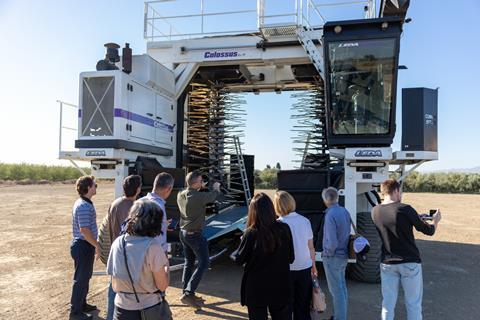
The olive harvester costs around $1 million, surrounds the tree as it moves, agitates the canopy and catches the fruit into a moving bin. Co-CEO and Chief Olive Oil Maker Leandro Ravetti said it can harvest roughly 100 trees an hour, comparing one hour of machine harvesting with around a day’s work by 2,000 people picking by hand.
That productivity has consequences far beyond the number of workers required at harvest. Orchard density and tree structure must suit the machinery, while super-high-density systems can also restrict which varieties can be grown successfully.
The machinery is therefore influencing decisions made years before the olives reach the mill.
Ravetti also linked modern mechanical harvesting and increased milling capacity with the ability to harvest greener olives and move them from tree to mill more quickly, helping preserve the freshness and quality required for extra virgin olive oil.
The people after the AI
At Cobram, technology has become influential enough to shape how the orchard itself is designed. At St. Supéry Estate Vineyards & Winery in Napa Valley, the limits of automation were easier to see.
Freshly harvested red grapes were travelling through a camera-based optical sorter that winemaker Brooke Shenk described as an AI application. Leaves, raisins and unsuitable berries could be identified and rejected at speed.
Then came the people.
During the visit, workers were positioned further along the line, watching the fruit and removing anything that had made it through the automated stage but fell short of the winery’s standards. The AI sorter handled much of the initial sorting at speed. Human inspection still followed.
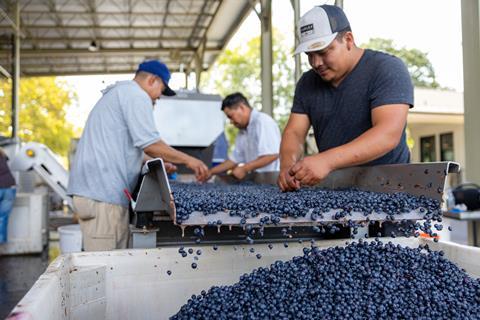
The same emphasis on judgement was evident before the grapes even reached the winery. Laboratory analysis helps inform when to harvest, but so do tasting and what the team sees in the vineyard. Weather and the practicalities of bringing the fruit in also shape the decision.
That may be the clearest thread running through the technology I saw across California. Greater capability does not remove the need for judgement. A cow can generate more data than ever before and cameras can inspect product at speed, but someone still has to decide whether the information is useful and whether the investment makes sense.
Ultimately, technology has to solve a real operational problem and justify its place in the business.






No comments yet