


The retailer has warned customers not to eat the affected Truffle Gouda after Listeria monocytogenes was identified.
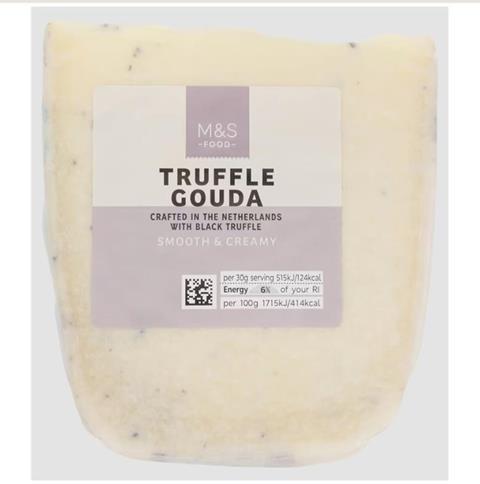
Marks & Spencer (M&S) has recalled its M&S Food Truffle Gouda in Northern Ireland “out of an abundance of caution” after identifying Listeria monocytogenes and has told customers not to eat the affected product.
The recall applies to 150g packs with product code 29424887 and a use-by date of 09 October 2026. No other M&S products are affected.
Customer safety is of paramount importance to Marks & Spencer and we take food safety extremely seriously.”
Marks & Spencer
Listeriosis can cause serious and potentially fatal infections, particularly among older adults, pregnant women, infants and immunocompromised people. Symptoms may include fever, headache, nausea, abdominal pain and diarrhoea, while infection during pregnancy carries risks including miscarriage, stillbirth, premature delivery or severe newborn infection.
The retailer has confirmed it will display point-of-sale notices in stores selling the product, explaining why it has recalled the cheese and what customers should do next.
In a statement M&S said: “Customer safety is of paramount importance to Marks & Spencer and we take food safety extremely seriously.”
They added: “We apologise to our customers for any inconvenience caused.”
Customers should return the cheese to the store where they purchased it for a full refund. For more information, contact M&S on 03330148555.
Why listeria is climbing the food safety agenda
The recall highlights growing concern over listeria controls in ready-to-eat foods across Europe.
Listeriosis cases in the EU rose from 0.40 per 100,000 inhabitants in 2010 to 0.69 per 100,000 in 2024. The disease has a case fatality rate of 15.6 per cent and accounts for approximately 32 per cent of all deaths linked to foodborne disease outbreaks in the EU.
Against that backdrop, researchers at the DTU National Food Institute last week called for a voluntary “STABILISED” label to help consumers identify ready-to-eat foods that prevent listeria growth during shelf life.
The proposed label would apply to products such as smoked salmon, gravad fish, spiced pork roll and cold cuts, giving consumers a clearer way to choose foods with a lower listeriosis risk.
At the regulatory level, manufacturers also face tougher shelf-life obligations. From 1 July 2026, stricter EU rules require manufacturers of non-stabilised ready-to-eat products to prove Listeria monocytogenes does not exceed 100 bacteria per gram throughout shelf life. Where manufacturers cannot demonstrate this, the bacterium must not be detectable in a 25g sample.









No comments yet