




The equity-free accelerator links sustainable food ventures with manufacturers, pilot facilities and investors to accelerate commercial scale-up and market adoption.
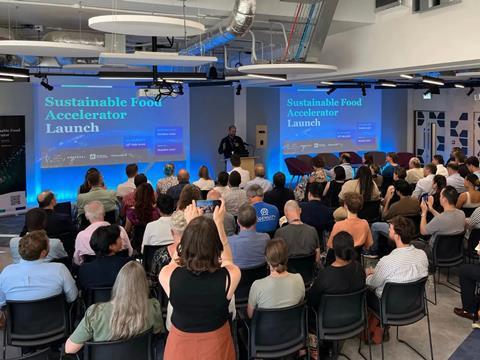
The Bezos Centre for Sustainable Protein and Imperial College London’s climate innovation hub Undaunted have launched a 12-month accelerator to help sustainable food ventures move from laboratory validation to commercial pilots and scale-up.
Cargill, Danone, Kerry and Mars will define industry challenges, identify the evidence ventures must produce and commit pilot budgets for businesses that meet agreed milestones.
The two organisations created the equity-free Sustainable Food Accelerator to tackle a persistent gap between promising food science and industrial adoption. Applications close on 21 August 2026, with the first cohort set to work from Imperial’s White City Innovation District in London.
Many of the technologies needed to transform the food system already exist in laboratories, start-ups and research teams. The challenge is helping them become scalable, investable and useful to industry.
The Sustainable Food Accelerator has been designed to close that gap.”
Professor Rodrigo Ledesma Amaro, Director of the Bezos Centre for Sustainable Protein at Imperial College London
The programme will provide selected ventures with £100,000 in equity-free funding and access to up to £2 million in potential investment, alongside technical facilities, regulatory support and opportunities to secure corporate pilots backed by committed budgets.
It primarily targets pre-Series A businesses that have validated their technologies to approximately technology readiness level 3–4, although the organisers may consider companies outside this profile where they see a strong strategic fit. Applications are open to founders worldwide.
Many emerging foodtech businesses struggle to generate the pilot-scale data, cost models, technical specifications, regulatory evidence and product performance results that manufacturers and investors require before backing commercial scale-up.
The launch reflects a wider challenge facing food biotechnology businesses as they move beyond scientific validation. Commercial scale-up can expose engineering bottlenecks that increase risk, weaken process efficiency and undermine production economics.
The accelerator will give participating companies direct corporate feedback and clearer validation targets, helping founders build the evidence needed to secure pilots and investment.
“Many of the technologies needed to transform the food system already exist in laboratories, start-ups and research teams. The challenge is helping them become scalable, investable and useful to industry,” said Professor Rodrigo Ledesma Amaro, Director of the Bezos Centre for Sustainable Protein at Imperial College London. “The Sustainable Food Accelerator has been designed to close that gap. By connecting founders with corporate demand, scale-up infrastructure, regulatory insight and investment networks, we want to help promising science become commercial reality.”
First cohort targets ingredient scale-up
The first cohort will focus on technologies that improve the economics, performance and scalability of sustainable ingredients.
Priority areas include reducing production costs at industrial scale, improving ingredient taste, texture, nutrition and functionality, converting side streams and low-carbon feedstocks into food inputs, and developing tools or infrastructure that reduce scale-up risks.
These priorities build on challenges raised at the Bezos Centre for Sustainable Protein’s 2026 conference, where industry and research leaders identified cost, taste and consumer trust as continuing barriers to wider alternative protein adoption.
The programme will also draw on collaborators from across the foodtech investment ecosystem, including Beyond Impact, Big Idea Ventures, biotope by VIB, Clay Capital, Döhler Ventures, FoodLabs, Newland Ventures, OysterBay, SOSV, Synthesis Capital and The Mills Fabrica.
Start-ups gain access to pilot facilities
Selected companies will use a network of research, development and scale-up facilities across Imperial, UCL, the University of Cambridge, Aberystwyth University, AberInnovation, the Quadram Institute and the universities of Reading and Greenwich.
The network covers discovery and strain engineering, bioprocessing, downstream processing, analytical characterisation, pilot-scale production, food applications, sensory analysis and product prototyping. Additional partners across the UK and Europe will support later-stage scale-up.
Undaunted said its accelerator model has helped green start-ups achieve an 88 percent survival rate since 2012.
Alyssa Gilbert, Director of Undaunted, Director of Innovation at Imperial Grantham Institute and Co-Director of Imperial School of Convergence Science: Sustainability, added: “Food innovation has enormous potential to reduce environmental impacts and strengthen global food security, but too many promising technologies struggle to make the journey from lab to plate.
“We encourage ambitious entrepreneurs with bold ideas to apply and join us in shaping a more sustainable, resilient and climate-friendly food system.”
For more information and to apply, visit sustainablefoodaccelerator.co.uk










No comments yet