




Specright’s Andy Stark explores how fragmented product data can increase compliance risk, slow reformulation and drain R&D capacity – and why trusted data is becoming critical to effective AI adoption.
When food compliance fails, the consequences are usually measured at the point they become visible. Product is recalled, stock is destroyed, production may be disrupted and sales disappear.
The financial exposure can be substantial. A 2025 study in the Journal of Food Protection estimated median costs of around $8.2 million per producer or processor from an overly broad recall, with lost sales and product destruction being among the largest contributors. The researchers also highlighted the potential for longer-term reputational damage and sales losses where problems recur or remain unresolved.
Yet these are largely the costs that surface only once something has gone wrong. Andy Stark, GM for R&D Workbench for Food & Beverage at Specright, argues that manufacturers can begin paying far earlier due to how product information is managed across R&D, quality and regulatory functions.
The issue also sat at the heart of a recent New Food and Specright webinar on the foundations needed to use AI effectively in food R&D. Central to that discussion was structured product data – the information behind ingredients, formulations, specifications and labels that gives AI the context needed to support meaningful decisions.
AI may make that foundation more urgent, but the underlying issue predates it. Information that is fragmented, difficult to find or cannot be trusted, diverts technical resources from higher-value work.
“I think the next thing in line would probably be the labour that goes into managing all of this and then, as a derivative of this, the trade-off of not having those resources and funds allocated to the products that you’re trying to manage,” Stark explains.
If I can allow you to run 20 experiments in the same time that someone else can run five, over time they will pretty quickly outcompete. They will learn more. They will know more.”
Andy Stark, GM for R&D Workbench for Food & Beverage at Specright
Fragmented data creates downstream risk
Food development requires formulation, regulatory, quality, labelling and manufacturing considerations to converge on the same finished product. In practice, the information connecting those functions can be surprisingly dispersed.
“They not only work with fragmented data; sometimes they work with the same data, but they have three versions, three copies of the same data point, in different formats,” admits Stark. “One keeps it in a shared drive, the other in an email, the other in a label tool. That’s unfortunately not an exceptional extreme that I’ve described. That’s still very common in today’s world .”
That fragmentation can shape how decisions are made. A food scientist may optimise a formulation around ingredient performance, taste and texture before regulatory or labelling teams establish whether claims can be substantiated, allergens are correctly declared or nutritional information meets requirements. If those constraints arrive late, development can move backwards.
The Food Standards Agency (FSA)’s 2025/26 Retail Surveillance Sampling Programme illustrates how many details must remain aligned. It found 76 percent of 621 food labels reviewed were satisfactory, while non-compliances included inaccurate nutritional information and incomplete ingredient lists, allergen declarations and mandatory warnings. Across 205 products tested for specified undeclared allergens, 88 percent were satisfactory. The FSA stresses that the targeted programme does not represent compliance across the wider market.
The weakness becomes clearest when something changes. Stark uses a supplier switch as an example. A replacement ingredient may need to be traced through every formulation that uses it before teams establish whether its composition affects allergens, claims, nutrition information, specifications or artwork.
“You swap out an ingredient supplier. In theory, you should be able to identify all the formulas that are associated and affected,” he says. “But it’s a downstream wave that hits a lot of different things.”
When compliance becomes a capacity problem
For large portfolios, seeing that downstream impact quickly can determine how proactively a manufacturer responds.
The US Food and Drug Administration’s industry tracker on petroleum-based food dyes shows major manufacturers working through portfolio-wide reformulation commitments extending through 2026 and 2027. One ingredient-level change can therefore require technical teams to identify affected products, shared formulations, label implications and where development resources should be directed first.
For Stark, this is where compliance and competitiveness begin to overlap.
“If I can allow you to run 20 experiments in the same time that someone else can run five, over time they will pretty quickly outcompete. They will learn more. They will know more.”
Food development is inherently iterative. Scientists formulate, test, learn and try again. Reducing avoidable cycles affords greater opportunity to generate useful experimental knowledge in the time available.
It can also change the role of compliance within product development. Stark says regulatory and quality teams are often positioned primarily to “protect the downside”, whereas earlier access to their knowledge can help technical teams make better-informed decisions sooner. Applying regulatory, quality and specification constraints during formulation can reduce downstream rework and avoid experiments that were never viable.
Giving AI the right job
Once workflows and data relationships are better connected, the next consideration is what technology can realistically do with them.
The webinar established good product data as the foundation for meaningful AI adoption. For Stark, the next step is identifying where AI can create practical value for food scientists.
“People don’t want AI to do music and poetry; they want it to do laundry and dishes.”
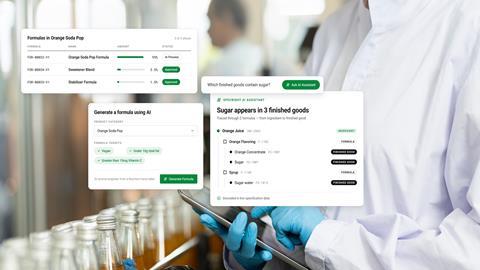
In food R&D, the equivalent might be extracting information from supplier specifications, searching ingredient databases, identifying possible substitutes or creating a credible starting point for a formulation. Removing those tasks can give scientists more time for experimentation and technical judgement.
People don’t want AI to do music and poetry; they want it to do laundry and dishes.”
Andy Stark, GM for R&D Workbench for Food & Beverage at Specright
“It’s [AI’s] not there to give me the final answer. I think AI is a great accelerator. It is a great enabler and a great support; a true assistant that can work with me across all the different things I need to do.”
That philosophy is also beginning to shape how Specright is developing its own AI tools. The company recently expanded its AI offering for food manufacturers, adding capabilities across formulation, specification management and packaging decisions. Specright says early users have reported up to 10 times faster formula creation and 50 percent time savings across non-laboratory tasks – although these figures are customer-reported.
The requirements change once an AI-generated output influences something that has to be unquestionably correct. Generative AI is probabilistic. Nutrition calculations, prescribed labelling requirements and defined regulatory rules require reproducible outcomes.
“I need a platform that produces the same result now, in a week, in a month”, Stark says. “It needs to be identical: same input, same output, every single time. Not nine out of ten, not eight out of ten, not quite right. Exactly right.”
That points towards AI-assisted interpretation and workflow automation alongside deterministic rules where precision is non-negotiable. The US National Institute of Standards and Technology’s 2024 Generative AI Risk Management Profile similarly calls for trustworthiness considerations throughout the design, development, use and evaluation of generative AI systems.
Effective adoption therefore requires manufacturers to define where AI can add value, where reproducibility is essential and where human judgement remains central.
Turning knowledge into an advantage
Even an efficient workflow can lose value if the knowledge created within it disappears with the people who generated it.
Failed prototypes, rejected ingredients and previous formulation versions all contain evidence about what worked, what did not and why. Much of that knowledge can remain with individual scientists.
As Stark puts it: “One guy called Peter leaves the company and suddenly nobody knows.”
Capturing the development journey gives that information continuing value. Scientists can see whether colleagues have already attempted something similar, while AI can draw on accumulated organisational context based on what that company has learnt.
As generic AI capabilities become more widely available, Stark believes proprietary context could become increasingly important. Established food-science knowledge may be available to different systems; each manufacturer’s history of experiments, formulation decisions and lessons learnt remains specific to that organisation.
Seen across the product lifecycle, a compliance failure can be the visible end of an information problem that has already consumed technical capacity and slowed innovation.
Better-connected data can help manufacturers control those risks while giving R&D, regulatory and quality teams more time to use information productively.