




Arla will increase financial rewards for farmers cutting emissions, adding six measures to its climate incentive programme from January 2027.
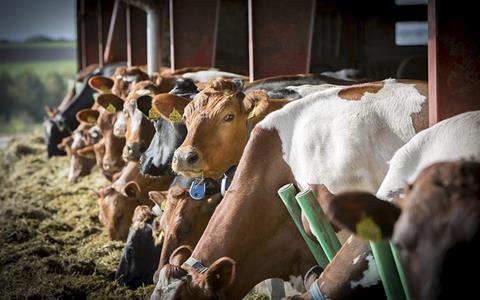
Arla Foods will increase financial rewards for farmers reducing greenhouse gas emissions, adding six new measures to its FarmAhead Incentive programme from January 2027.
The dairy cooperative plans to expand the number of available incentive points from 84 to 111 and raise their value by a third, aiming to accelerate emissions reductions across its milk supply chain.
The changes build on an existing incentive framework worth up to €550 million annually, through which Arla financially rewards farmer owners for eligible environmental practices.
Under the scheme, introduced in 2023, farmers earn points for documented actions to reduce emissions, which directly influence the price they receive for their milk. From 2027, each point will be worth 0.04 euro cents per kilogramme of milk, up from 0.03 euro cents.
Arla reports that its farmer owners have reduced absolute emissions from raw milk production by 1.2 million tonnes of CO2 equivalent since 2020.
“With FarmAhead™ Incentive, we link actions to reduce the climate impact of milk production on farm directly with the milk price paid to our farmers. That is a powerful way for a farmer-owned cooperative to drive change,” said Hanne Søndergaard, Executive Vice President, Agriculture, Sustainability and Communication at Arla Foods.
Farms differ, and so do the opportunities to take action to reduce emissions. With this update, we are giving more farmers more options to move forward in ways that fit their farms.”
Jan Toft Nørgaard, Chair of Arla Foods.
Expanding opportunities to cut emissions
The expansion introduces six additional areas for farmers to earn points: forage, manure treatment, biofuels, low-carbon fertiliser, reducing methane emissions from grazing cows and breeding.
Arla will also revise existing criteria for feed efficiency, fertiliser use, protein efficiency and grazing, drawing on updated farm data, scientific research and developments in emissions reduction technologies.
The cooperative said farmers have increased their average incentive score by six points since 2023, with its data indicating a relationship between higher scores and lower on-farm emissions.
Opportunities to reduce emissions vary between farms, depending on factors such as production systems, geography and existing practices. The revised model aims to give farmers more flexibility to adopt measures suited to their operations.
“Farms differ, and so do the opportunities to take action to reduce emissions. With this update, we are giving more farmers more options to move forward in ways that fit their farms,” said Jan Toft Nørgaard, Chair of Arla Foods.
Turning farm-level action into supply chain reductions
The expansion addresses a wider challenge for the dairy industry: encouraging farmers to adopt lower-emission practices while delivering measurable reductions across food supply chains.
Other major food businesses are also working to tackle agricultural emissions. In June 2026, Nestlé reported a 26 percent reduction in emissions across its dairy supply chain since 2018, citing measures including lower-carbon feed and improved manure management.
By linking environmental practices directly to the milk price, Arla’s model could encourage wider adoption of emissions reduction measures, although the extent to which higher payments will translate into further reductions remains to be seen.
The cooperative has also committed to reducing its absolute Scope 3 forest, land and agriculture (FLAG) emissions, covering raw milk and externally sourced whey, by 30.3 percent by 2030 against a 2020 baseline.
Meeting that target will require measurable reductions rather than simply greater uptake of environmental practices, with reliable farm-level data also helping manufacturers and retailers assess progress against their Scope 3 commitments.
Through its FarmAhead Customer Partnerships, Arla provides participating customers with farm-level carbon footprint data and opportunities to support farmer-led climate measures.
The cooperative will introduce the changes in stages throughout 2027, with the first payments under the revised programme taking effect on 1 January.












No comments yet