




AI modelling identifies 84 Salmonella resistance traits predicted to increase across China’s food chain by 2050, highlighting potential gaps in food safety surveillance programmes.
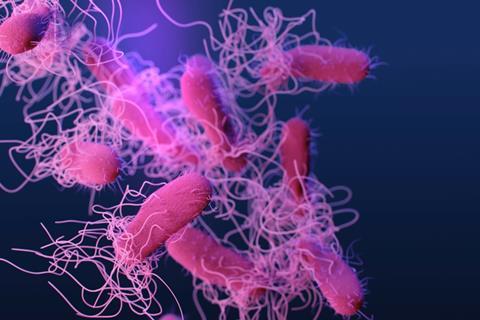
An AI-powered study has identified 84 high-risk antimicrobial resistance (AMR) traits in Salmonella that could become more prevalent across China’s food chain by 2050, including genes linked to resistance against antibiotics used to treat serious infections.
Researchers from King’s College London and the Chinese Center for Disease Control and Prevention (CDC) analysed more than 2,500 genomes of multidrug-resistant Salmonella, using machine learning to forecast how resistance patterns could change over the coming decades.
The findings, published in Nature Communications, also highlight food-processing workers as potential reservoirs of resistant bacteria, raising questions about whether current surveillance programmes adequately account for their role in the food chain.
This study shows that food workers carry a disproportionate burden of these traits, including resistance to last-resort antibiotics, underscoring the need to include occupational groups in AMR prevention.”
Professor Biao Kan, Chinese Center for Disease Control and Prevention
Food workers emerge as potential reservoirs of resistance
The researchers examined 2,536 whole-genome sequences of multidrug-resistant Salmonella enterica collected across China over 16 years. Samples came from patients, food and non-food workers, meat, livestock and farm environments.
Using bioinformatics, the team identified 421 genetic traits linked to AMR, assessing their clinical significance and potential to spread between different sources. Many were associated with mobile genetic elements, which can enable resistance genes to move between bacteria.
More than half met the researchers’ high-risk criteria, while 40 appeared across all the sources studied. These included genes associated with resistance to colistin, cephalosporins, beta-lactams and carbapenems, some of which are important treatments for serious bacterial infections.
Food-processing workers emerged as a particular concern. The study found that 95 percent of the high-risk resistance traits identified across the dataset occurred in food worker isolates, compared with 59 percent in retail meat isolates.
The difference remained statistically significant after researchers adjusted for unequal sample sizes, although its magnitude decreased.
Professor Biao Kan, co-senior author of the study at the Chinese CDC, said: “Our earlier work found they can act as hidden reservoirs for antimicrobial-resistant Salmonella.”
He added: “This study shows that food workers carry a disproportionate burden of these traits, including resistance to last-resort antibiotics, underscoring the need to include occupational groups in AMR prevention.”
The findings come amid wider concerns about resistance in foodborne pathogens. In February, the European Food Safety Authority (EFSA) and European Centre for Disease Prevention and Control (ECDC) reported persistent antimicrobial resistance in Salmonella and Campylobacter across humans, food-producing animals and meat in Europe.
However, the Chinese study does not establish that workers transmitted resistant bacteria to food. The researchers also acknowledge that differences in sampling locations and periods could have influenced comparisons between groups, with food worker samples collected exclusively from Guangxi Province.
AI forecasts emerging resistance risks
The researchers also used machine learning to investigate how resistance patterns could change by 2050, combining genomic data with 96 indicators covering antibiotic use, climate, environmental conditions, healthcare, urbanisation and socioeconomic factors.
Their models predicted increases in 84 high-risk AMR traits, with antibiotic use, population growth, healthcare spending and urbanisation among the factors most closely associated with those projections.
Predicted trends varied even between genes associated with the same antibiotic class, suggesting that interventions targeting specific resistance mechanisms could offer greater precision than broader approaches.
Professor Tania Dottorini, Professor of Artificial Intelligence for Science at King’s College London and co-senior author, said: “Understanding the relationships between AMR, the environment, climate and societal factors give us the possibility to identify where we should act and when we should act to prevent the spread of AMR.”
The forecasts concern the prevalence of individual resistance traits rather than the number of future Salmonella infections. The models also identify associations rather than establishing that individual environmental or socioeconomic factors directly cause resistance to increase.
The findings support closer consideration of occupational groups in AMR surveillance, alongside livestock, food products and production environments.
Combining whole-genome sequencing with predictive modelling could help authorities prioritise emerging resistance threats, although further research is needed to establish how resistant bacteria move through the food chain and which preventive measures would be most effective.
















No comments yet