


Aberystwyth University scientists develop biodegradable seaweed food wrapping as manufacturers seek sustainable alternatives to fossil fuel-based plastic packaging.
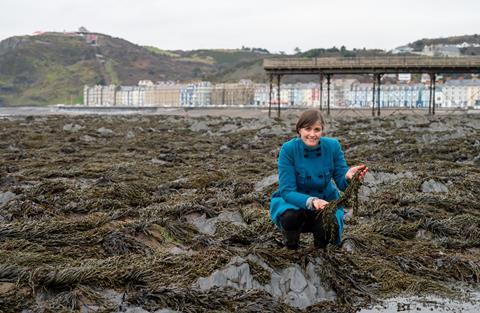
Scientists at Aberystwyth University have developed a biodegradable seaweed-based plastic for food packaging, offering manufacturers a potential alternative to conventional fossil fuel-derived wrapping films as the sector faces mounting pressure to reduce plastic waste.
Researchers at the university’s Institute of Biological, Environmental and Rural Sciences (IBERS) created the material using alginate, a seaweed extract, combined with biological compounds to improve strength and elasticity for food wrapping applications.
The team published its findings in the journal Algal Research.
Seaweed can be used to form thin, transparent plastic-like sheets that have many valuable traits, making them excellent candidates for replacing food wrapping.”
Dr Jessica Adams from IBERS at Aberystwyth University
The development could help food manufacturers reduce reliance on traditional plastic films, which accounted for almost a third of the 400 million tonnes of plastic produced globally in 2022. Plastic waste remains a major environmental concern, with an estimated 15 billion kilograms entering the marine environment every year.
Seaweed packaging gains industry momentum
The research comes as food businesses increasingly explore seaweed-derived packaging materials, following recent commercial rollouts by Notpla, which introduced seaweed-based food packaging at Imperial College London earlier this year.
The IBERS team converts seaweed extracts into powder before mixing them with water, heating the solution and casting it into moulds to create thin, transparent films. Researchers are now testing the material for durability, antibacterial performance and water resistance to assess its suitability for commercial food packaging.
Dr Jessica Adams of IBERS said: “It is good news for the planet that seaweed grown in the UK can be used to create more sustainable plastics. Seaweed has so many special and unique properties, not least because films produced from alginate are completely biodegradable, making this a completely circular product.
“Seaweed can be used to form thin, transparent plastic-like sheets that have many valuable traits, making them excellent candidates for replacing food wrapping.”
Researchers target commercial food packaging applications
The project received support from the Biotechnology and Biological Sciences Research Council (BBSRC) and food manufacturer Samworth Brothers.
Professor Anne Ferguson-Smith, Executive Chair of the BBSRC, said the research demonstrated how bioscience could help tackle environmental challenges and support the transition towards “a more sustainable circular bioeconomy”.
Researchers now hope the material could support the food industry’s shift towards more sustainable packaging solutions as demand grows for alternatives to conventional plastic films.
Luke Barnett, the PhD student who led the study, said industry demand for sustainable packaging alternatives was accelerating interest in bioplastics.
“While bioplastics have a long history, plastic packaging, including films, are now starting to shift to environmentally-friendly alternatives. These more natural sources for packaging will help reduce the effect plastic pollution is having on the environment,” he said.
“That is why myself and others are so passionate about taking this research forward to practical applications.”






No comments yet