


Unlocking the secrets of plant-based foods, Dr Kevin Nott at Oxford Instruments shows how TD-NMR helps scientists understand water and fat at a molecular level, shaping the next generation of meat and dairy alternatives.
The plant-based food boom has reshaped the priorities of food research. Yet despite rapid innovation, one challenge continues to define the category: replicating the structure of conventional foods using entirely different ingredients. Delivering the texture, juiciness and cooking behaviour consumers expect depends on understanding how water, fats and proteins interact within complex food matrices.
The scale of this transformation is substantial. The global plant-based meat market alone was valued at around $7.17 billion in 2023 and is projected to grow at nearly 20 percent annually through 2030, reflecting accelerating demand for alternative protein products. But growth alone does not guarantee consumer acceptance. Sensory attributes – particularly juiciness, tenderness and mouthfeel – remain the decisive factors shaping how consumers judge plant-based products.
In short, understanding food structure is becoming central to plant-based innovation.
Among the analytical techniques helping researchers explore these interactions is time-domain nuclear magnetic resonance (TD-NMR), a method that has supported food science for decades but is gaining renewed relevance as formulation science becomes more sophisticated.
“TD-NMR has been used in food research probably for the last 50 years,” explains Dr Nott, Senior Product Manager – TD-NMR at Oxford Instruments. “A lot of the initial work was related to more traditional foods or ingredients.”
Today, however, the questions researchers are asking of their ingredients are far more complex.

Reformulation and the expanding complexity of food design
Over the past decade, the food industry has undergone successive waves of reformulation. Early efforts centred on removing trans fats from processed foods, but more recent innovation has expanded to include plant-based proteins, alternative lipid systems and functional ingredients designed to support health and sustainability goals.
“If we go back more than a decade, when people started talking about trans fats, that was when people became more concerned about their food,” says Nott. “That in turn means that food companies need to reformulate their foods… and they start to look around for different methods to study their reformulations based on healthier or plant-based ingredients.”
These shifts have dramatically expanded the formulation landscape. Modern food products may combine multiple plant proteins, carbohydrates, fibres and fats in carefully balanced formulations designed to replicate the sensory qualities of meat or dairy.
“I think the main challenge is probably the scale of the work,” Nott notes. “This opens up a variety of different formulations using a variety of ingredients to characterise.”
Understanding these interactions requires analytical techniques that reveal how water and fat behave within complex food matrices – factors that ultimately determine texture, stability and sensory performance.
Understanding water and fat distribution requires analytical techniques that reveal how they behave within complex food matrices – factors that ultimately determine texture, stability and sensory performance.”
The hidden role of water mobility in food structure
Among the many factors shaping food structure, water behaviour is one of the most influential.
Water mobility – the way water molecules interact with proteins, carbohydrates and other components – directly influences texture, juiciness and shelf life. In plant-based meat analogues, water retention during cooking is closely linked to whether the final product feels succulent or dry.
“Water mobility relates to the whole process really – how water is either lost or retained during cooking,” Nott explains. “The water holding capacity affects the juiciness, the texture and the processing behaviour, and ultimately the consumer acceptance.”
TD-NMR relaxometry provides a powerful way to analyse these interactions by measuring the relaxation behaviour of hydrogen nuclei in water and fat molecules. Changes in relaxation times, particularly T₂ relaxation, reflect how tightly water is bound within the food matrix and how molecular mobility evolves during processing or heating.
Dr Nott notes that this is the same fundamental technology found in clinical MRI scanners. Just as a hospital scanner maps water and fat in the body to identify different tissues and structures, benchtop TD-NMR instruments also allow food scientists to differentiate water and fat on a macroscopic scale. For example, it is possible to monitor hydration fronts, or concentration gradients during phase separation, in real time.
In contrast, these relaxometry measurements allow researchers to distinguish between free water, immobilised water associated with proteins and carbohydrates, and water confined within structural networks at a microscopic scale. Each behaves differently during processing, and they play a key role in the product’s texture.
Recent studies suggest that TD-NMR measurements can help reveal how water mobility shifts within plant protein matrices during thermal processing, helping scientists correlate molecular mobility with functional properties such as cooking yield and juiciness. Similar approaches have been used to analyse water mobility in protein-fortified noodle systems and other plant-based formulations.
One of the most revealing moments to observe these changes is during cooking.

Observing structural change during cooking
Thermal processing triggers rapid structural transformations within plant-based foods. Proteins denature, fats melt, and water redistributes through the matrix.
This makes cooking a useful window into how plant-based formulations behave under real conditions.
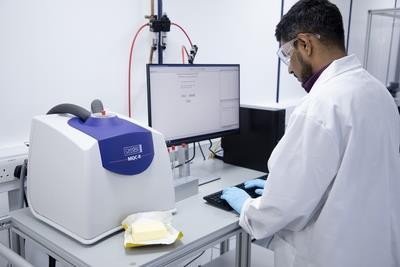
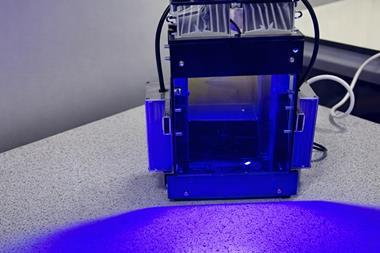
A particularly illustrative application of TD-NMR is the study of plant-based burger analogues during cooking using the MQC-R TD-NMR research system.
“Plant-based meat analogues are quite a complex material and obviously undergo a lot of changes during cooking,” says Nott. “TD-NMR measures the effects of protein denaturation as the temperature rises, fat melting and phase separation, and moisture loss and redistribution.”
A particularly illustrative application of TD-NMR is the study of plant-based burger analogues during cooking using the MQC-R TD-NMR research system. TD-NMR measures the effects of protein denaturation as the temperature rises, fat melting and phase separation, and moisture loss and redistribution.”
Using relaxometry techniques such as T₂ distribution analysis and two-dimensional T₁–T₂ correlation mapping, TD-NMR allows researchers to separate overlapping signals from water and fat within these multi-phase systems.
This provides a clearer picture of how structural components evolve during heating.
Application studies using the MQC-R system have compared plant-based burger formulations with different compositions – including formulations with varying fat and ingredient profiles – revealing how composition influences moisture redistribution and structural behaviour during cooking. The results showed clear differences in moisture redistribution and fat behaviour, illustrating how ingredient composition shapes structural dynamics and ultimately product texture.
These insights help link formulation choices directly to cooking performance, providing a clearer understanding of how ingredient composition influences final product texture.
Characterising emulsions and alternative fat systems
While water mobility is central to many plant-based formulations, the behaviour of fats and emulsified systems represents another critical dimension of food structure.
Emulsions underpin the structure of many foods, including spreads, sauces, dressings and dairy alternatives. Their physical properties are strongly influenced by droplet size distribution, which affects both texture and microbiological stability.
Traditional techniques for measuring droplet size – such as microscopy or laser diffraction – often require dilution or extensive sample preparation.
TD-NMR offers an alternative approach.
By measuring restricted diffusion of water molecules, researchers can determine droplet size distribution directly within the product matrix of a water-in-oil emulsion, for example margarine. This allows droplet size to be characterised at the desired temperature without disrupting the structure of the emulsion. Sample preparation, measurement and data analysis are fast and easy.
TD-NMR has also been used to analyse droplet size distribution in emulsions using diffusion measurements, providing a non-destructive alternative to traditional particle sizing methods.
In reformulated fat systems or plant-based emulsions, these measurements can provide valuable insight into how processing conditions influence stability and mouthfeel.
Accelerating innovation in complex food systems
As plant-based and functional foods continue to proliferate, the ability to analyse formulations rapidly is becoming increasingly important for R&D teams.
“Time-domain NMR can quicken the process by giving R&D teams unique and direct measurements of water content distribution across different environments,” Nott explains.
Because TD-NMR is non-destructive and requires minimal sample preparation, researchers can analyse the same sample repeatedly during processes such as heating or hydration. This allows scientists to observe dynamic structural changes within food systems rather than relying solely on comparisons between separate test samples.
“It’s also possible to study processes such as heating or hydration non-invasively and non-destructively, which makes the acquisition of data more efficient,” Nott adds.
As ingredient systems become more complex, the ability to monitor structural behaviour in real time provides valuable insight into how formulations behave during processing and how they can be refined.
Analytical insight for the next generation of foods
As formulation science becomes more complex, the structural behaviour of ingredients is becoming a central focus of food innovation.
Analytical techniques capable of revealing how water, fats and proteins interact within food matrices are therefore playing an increasingly important role in product development.
For researchers exploring how TD-NMR can support food formulation and product development, further information on the MQC-R TD-NMR research system and its applications in food R&D can be found here.






No comments yet