



The new tuna carton targets lower emissions, improved logistics and stronger shelf impact as brands seek alternatives to cans.
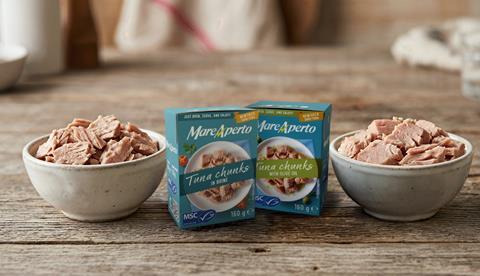
Tetra Pak has launched what it describes as the food industry’s first carton packaging for shelf-stable tuna, giving manufacturers a paper-based alternative to traditional metal cans.
Developed with Spanish seafood producer Jealsa, the Tetra Recart® format launched in Sweden last month through retailer Axfood and is now available to food producers worldwide.
This is true packaging innovation in a category that has looked the same for generations.”
Tatiana Liceti, Executive Vice President, Packaging Solutions at Tetra Pak.
The company says the new format can help tuna brands cut packaging-related emissions, improve logistics efficiency and stand out in a category that has remained largely reliant on metal cans. Tetra Recart is already used for a range of shelf-stable foods and can accommodate tuna products including spreads, flakes, shredded tuna and chunks.
The launch comes as demand for shelf-stable tuna continues to rise. According to a 2025 market assessment commissioned by Tetra Pak from Meticulous Research, the global shelf-stable tuna market is expected to reach 12.4 billion units by 2030, driven by demand for affordable, convenient and long-lasting protein products.
“This is true packaging innovation in a category that has looked the same for generations,” said Tatiana Liceti, Executive Vice President, Packaging Solutions at Tetra Pak. “With the industry’s first carton for shelf stable tuna in Tetra Recart, we are giving producers and brands a new way to stand out on shelf to protect and grow market share, support cost competitive, scalable production, and modernise with a paper-based alternative to cans, while contributing to more sustainable food systems through smarter production and distribution.”
Beyond the can
Sustainability forms a key part of Tetra Pak’s pitch to manufacturers. According to the company, Tetra Recart has an 85 percent lower carbon footprint than steel cans and an 83 percent lower footprint than glass jars. The packaging contains up to 71 percent FSC-certified paper sourced from responsibly managed forests.
The format also aims to address practical challenges across retail and distribution. Its rectangular design allows packs to sit closer together on shelves and in warehouses than round cans, while larger flat surfaces provide more space for branding and product information. Tetra Pak says the design is also suited to e-commerce and meal-kit distribution because it is easy to stack, store and transport.
Consumer research commissioned by Tetra Pak suggests appetite for alternative packaging formats. The company’s Global Shelf-stable Tuna Market Assessment Study, published in October 2025, found that more than 80 percent of consumers surveyed would buy tuna packaged in Tetra Recart, while 58 percent said they preferred it to existing tuna packaging options.
Jealsa, which partnered with Tetra Pak on the launch, plans to introduce products in the format across its own brands, including Rianxeira, Mare Aperto and Robinson Crusoe, as well as through third-party brands.
Jesús M. Alonso Escurís, President at Jealsa, said: “In Jealsa’s 68-years history in shelf-stable seafood, we have always been committed to innovation. The launch of this market-leading product sets a new benchmark for the industry. Through our collaboration with Tetra Pak, we’ve brought a game-changing packaging solution to market, combining their expertise in innovative formats with our long-standing heritage in high-quality seafood.
“Together, we are delivering a solution that responds to evolving consumer expectations. Following a successful launch in Sweden, we are already seeing strong market momentum and are confident this will continue as demand for more convenient, modern and sustainable products grows.”













No comments yet