



Food safety leaders at GFSI Vancouver say AI and advanced analytics are transforming how companies detect and prevent risks across global supply chains.
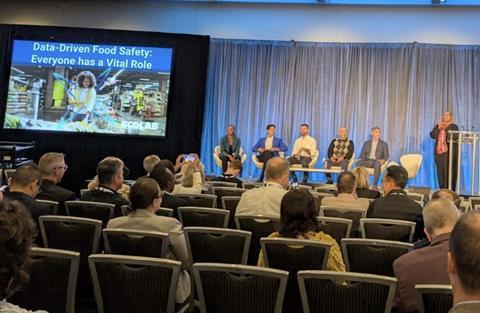
Artificial intelligence (AI) and advanced data analytics are rapidly reshaping how food companies detect and prevent safety risks, industry leaders told delegates at The Global Food Safety Initiative (GFSI) Conference in Vancouver this week.
As food supply chains grow more complex and interconnected, companies are increasingly turning to data-driven tools to analyse operational signals, identify emerging risks earlier and intervene before problems escalate.
Opening a panel discussion on data-driven food safety, Lisa Robinson, VP Global Food Safety & Public Health at Ecolab, said the scale and speed of modern food systems are exposing the limits of traditional monitoring approaches.
We heard earlier food safety is complex, so it’s never been simple, but it’s becoming even more interconnected and fast-moving.
Risk can show up earlier in different places and sometimes in ways our traditional systems weren’t built to catch.”
Lisa Robinson VP Global Food Safety & Public Health at Ecolab
For many organisations, the central challenge is turning the huge volumes of data they collect into actionable insight.
Moving beyond averages
One area where the shift is already visible is in retail operations, where companies are using AI to analyse large volumes of operational and audit data. Instead of relying on system-wide averages, organisations are increasingly using AI to pinpoint where risks are emerging.
Retailers are already applying this approach to analyse the vast amount of audit data generated across thousands of locations.
Catherine Cosby, Senior Director of Food Safety and Regulatory Compliance at The Kroger Co., said the technology is helping teams prioritise where support is needed most.
We have a little over 2,500 stores and get audited at some cadence and frequency throughout the year.
Being able to comb through that data, analyse that data and make an informed decision on which of our stores may need some additional support from a food safety standpoint or where we need to do things differently [is invaluable].”
Catherine Cosby, Senior Director of Food Safety and Regulatory Compliance at The Kroger Co.
By identifying risk hotspots earlier, companies can intervene more quickly and allocate resources more effectively.
Predictive safety on the factory floor
The same shift towards predictive risk management is also reshaping food manufacturing.
Previous reliance on fixed maintenance schedules is increasingly unnecessary as machine learning is able to anticipate equipment failures that could lead to contamination incidents.
Tola Alade-Lambo, VP Food Safety and Quality at McCain Foods, said predictive maintenance models are helping manufacturers act before problems occur.
Historically we do our [preventative maintenance] PMs based on, ‘well last year it failed at six months or two years ago it failed at seven months’.
Now we build models that will tell us that it is about to fail.”
Tola Alade-Lambo, VP Food Safety and Quality at McCain Foods
These tools can reduce the likelihood of foreign material contamination while also improving operational efficiency across production lines.
Data – changing conversations across the supply chain
Data is also changing how companies discuss food safety risks internally across complex global supply chains.
Gary van Breda, Director of Global Food Safety (Food & Packaging Suppliers) and Consumer Product Safety at McDonald’s, said visualising operational data helps align discussions across suppliers, operators and restaurants.
When you visualise the data to understand the implications and how it’s interconnected between an operator, supplier and a restaurant, for example, it’s then easier to have a conversation about parts of the business that’s a lot more meaningful.”
Gary van Breda, Director of Global Food Safety (Food & Packaging Suppliers) and Consumer Product Safety at McDonald’s
By translating large datasets into clearer insights, companies can help teams across different parts of the organisation understand how risks move through the system.
Technology still requires strategy
Speakers also cautioned that technology alone will not solve food safety challenges.
Organisations must also build the infrastructure, governance and internal alignment needed to support digital systems.
Pavlos Fragkopoulos, Global Quality Management Director at Mars Petcare, cautioned that many organisations are adopting AI tools without clearly defining the problem they are trying to solve, and as a result struggle to generate returns because they lack the infrastructure and internal support needed to scale them, referencing a recent MIT report.
The report The GenAI Divide: State of AI in Business 2025 found that despite 30–40 billion dollars in enterprise investment in generative AI, most organisations are seeing no measurable business return, while only about 5 percent of integrated AI pilots create significant value.
The discussion highlighted a broader shift taking place across the sector as companies begin using digital tools to detect risks earlier and respond faster across complex global supply chains.
Businesses are increasingly using digital tools to detect signals earlier, understand risks more clearly and make faster decisions across increasingly complex global supply chains.












No comments yet