




US regulators set out plans to accelerate Salmonella action, strengthen traceability and tighten food chemical oversight at IAFP 2026.
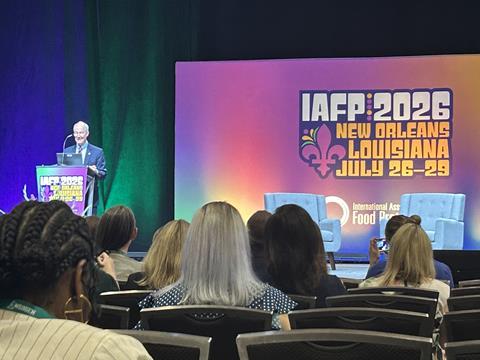
US food regulators have outlined plans to reshape Salmonella controls, overhaul traceability expectations and strengthen scrutiny of chemicals entering the food supply.
Speaking on Day 1 of the 2026 International Association for Food Protection (IAFP) Annual Meeting in New Orleans, USDA Under Secretary for Food Safety Dr Mindy Brashears detailed the proposed Salmonella SAFE strategy, while FDA Acting Deputy Commissioner for Food Dr Donald Prater set out priorities spanning traceability, GRAS reform, post-market chemical reviews, infant formula safety and predictive technologies.
Across both updates, the agencies emphasised earlier intervention, faster access to safety data and stronger evidence of process control.
USDA turns to existing Salmonella standards
At the centre of the USDA update was a proposed new approach to Salmonella control that would build on existing performance standards rather than introduce an entirely new regulatory framework.
SAFE stands for science, action, faster response and effective control. Brashears stressed that the strategy remained pre-decisional and would be subject to public meetings and comments.
Initially focused on chicken and turkey, the approach would later expand to other commodities. Poultry establishments could achieve a Salmonella “gold standard” by going beyond minimum performance requirements through measures including biomapping, continuous testing, validated critical control points, data sharing and pre-harvest controls such as vaccination.
“We don’t need a new rule right now. We have a lot of authority under salmonella performance standards and in a rule we already have. We don’t need to go through a seven-year process of rulemaking to control salmonella,” Brashears said.
That reliance on existing standards would also shape how FSIS responds to poor performance. The agency is exploring a pass-or-fail system alongside the gold standard and examining whether repeated failure to meet performance standards could demonstrate a lack of process control and support enforcement, rather than taking action solely because of an individual positive Salmonella result.
A shorter assessment period would support that faster response. FSIS is piloting a reduction in the window used for its Salmonella performance standards from 52 weeks to 13. Brashears said this could allow establishments to move out of a failing category more quickly while enabling regulators to act sooner when process-control problems persist.
The strategy follows FSIS’s withdrawal of its proposed Salmonella Framework for Raw Poultry Products in April 2025, when the agency said it would reconsider its approach and assess whether existing performance standards should be updated.
Alongside the regulatory changes, USDA is building the evidence needed to determine what effective future standards should look like. The agency is quantifying positive beef, pork, chicken and turkey samples to understand current contamination levels.
Brashears said the work could help avoid setting a future threshold so high that almost every establishment passes without delivering a meaningful public health benefit.
FDA targets traceability and chemical controls
While USDA focused on process control inside plants, FDA’s update centred on the information regulators need to identify risks and act more quickly across the wider supply chain.
Prater said ongoing Cyclospora outbreak investigations had reinforced the importance of receiving complete and timely traceback information from industry.
FDA tabletop exercises involving 15 volunteer companies found that most participants responded within 24 hours.
“Most firms responded within 24 hours, and proactive supply chain coordination, more than any particular technology, drove the strongest results,” Prater said.
The exercises also exposed continuing weaknesses. Prater acknowledged remaining challenges around certain data elements, lot-level tracking and the flexibilities businesses need to comply.
“In current outbreaks in 2026, we are still receiving paper records,” he said.
Prater said improved traceability should help FDA obtain critical information more quickly, conduct more targeted recalls and provide actionable information to consumers.
Prater said FDA had proposed extending compliance with the Food Traceability Rule to 2028. According to FDA guidance, the proposal would extend the compliance date by 30 months to 20 July 2028, with Congress directing the agency not to enforce the requirements before then.
The same emphasis on identifying risks earlier is shaping FDA’s wider chemical and ingredient safety work. Prater highlighted the agency’s new systematic post-market assessment programme, which is intended to prioritise chemicals already in use for renewed scientific review, alongside proposed reform of the generally recognised as safe (GRAS) process.
The proposed rule would make FDA notification mandatory for most substances claimed as GRAS, addressing concerns over chemicals entering the US food supply without FDA review.
In current outbreaks in 2026, we are still receiving paper records.”
FDA Acting Deputy Commissioner for Food Dr Donald Prater
That push for greater oversight is also reflected in FDA’s recent action on food colours. The agency has revoked the authorisation for Orange B and proposed removing Citrus Red No. 2 as part of its wider work on petroleum-based food colours.
Prater then turned to infant formula, where FDA is applying the same risk-based focus to contaminants and supply chain controls. He referred to testing under Operation Stork Speed and the agency’s call for manufacturers to strengthen ingredient and supplier oversight following investigations into infant botulism outbreaks.
Technology is increasingly supporting that move towards more proactive oversight. FDA is using WILEE, an advanced AI engine for signal detection and knowledge discovery, in its chemical safety work. The system can review more than 30 million text articles for post-market surveillance of food ingredients, additives, food colours, food contact substances, dietary supplements and chemical contaminants.
The agency has also completed a three-phase pilot involving artificial intelligence and machine learning for imported seafood. FDA is using the findings to determine how best to integrate the models into predictive systems that target cargo inspections and support the deployment of inspectors.
“It’s all about the data now. It’s about the data sources. It’s about how we evaluate those data sources and be able to use them to see if they have reliable outputs that can help us,” Prater said.
He said FDA scientists, inspectors and reviewers were still examining the outputs, meaning the agency retained a “human in the loop” at this stage of the technology’s use.
Taken together, the updates showed both agencies moving towards earlier intervention, using existing powers more assertively and demanding stronger evidence from industry.




Topics
- Automation, AI & digital manufacturing
- Contaminants & residues
- Enforcement, policy & governance
- Flavours, colours & sensory
- Food and Drug Administration (FDA)
- Food safety & integrity
- Pathogens & microbiology
- Recalls & incident response
- Regulation, labelling & compliance
- Traceability, transparency & compliance
- U.S. Department of Agriculture (USDA)











No comments yet