


Food fraud rarely reveals itself willingly. The Food Authenticity Network examines what three years of monitoring can tell us about a problem that remains notoriously difficult to measure.
Food fraud is inherently difficult to measure. Unlike many food safety incidents, fraud is deliberately concealed, definitions and reporting practices vary between countries, and a substantial proportion of incidents may never appear in official statistics.
For that reason, since 2023 we at the Food Authenticity Network (FAN) have been developing a systematic approach to monitoring global food fraud reports. Our aim is not simply to count incidents, but to build a more robust and representative picture of what reported data can tell us about changing food fraud risks.
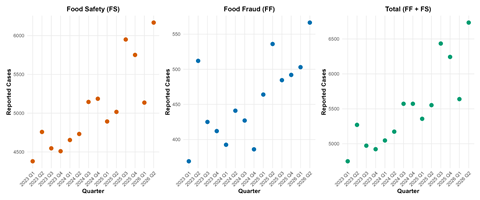
Our latest analysis provides stronger evidence that reports of global food fraud are increasing. The Q2 2026 Global Food Fraud Report shows that the upward trend in reported food fraud incidents observed between 2023 and 2025 has continued into 2026. Reports of both food fraud and food safety incidents have now reached their highest levels since we began this analysis in January 2023.
Our aim is not simply to count incidents, but to build a more robust and representative picture of what reported data can tell us about changing food fraud risks.”
From an emerging signal to a clearer trend
In our 2025 annual report, analysis of regulatory food fraud reports from January 2023 to December 2025 provided evidence of an emerging upward trend. At that stage, however, we concluded that further data were needed before determining whether the increase represented a consistent and continuing trend.
The additional data collected during the first half of 2026 have strengthened that evidence, as Figures 1–3 show. Linear regression of global food fraud regulatory reports continues to identify a statistically significant positive trend, with p=0.003. In addition, a statistically significant positive trend is evident for food safety regulatory reports, with p=0.0003.
Building robustness through multiple data sources
A key feature of FAN’s approach is that we do not rely on a single food fraud database. We collaborate with the providers of three leading commercial tools for collating food fraud incidents: the FoodChain ID Food Fraud Database, HorizonScan and Safety HUD. Bringing together these sources provides a broader and more representative view of reported global food fraud than any one dataset could offer alone.
However, these systems are not identical. They differ in purpose, data sources, collection methods, classification and curation. Simply pooling their data could therefore produce misleading results.
We therefore carefully assessed the comparability of the datasets. Following our initial analysis in 2023, we determined that regulatory data from HorizonScan and Safety HUD could be compared and combined, so we average their results. We present FoodChain ID data, which include regulatory, media and peer-reviewed sources, separately in our annual reports. We also agreed a common set of commodity group definitions for HorizonScan and Safety HUD to ensure consistent comparisons between equivalent categories. We review these definitions every quarter and update them as required.
This harmonisation is an important element of the methodology. Without it, differences in terminology or classification between databases could easily be mistaken for changes in the underlying pattern of food fraud.
What are the latest data telling us?
During Q2 2026, our analysis identified an average of 567 official food fraud reports, compared with 6,168 food safety reports. The number of official food fraud reports therefore remained relatively low, at around 10 percent of the number of food safety reports.
As Figure 4 shows, the commodities associated with the highest numbers of official food fraud reports during the quarter were processed foods (108 reports), beverages (66 reports), and fruit, vegetables and legumes (52 reports).
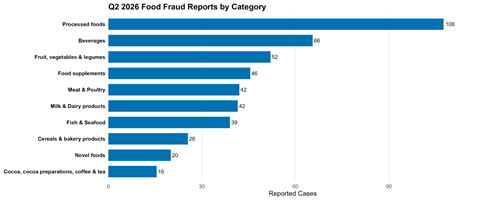
These rankings nevertheless require careful interpretation. The foods appearing most frequently in regulatory reports should not necessarily be interpreted as those most affected by fraud. Reported incidents reflect a combination of underlying fraud and regulatory activity. Sampling programmes, targeted enforcement campaigns, regulatory priorities, international operations and available resources can all influence how many incidents authorities detect and report. This distinction is fundamental to interpreting food fraud intelligence responsibly.
Making the evidence accessible
Transparency and continued scrutiny are also important parts of FAN’s approach. We publish our annual Global Food Fraud Reports on the Food Authenticity Network website, where they are freely available. This allows the wider food community to examine the findings and track how the evidence develops over time. The 2025 report is the third annual report produced through this FAN Partner project.
In addition, we also produce quarterly Global Food Fraud dashboards for FAN Gold and Platinum funding partners, providing more frequent intelligence on emerging changes in regulatory reporting and commodity patterns. These dashboards give funding partners earlier and more regular insight into developing trends, while supporting FAN’s wider open-access work.
One significant limitation remains in the global evidence base: relatively few regulatory food fraud reports are publicly available compared with food safety reports. If regulatory authorities made more food fraud data openly accessible, we could better understand the scale of the problem and how it is evolving.
FAN’s monitoring of global official reports demonstrates the value of collaboration: drawing on expert-curated sources, harmonising classifications, keeping datasets that are not directly comparable separate, monitoring reports consistently over time and applying statistical analysis to emerging patterns.
To reflect the growing number of tools that monitor and collate reports or suspicions of food fraud, and identify trends, FAN has created a new Incident Trends page. It brings together commonly used tools, giving members a convenient starting point for accessing intelligence on food fraud incidents and trends. FAN membership is free and gives food professionals access to this resource, alongside global news, events and information on food authenticity and fraud prevention (see below for details on how to join).
Key takeaway
The key message is that the upward trend in both food fraud and food safety reports is continuing as more data become available.
By making much of this intelligence openly accessible, while providing in-depth quarterly analysis to funding partners, FAN is helping industry and regulators better understand and respond to evolving food fraud risks.
About the authors
Selvarani Elahi, Merry Rivas, Gary Bird, John Points and Katie Piper are from the Food Authenticity Network at LGC. Massimo Frera is from Mérieux NutriSciences, Jordina Farrus Gubern is from Fera Science Ltd, and Karen Everstine is from FoodChain ID.
About FAN
The Food Authenticity Network (www.foodauthenticity.global) is an open-access global resource for food authenticity testing, food fraud prevention and supply chain assurance. Membership is free and provides access to trusted information, news, events, resources and the FAN Monthly Summary. Organisations that want to support and help shape FAN’s work, while gaining access to additional intelligence, including quarterly Global Food Fraud dashboards, can become funding partners. For further information, contact Secretary@foodauthenticity.global.
Join using this link or the QR code.
Acknowledgements
We are grateful to Fera Science Ltd (HorizonScan) and Mérieux NutriSciences (Safety HUD) for participating in this project on a pro bono basis.
We are also grateful to our partners (McCormick & Company, LGC Standards (Dr Ehrenstorfer and LGC Axio), the Food Industry Intelligence Network, the Institute of Food Science & Technology, SSAFE, BRCGS (LGC Assure), iComplai, Food Law Latest and Purity IQ) for funding this work.
FAN’s Global Food Fraud Reports are produced by the Executive Team of the Food Authenticity Network (LGC Ltd) in collaboration with HorizonScan (Fera Science Ltd), Safety HUD (Mérieux NutriSciences) and the Food Fraud Database (FoodChain ID). Although the reports are produced with all reasonable care and skill, they are provided without liability for their application or use. The research was commissioned using funding from the above-named FAN partners. The views expressed reflect the research findings and the authors’ interpretation; they do not necessarily reflect the opinions of LGC Ltd, Fera Science Ltd, Mérieux NutriSciences, FoodChain ID or any FAN partner organisation. No responsibility can be taken for the use made of this information.






No comments yet