



The recent outbreaks of salmonella poisoning have yet to confirm an origin, but they have served to highlight a system vulnerability. Chris Elliott unravels the complex journeys eggs take into the UK food service sector and suggests important measures for improvement.
Salmonella and eggs. For those who have worked in food safety for many years, the appearance of these two words in the same sentence has an uncomfortable familiarity. Britain had good reason to believe that it had largely brought this particular threat under control. Yet the present outbreak of Salmonella Enteritidis – potentially linked to imported eggs used in cafés, restaurants and takeaway businesses – shows that progress in one part of the food system does not protect consumers when other parts operate to very different standards.
As of 25 August, the UK Health Security Agency (UKHSA) had confirmed 259 cases and one death in the principal outbreak cluster. Two additional, genetically distinct clusters were also under investigation, each within the wider S. Enteritidis family and all potentially associated with imported eggs. Wider reporting subsequently put the total across the clusters at 474 cases. The investigations continue and, while frustrating, it’s important not to point the finger of blame at a particular country or supplier before the evidence gathered fully supports that conclusion. However, what is already evident is a systemic vulnerability in terms of salmonella.
When I look at the data, the current episode is far from an isolated problem. In England, laboratory reports of non-typhoidal Salmonella increased from 8,185 in 2015 to 10,388 in 2024. This is the highest figure of the decade and an increase of almost 27 percent. The 2024 figures were over 17 percent higher than 2023. S. Enteritidis, the type most strongly associated with eggs, rose by 16.8 percent in that single year to 3,166 reports, with cases remaining at around the same elevated level in 2025. It is fair to assume that the true number of cases is likely to be around 32,000, as less than one in three cases have samples submitted for testing.
The dip in cases for 2020 and 2021 was likely a reflection of the exceptional conditions of the pandemic, thus should not obscure the longer-term and worrying direction of travel. The public health burden is considerable and growing. The reason for rising case numbers is still based more on conjecture than hard evidence but the increased imports of poultry meat and eggs, alongside growing amounts of illegal meat, must be significant factors.
The British Egg Industry Council, which I totally agree with, argues that imports should meet standards demonstrably equivalent to those imposed on British producers.”
Finding the source of the outbreaks is forensic work
Modern testing capabilities such as whole-genome sequencing gives the UKHSA a remarkably precise way to identify patients infected by closely related strains. They can reveal clusters of cases that would previously have remained difficult if not impossible to identify. But while genome sequencing informs investigators that cases are connected, it cannot reveal what the patients ate to cause their illness; and if it was from infected eggs, where it was produced and where along the supply chain the contamination occurred.
For this, investigators must interview patients. Many in the current outbreaks have attempted to reconstruct meals eaten days or even weeks earlier, to identify common venues and then work backwards through invoices, wholesalers, distributors, packing centres and farms. Our memories are far from perfect in terms of what we have eaten, especially when eggs could have been one ingredient of many in mayonnaise, hollandaise, mousse, batter, pastry, desserts or a breakfast eaten outside the home.
A single restaurant may buy shell eggs and liquid egg from several different wholesalers. A wholesaler may consolidate consignments from several packers and a packing or processing operation may handle eggs from multiple farms or countries. Liquid egg is a pool of many individual eggs, while packaging and vital batch information may no longer be present at the point of service. Records may exist but in incompatible digital systems, or still in many cases on paper where descriptions around source can be vague. A catering invoice might identify ‘medium or large eggs’ without making their source readily apparent. Furthermore, brokers and intermediaries will often sit between the producer and the final business customer making the supply chain even more opaque.
A further complicating factor is that stocks of the contaminated food may also have been fully consumed or discarded by the time a cluster is detected, leaving no samples available to test. If supply-chain data crosses borders, investigators must coordinate with overseas businesses and competent authorities operating under different languages, systems and timescales and with differing degrees of collaboration. This is why epidemiological evidence can point strongly towards imported eggs while the definitive source or sources remain as yet unidentified.
Yet far from evidence of agency failure, it is evidence that our traceability systems are too often designed to satisfy a financial transaction rather than support a rapid public-health investigation. I believe if the incidents had occurred in retail products as opposed to food service the origins of the problem would now be known. The traceability capabilities, particularly of larger retailers in my opinion, are far superior to the vast array of food service providers who lack the technical resources and knowledge required to have robust systems in place.
Why are we importing so many eggs?
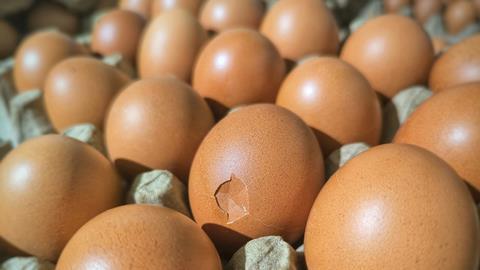
The UK produces most of the eggs it consumes and domestic production increased by by nearly 5 percent in 2024. Nevertheless, demand has risen and imports are increasingly filling the gaps, particularly in food service and food manufacturing rather than supermarket shell-egg aisles. According to British Lion Eggs, despite national production of well over 12 billion eggs per year we are increasing imports to around 2 billion each year.
Why is this? Price is one of the major factors. Imported eggs and egg products can be cheaper, especially where producers operate with lower labour, housing, welfare or regulatory costs. Food-service businesses, public-sector caterers and manufacturers work under intense cost pressure, and the provenance visible to shoppers on the cartons of eggs we purchase is far less visible on a sandwich, cake wrapper or restaurant meal. Imports also provide volume, continuity and flexible supplies when domestic production is disrupted; and while we might think local supplies should be increased, it’s not that simple.
A new laying unit requires substantial capital, planning consent, grid and water connections, environmental approvals and confidence that a market will exist throughout the investment’s life. Producers have faced volatile feed and energy costs, higher interest rates, labour constraints, avian-influenza risk and the expense of moving towards cage-free and higher-welfare systems. Poorly balanced contracts can leave farmers carrying increases in input costs while having little power over the price received. Defra’s consultation on contractual fairness exposed producers’ concerns about certainty, transparency and how risks and rewards are shared.
The UK egg industry’s argument is therefore straightforward: Britain needs more home-produced eggs, but farmers will invest only if retailers, manufacturers, food-service companies and government provide long-term confidence. That means sustainable farmgate returns, fair contracts, workable planning, access to finance and a level playing field. The British Egg Industry Council, which I totally agree with, argues that imports should meet standards demonstrably equivalent to those imposed on British producers. Its concerns are not only commercial. Some imported eggs originate from production systems that would not be legal in the UK and food-safety assurance, vaccination and audit requirements are not uniform across supplying countries. It is deeply frustrating that as a country we set very high standards for our own farmers and food manufacturers but are willing to turn a blind eye to the lower standards of many types of imported food – not only eggs.
British production has earned its safety reputation
It would be profoundly wrong for this outbreak to undermine confidence in all eggs. There is currently no evidence that UK-produced eggs are involved. While I’m sometimes seen as a critical friend to the UK agri-food industry and will point out issues that I do see, it would be wrong of me not to highlight the transformation I have witnessed from the British egg industry. Following the salmonella crisis of the late 1980s, the industry introduced the British Lion Code in 1998. Vaccination of laying hens against S. Enteritidis became central, supported by controls extending from breeder and pullet flocks to feed, farms, packing centres and transport. The scheme includes hygiene and biosecurity plans, pest control, cleaning and disinfection, environmental and flock testing, traceability, date marking, staff training, independent auditing and controls on feed. More than 90 percent of UK eggs are now produced under the Lion scheme.
The results of the radical rethink on effectively tackling salmonella were striking. Human cases fell sharply after the programme began and an assessment credited vaccination with reducing cases by more than half. By 2012, salmonella of public-health significance was reported in only 0.07 percent of UK laying flocks. The evidence was sufficiently strong for the UK Food Standards Agency (FSA) to change its advice in 2017, allowing vulnerable groups, subject to specific medical exceptions, to eat raw or lightly cooked British Lion eggs or eggs from an equivalent recognised scheme.
Biosecurity has continued to evolve, driven not only by salmonella but the increasing risks associated with avian influenza. Controlled access, dedicated clothing and footwear, vehicle and equipment hygiene, rodent and wild-bird control, secure feed and water, flock monitoring and documented veterinary health plans are now fundamental components of assured production.
I would urge the FSA to urgently convert its detailed evidence base into a one-page, multilingual ‘Egg Safety in Food Service’ factsheet.”
Interestingly, the FSA published a detailed scientific profile of the risks associated with imported eggs in 2024. Identifying Salmonella Enteritidis as the most frequently reported hazard, it highlighted vaccination, biosecurity, testing, traceability and independently auditable records as essential controls. However, this document was produced to inform government market-access and import-assurance decisions, explicitly stating that it was not a risk assessment or public-health guidance for food businesses.
Although existing food-safety, hygiene and traceability legislation can be enforced where businesses fail to control risks, the current outbreaks demonstrate the need to translate this extensive scientific evidence into clear, accessible and actionable information for every café, restaurant, takeaway, school, hospital and care-home kitchen. I would urge the FSA to urgently convert its detailed evidence base into a one-page, multilingual ‘Egg Safety in Food Service’ factsheet and distribute it directly through local authorities, procurement bodies, wholesalers and hospitality associations.
What must change now?
I believe five steps should be taken to better protect UK consumers and our indigenous egg sector. First, government should require imported shell eggs and egg products to meet demonstrably equivalent food-safety requirements, including effective Salmonella-control programmes, vaccination where appropriate, independent audit and transparent surveillance data. This should be verified through risk-based audits and targeted testing, not accepting merely tick-box paperwork. In the growing world of remote audits, this could be achieved in a highly cost-effective and robust manner.
Second, I firmly believe traceability in our food service sector must be transformed. Every case, pallet and batch should carry standardised digital information identifying country of lay, farm or approved establishment, packing or processing site and assurance status. Regulators need rapid access to information during an incident. The goal should be traceability within hours – not weeks of one-to-one interviews, telephone calls and invoice searches.
My third call is for sector procurement to lead the way. Schools, hospitals, care homes and government catering should specify British Lion Eggs or demonstrably equivalent assured eggs, including eggs used as ingredients. Vulnerable people should not receive a lower level of assurance simply because they eat outside the home and in places where they have little or no choice or voice.
My fourth step is about making the origin of major ingredients in foods much more transparent, especially eggs. This does not require menus to list all this information for every dish, but I think catering staff should know and be able to tell customers whether raw or lightly cooked eggs on the menu are from the UK and covered by a recognised assurance scheme.
Finally, our government and the supply chain must create the conditions for domestic investment: fairer and longer-term contracts, proportionate planning decisions, support for modern biosecure housing and a clear market commitment to British production. Imports will always remain part of a resilient food system, but they should complement strong domestic capacity rather than displace it through differences in standards and cost. International trade cannot stop but the safety of what we eat depends on controls that are equivalent, visible and verifiable.
Britain has proved that coordinated vaccination, biosecurity, surveillance and assurance can be achieved; we should not allow complex, opaque supply chains and short-term purchasing decisions to unravel that achievement, undermine public confidence and most importantly, put consumers at risk.









No comments yet