

Brazilian researchers have developed a porous, starch-based cryogel sensor that uses cobalt chloride to provide an instant visual signal of moisture ingress in food packaging.
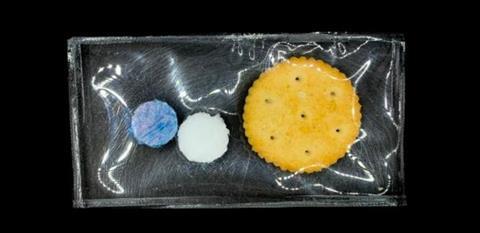
Brazilian researchers have developed a biodegradable, starch-based sensor that changes colour when moisture enters food packaging, potentially giving consumers a simple way to monitor the freshness and crispness of products.
The device uses cobalt chloride to change colour from blue to pink as moisture levels rise. The visual indicator can be monitored with the naked eye or through a mobile phone screen, removing the need for specialist equipment.
The research was led by scientists at the São Carlos Institute of Chemistry at the University of São Paulo (IQSC-USP) and was supported by Brazil’s São Paulo Research Foundation (FAPESP).
Testing food freshness
Researchers initially tested the sensor using cream crackers, which are particularly sensitive to moisture and can quickly lose their crispness when stored in unsuitable conditions.
The experiments found that changes in the sensor’s colour corresponded with increasing moisture levels and were strongly linked to the loss of texture in the crackers. The results suggest the device could provide a visual indication of changes in storage conditions.
The small starch-based cylinder can change between different shades of blue and pink within seconds. When the cobalt chloride is dry it appears blue, while hydration causes it to turn pink as water vapour enters the material.
The colour change occurs because cobalt chloride undergoes hydration in the presence of water, altering its chemical structure and producing a visible change.
What set this study apart was having a larger surface area for the sensor, making it highly sensitive and allowing us to observe different humidity conditions inside the packaging. If I place it in a very dry environment, it responds. Conversely, if I place it in a very humid environment, it also responds.”
Bianca Maniglia, Professor, IQSC-USP
Toxicity remains a challenge
The researchers say further development is needed before the technology can be used commercially. In particular, cobalt chloride presents safety concerns.
The team is investigating alternative materials including natural compounds derived from fruit such as jabuticaba peel, which contain pigments that respond to changes in pH.
“These natural pigments are sensitive to pH variations, exhibiting colour changes that can be used as visual indicators, in addition to possessing antioxidant activity,” says Maniglia. ”In this case, the goal is to develop a system that can monitor the spoilage process of meat, for example. Incorporating these natural compounds is also important because it helps add value to them.”






No comments yet