





Modern food chains must shift focus from quality and sustainability to agility and resilience; supply chain experts from Wageningen University & Research explain why data sharing is the way to go.
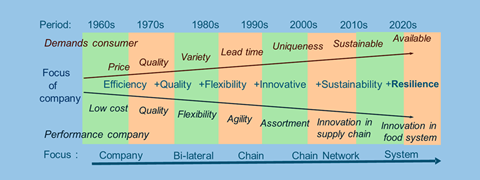
Global food supply chains are facing growing volatility, uncertainty and complexity, driven by geopolitical tensions and trade disruptions, climate volatility, faster shifting demand patterns, labour and workforce disruptions, and pressures for transparency and sustainability. As a result, food chains must move beyond a focus on efficiency, food quality and sustainability; they must also become transparent, agile and resilient to shocks and change (Figure 1). Furthermore, looking at single companies or supply chains is no longer enough; the complex interdependencies between all relevant stakeholders require a network- or even food-system approach.
Trusted and timely exchange of data has become a critical enabler of this transformation, accelerated by rapid technological advances such as IoT, blockchain, data spaces, AI and digital twins. This article examines how data sharing enables resilient food supply chains by enhancing transparency, early warning, aligned decision making and rapid response to disruptions across the entire food system.
Building resilient food chains
Disturbances in food supply chains can have significant consequences for the economy as well as for local and global food availability, as shown by the COVID-19 pandemic and recent conflict-driven trade barriers. A key challenge is building resilient food supply chains that can anticipate, absorb, adapt to and recover from shocks while continuing to deliver adequate and safe food. Generically this is done by leveraging three strategies:
1. Creating adaptive capacity: being able to change sourcing, products, routes or practices; using flexible contracts and governance arrangements; diversifying suppliers, regions, crops, inputs and logistics routes; and strengthening adaptive human capacity through skills, knowledge and organisational capacity to manage change.
2. Building redundancy and buffer capacity: maintaining strategic stocks (not easy for perishable products!); having spare processing, transport and labour capacity; balancing efficient and responsive/resilient processes; and considering postponement strategies (delaying final configuration or packaging) via product modularisation.
3. Improving decision making via increased transparency and visibility: building trust-based collaboration with supply chain partners; sharing real-time data on production, inventories, prices and logistics; having traceability, early-warning and monitoring systems; and establishing long-term relationships with joint contingency planning and shared capacity agreements.
Data-sharing approaches to support resilience
Trusted, timely data exchange plays a pivotal role in strengthening these resilience capabilities. Four data-sharing approaches can be identified (Figure 2):
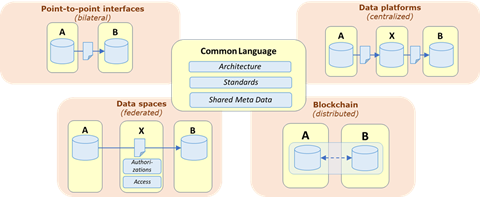
1. Bilateral data sharing via point-to-point interfaces directly connects two systems without intermediaries, using technologies such as electronic data interchanges (EDIs) and application programming interfaces (APIs). While cost-efficient and flexible, these quickly become complex and difficult to manage when the number of partners increases (spaghetti architecture). Bilateral interfaces also lack end‑to‑end visibility, offering only one‑step‑forward, one‑step‑backward traceability.
2. Centralised data sharing via platforms stores data from multiple supply chain partners in a single, often cloud-based database. Platforms enable real‑time, end‑to‑end visibility and traceability and act as a single source of truth. However, they can also become a single point of failure and create strong dependence on the platform owner.
3. Distributed data sharing via Blockchain enables multiple supply-chain actors to collaboratively manage data without a central database. Information is stored and synchronised across multiple nodes, such as servers, databases or devices. Blockchain records transactions as encrypted, time‑stamped, immutable blocks validated by consensus. Smart contracts automate actions and tokens enable secure transfer of value, rights or access. Its key strength is secure, trusted data sharing, though distributed systems can be technically complex and less efficient.
4. Federated data sharing via data spaces allows participants to keep control over their data, which remains stored in their systems until shared upon request through agreed data standards and governance rules. This approach enables secure, interoperable data access and collaboration without requiring central storage, supporting trust, scalability and compliance with data privacy regulations.
An important prerequisite of all approaches is the interoperability of information systems supported by aligned architectures, information standards and shared meta data.
Developments in blockchain and data spaces
Today, in food supply chains, the most common approaches are bilateral and centralised data sharing. Distributed blockchains were heavily hyped around 2018 and often promoted as a solution to almost every problem. Since then, blockchain has faced considerable criticism. While many projects failed to meet expectations, other applications have continued to mature, although with less visibility. These cases appear to use blockchain where it adds real value, focusing on key data in areas where trust, fraud prevention and efficient approval processes matter most. Examples include automated compliance checks, verification of sustainability and authenticity claims, smart commodity contracts, digital micro‑finance for smallholder farmers, tracking of returnable trade items and the provision of tamper-proof food‑safety evidence.
Although data spaces are still at a relatively early stage of development, they are widely regarded as one of the most promising advances for enabling data-driven food chains.”
Federated data spaces have emerged in response to the dominance of large data platforms and the associated risks of data lock-in and loss of control.3 They are designed to support data sovereignty, making them particularly suitable for food chains, where sensitive data must be shared responsibly among multiple stakeholders. Although data spaces are still at a relatively early stage of development, they are widely regarded as one of the most promising advances for enabling data-driven food chains. For example, in Europe, data space development is fostered by the EU Data Strategy and supported by laws such as the Data Governance Act and the Data Act. Common European data spaces are being developed for various domains to enable secure and trustworthy data sharing within Europe. For agrifood data this is realised through the Common European Agricultural Data Space (CEADS) with use cases such as sharing farm machinery data, verifiable data for biofuels, and climate, nutrition and traceability data for digital wine product passports.
Challenges of data sharing to establish resilient food supply chains
Two recent studies investigated actual supply chain-management responses used by companies in the food supply chain to strengthen resilience during the COVID-19 pandemic.4,5 They identified many resilience levers to proactively anticipate, absorb, and adapt to disruptions, while also highlighting specific challenges related to data sharing.
A key strategy used was to accelerate information exchange and planning cycles within and between organisations. Some multinationals established international ‘control towers’ to consolidate cross-functional data streams. Others used consolidated market intelligence from industry associations to deal with absent firm-level data systems. Also, more flexible forecasting systems were introduced, capable of being overridden in rapidly changing conditions. However, digital data systems for disruption management were notably absent even in large multinationals.
Another strategy was to proactively request key suppliers to share advance information on operational changes that could lead to disruptions, enabling downstream firms to build precautionary inventory during the critical window. However, there was a lack of formalised data-sharing obligations within supplier contracts and digitalising the underlying information flows, resulting in low reliability and scalability of this practice. Also, for data sharing to strengthen resilience, the channels, protocols and IT systems enabling rapid information exchange must be established and tested well before a crisis materialises.
These studies indicate a lack of sector-wide adoption of integrated, real-time data sharing. Supply chain visibility beyond the immediate tier remains underdeveloped, limiting early warning capability. Investment in shared data infrastructure that extends visibility across supply chain tiers is therefore a precondition for effective early warning. This should be supported by regulatory harmonisation as current fragmentation in the EU limits the potential of cross-border data and supply chain rerouting during disruptions. This also holds for data standards, reporting obligations and privacy frameworks across Member States. This calls for an urgent operationalisation of the European Food Security Crisis Preparedness and Response Mechanism adopted by the European Commission in November 2021, as it provides a policy anchor for institutionalising data sharing and strengthens monitoring and early warning systems to support preparedness.
Recommendations for implementing data sharing
Data sharing is essential for food-chain resilience, yet there is no single best solution for its implementation. Decision makers in food supply chains should look beyond the hypes and doom stories and critically assess options based on their specific context. The following five recommendations provide practical guidance:
- Adopt a business‑oriented, user‑driven approach that avoids technology dominance, approaches data sharing as a means to create value and resilience, and involves end users from the very beginning.
- Address key non‑technical barriers to data sharing by building trust, creating clear win‑win business cases and establishing strong data governance with robust ethical and legal frameworks, complemented by stringent privacy and security measures.
- Establish a strong data foundation across your organisation and supply chain by ensuring high‑quality source data, interoperability of information systems and harmonised data management.
- Embrace an integrated, holistic digital perspective by embedding data sharing within a clear digital vision, strategy and robust digital architecture. Ensure alignment with related digital technologies, such as IoT, AI and digital twins, so data sharing becomes a seamless part of the broader digital ecosystem.
- Approach the implementation as a human‑centred change process by assessing and strengthening digital readiness, fostering a strong digital mindset, addressing resistance and developing the required skills and competencies, both within the company and across the food chain.
Acknowledgements
This research is supported by the Food Data Quest project (fooddataquest.eu), funded by the European Union under Grant Agreement no: 101134138.
References
1. Van der Vorst J GAJ. (2011). Toekomstverkenning transities tot 2040 voor de topsectoren: AgroFood en Tuinbouw vanuit logistiek perspectief, In opdracht van de Raden voor de Leefomgeving en Infrastructuur, 19 pgs, https://share.google/FcNxAqC6WxCqVDrtZ.
2. Verdouw C (2025). Data landscape and opportunities. In: Data and AI in the Agrifood Sector, FoodDataQuest Stakeholder Meeting, 3 Oct 2025, Chania, Greece, https://edepot.wur.nl/708614.
3. Wolfert S, Verdouw C, Piot-Lepetit I. (2026). How data and the digital technologies are shaping the data economy for agrifood systems. Digital Technologies for Sustainable Agriculture and Food Systems (pp. 43-68). Academic Press, https://doi.org/10.1016/B978-0-443-33508-2.00009-8.
4. Akkerman R, Haijema R, Kunz M, et al. (2024), Supply chain resilience capabilities in European food supply chains: the impact of COVID-19 in The Netherlands. In: de Leeuw, S., Akkerman, R., Romero-Silva, R. (eds.). Frontiers in Agri-Food Supply Chains: Frameworks and Case Studies, Burleigh Dodds Science Publishing, Chapter 11.
5. Pauls-Worm KGJ, Romero Silva R, de Leeuw SLJM. (2026), Lessons learned on disruption preparedness in essential supply chains, Paper presented at the VLW conference, March 26-27 2026.










No comments yet