


New research links US–Israel–Iran war disruption in Strait of Hormuz to rising fertiliser costs, food inflation and worsening global food insecurity.
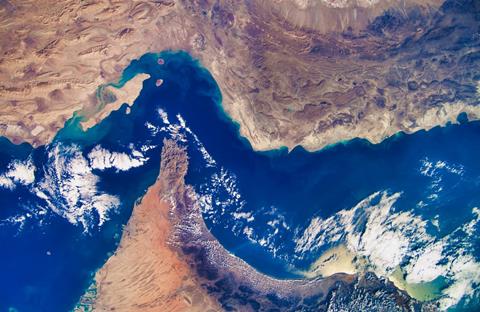
A conflict involving the United States, Israel and Iran is threatening global food security by disrupting energy and fertiliser trade through the Strait of Hormuz, according to research published in Global Food Security.
Researchers from the University of Sharjah say the war, which erupted on 28 February, has driven energy prices higher and triggered cascading shocks across global food systems. Although a fragile ceasefire has temporarily halted hostilities, tensions remain following Iran’s move to impede trade and oil shipments through the Strait of Hormuz and the subsequent US blockade of Iranian ports.
Disruption to the strategic waterway – one of the world’s most important energy corridors – is already pushing up fertiliser prices, maritime insurance premiums and food processing costs, worsening food insecurity in vulnerable regions. Researchers say the knock-on effects could push tens of millions of people deeper into poverty and hunger, particularly across the Middle East and Africa.
The Strait of Hormuz is also a critical route for agricultural inputs, with 20–30 percent of the world’s fertiliser exports passing through the waterway, making disruptions particularly significant for global food production.
The researchers warn that geopolitical conflict in the Arabian Gulf has implications for global food security far beyond the immediate theatre of hostilities. The Strait of Hormuz – which carries about 20 percent of global petroleum and one-fifth of liquefied natural gas trade each day – acts as a major chokepoint linking energy markets directly to food production costs.
Shockwaves across the food chain
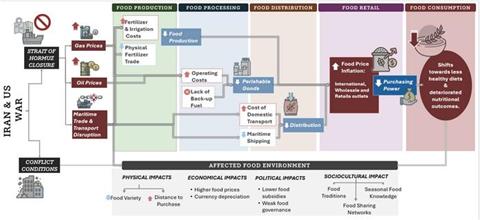
Energy market disruptions can ripple across the entire food supply chain – from fertiliser production and farm inputs to food processing, refrigeration and retail prices.
When that channel is disrupted, the shockwaves don’t stay in the Gulf.
They ripple through every stage of getting food from farm to table.”
Farah Naja, professor of nutritional epidemiology at the University of Sharjah and the study’s lead author
The study identifies the Middle East and North Africa (MENA) as particularly exposed, with East Africa also highly vulnerable. Both regions already face chronic food insecurity and depend heavily on imported food and agricultural inputs.
The researchers add that no country is truly insulated from cascading shocks created by energy and fertiliser disruptions.
Fertiliser disruption pushes food costs higher
Energy markets and fertiliser production are closely linked. Modern agriculture depends heavily on fertilisers derived from natural gas, and modern farming requires roughly 10 fossil fuel calories to produce a single food calorie.
When a war cuts off oil and gas, food gets more expensive almost immediately.
The Strait of Hormuz is a food chokepoint, not just an energy chokepoint. Between 20–30 percent of the world’s fertiliser exports pass through it.
Since the conflict began, urea prices have already risen around 36 percent above pre-war levels, and the FAO estimates roughly 3–4 million tonnes of fertiliser trade per month have stalled.”
Farah Naja, professor of nutritional epidemiology at the University of Sharjah
Higher fertiliser and energy costs increase agricultural production expenses while raising the cost of food manufacturing, refrigeration and global transport – putting further pressure on food supply chains.
Diet quality also under pressure
Beyond food availability, rising prices can reshape diets and worsen long-term health outcomes.
When household budgets shrink, families stop buying fruits, vegetables, and proteins first.
They shift toward cheaper, ultra-processed, calorie-dense options.
This quietly worsens long-term health even when people aren’t visibly starving.”
Mohamad Alameddine, a co-author and professor of health management and policy
He added that children and pregnant women face the greatest risks. Nutritional deficits during the first 1,000 days of life can cause irreversible cognitive and developmental damage and impose economic costs of 2–3 percent of GDP in affected countries.
Lessons from past crises
The researchers compare the conflict with previous global shocks – including the 2007–08 food price crisis, the COVID–19 pandemic and the Russia–Ukraine war – which also destabilised global food systems.
International organisations including the FAO, IEA, IFPRI, WFP and the World Bank are monitoring the conflict’s implications for food and energy markets. Fertiliser producer Yara International has also warned that the war could disrupt fertiliser supplies and worsen food insecurity.
Call for coordinated global action
The researchers argue that governments already have the policy tools needed to limit the impact of the crisis if action is taken early.
Katia Hazim, a research assistant and co-author, warned that institutional inaction would hit the world’s most food-insecure populations hardest and stressed the need for stronger multilateral food security governance.
The study proposes interventions at household, national and international levels to stabilise food systems and reduce vulnerability to price shocks. Energy- and fertiliser-driven shocks affect virtually every stage of the food system simultaneously, the authors note, amplifying both the speed and scale at which food insecurity spreads.
History keeps teaching the same lesson, and we keep forgetting it.
Reactive responses to food crises are always costlier than proactive ones.
The countries that invested in strategic grain reserves and social protection systems before COVID-19 fared significantly better.
The same logic applies now.”
Farah Naja, professor of nutritional epidemiology at the University of Sharjah











No comments yet