



International research team combines AI, satellite connectivity and extended reality to improve vineyard irrigation efficiency and crop traceability.
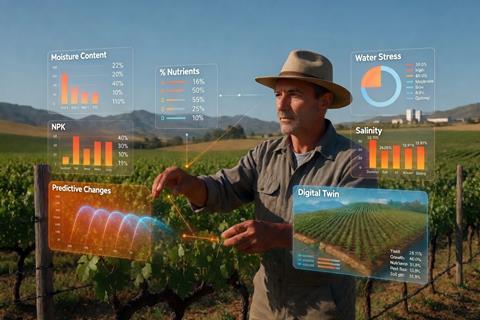
An international research team has developed an AI-powered digital twin system for vineyards that enables growers to simulate irrigation and fertiliser decisions before applying them in the field, helping reduce water use and improve crop traceability.
Developed by researchers at the Public University of Navarra and the Tecnológico de Monterrey, the system combines real-time IoT sensor data, extended reality tools and Low Earth Orbit (LEO) satellite connectivity. The technology was first deployed in Spain in March 2026 and is now being adapted for use in Querétaro, Mexico.
Researchers say the approach could significantly reduce water consumption and improve agricultural resilience as producers face increasing pressure from climate change and water scarcity.
Technology must be introduced following technical-economic criteria and social acceptance.
It is not about replacing traditional field knowledge, but about providing it with predictive tools that make it more sustainable and resilient in the face of climate change.”
Dr. Francisco Falcone, director of the Institute for Smart Cities and distinguished visiting professor in telecommunications at the School of Engineering and Sciences of Tecnológico de Monterrey
The platform creates a virtual replica of the crop and land using sensors that monitor soil moisture, temperature and nitrogen, phosphorus and potassium (NPK) levels in real time. Machine learning algorithms process the data to create “cognitive regions” capable of predicting water stress, anomalies and other risks before they occur.
Unlike conventional farm management systems that primarily collect and display data, the technology allows growers to interact directly with the virtual vineyard and test operational changes digitally before implementing them physically.
From vineyard monitoring to full supply chain traceability
The project also incorporates augmented reality tools that allow operators to receive remote technical support or view pest diagnostics hands-free while carrying out vineyard tasks such as pruning and maintenance.
Researchers say one of the most commercially significant aspects is the platform’s end-to-end traceability capability. The digital twin continuously records data across the supply chain, including harvesting, silo storage, processing and distribution, helping reduce spoilage, support food safety compliance and provide buyers with verifiable transparency.
The inclusion of LEO satellite networks also addresses connectivity challenges in remote agricultural areas where mobile coverage is unreliable, enabling continuous IoT monitoring and real-time predictive alerts.
Dr. Falcone said the technology has been designed to remain scalable and accessible through compatibility with low-cost devices and simplified communication systems, making it suitable for both cooperatives and large-scale producers.
Although initially validated in vineyards, the researchers believe the platform could also be adapted for other large-scale crops and urban farming operations.









No comments yet