

A new study has demonstrated that solid-state fermentation using oyster mushroom mycelium can significantly improve the nutritional value and sensory profile of okara, potentially upcycling tonnes of soy industry waste into higher-value food ingredients.
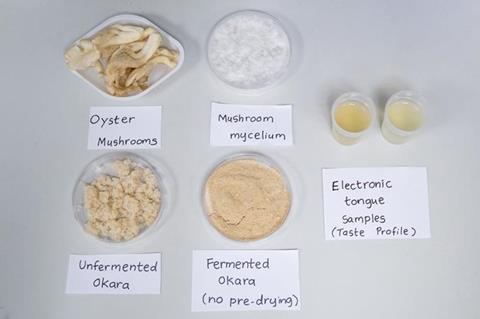
Scientists at Nanyang Technological University, Singapore (NTU Singapore) have developed a fermentation method that could transform okara, a nutrient-rich by-product of tofu and soymilk production, into a more palatable and protein-rich food ingredient.
The laboratory-scale study used oyster mushroom mycelium to ferment okara, improving its nutritional profile while reducing its sour taste and increasing compounds associated with umami flavour.
Turning a difficult by-product into food
Okara is produced when soybeans are processed to make foods such as tofu and soymilk. Although it contains protein, fibre and other nutrients, its high moisture content means it spoils quickly.
Its coarse texture, high levels of insoluble fibre and relatively sour flavour also limit its use in food products and these characteristics have contributed to most of the material being thrown away.
The NTU team, working with Japanese food manufacturer Ichimasa Kamaboko, investigated whether solid-state fermentation could overcome some of these limitations.
The process involves growing microorganisms directly on a moist solid material. In this study, researchers used oyster mushroom mycelium, the fine network that alloes the fungi grow.
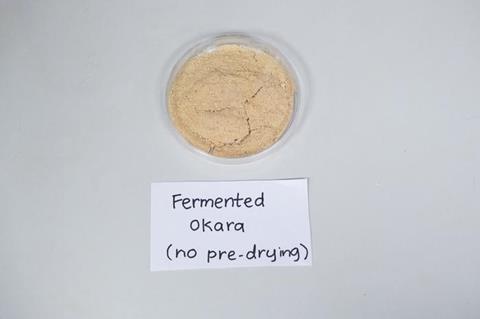
Fresh okara supported dense fungal growth, with the mycelium covering the material during an 11-day laboratory incubation. As it grew, the fungus produced enzymes that broke down complex plant fibres into simpler compounds.
The researchers also found that fermentation increased the nitrogen content of the okara, an indicator of protein levels. Protein content reached between 27.7 and 30.2 percent of dry weight in the fermented material.
Glucose concentrations also increased between 2.8 and 6.4 times as fungal enzymes converted complex carbohydrates into simpler sugars.
“Our findings show that oyster mushroom mycelium can naturally improve okara by changing its composition and producing compounds that give it a savoury, umami taste,” said Professor William Chen, Director of NTU’s Food Science and Technology Programme. ”In addition, a separate study by my team also showed that oyster mushrooms grown on a substrate containing okara have enhanced nutritional value. Together, these findings create an opportunity to make better use of both okara and mushrooms as sustainable food sources in the future.”
As this study was conducted at laboratory scale, further work will be needed to assess food safety, regulatory requirements, production costs and whether the process could be scaled up for commercial use.
UPCOMING WEBINAR | Human safety assessment for novel foods: De-risking the path from concept to compliance

Bringing new food ingredients from concept to market requires robust evidence around safety, testing and regulatory compliance.
Join our upcoming webinar on 8 October 2026 at 3pm BST to explore how tiered safety assessment strategies can help developers identify risks earlier, strengthen regulatory submissions and de-risk the route to market.
Changing the taste
To measure changes in taste, the researchers used an electronic tongue fitted with chemical sensors capable of objectively assessing different taste characteristics.
The fermented okara showed reduced sourness alongside stronger umami and greater overall taste richness. The material contained between 2.2 and 6.6 times more free amino acids than unfermented okara.
Glutamic acid and aspartic acid, which contribute to umami flavour, increased by up to 4.1 times. Fresh okara produced the highest concentrations among the materials tested.
Fermentation also increased 5′-nucleotides, natural compounds that can enhance umami, by between 3.2 and 6.3 times. Succinic acid increased by up to 14.9 times in some formulations while citric acid generally decreased.
Some samples did develop increased bitterness and dryness, highlighting the need to optimise the process.
From laboratory to food production
The researchers say the approach could help turn an underused industrial by-product into a higher-value ingredient while supporting more circular food production.
Rather than treating okara solely as a waste stream, our research demonstrates that mushroom fermentation can create new, high value opportunities to use this soybean by-product in food applications, contributing to a more circular and sustainable food system.”
Dr Malsha Samarasiri, Research Fellow, NTU’s School of CCEB
However, the technique remains at proof-of-concept stage and team plans to investigate energy requirements, food safety, storage stability and aroma profiles while conducting human sensory testing and assessing the economic feasibility of commercial-scale production in the future.








No comments yet