


The €4 million centre will test precision fermentation and cell cultivation processes before food firms commit to industrial-scale production plans.
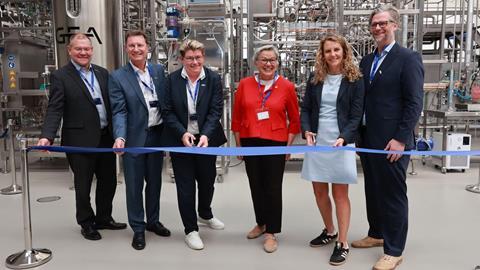
GEA has consolidated its €4 million Application and Technology Centre for New Food and Biotechnology in Sarstedt, Germany, as food, ingredients and biotech companies work to prove that fermentation and cell cultivation processes can scale commercially.
The centre, relocated from Hildesheim to an existing building at GEA’s Sarstedt site in Lower Saxony, supports pilot-scale production work for precision fermentation, cell cultivation and other biomanufacturing applications. It has operated since 2023, with three years of customer projects now feeding into its work in Sarstedt.
The centre addresses a critical question for precision fermentation and cell cultivation companies: whether a lab result can become a reliable, food-grade and economically viable process before major capital is committed.
New Food and biotechnology need places where you can find out whether a promising process can actually become a viable industrial application. In Sarstedt, we bring pilot infrastructure and engineering expertise under one roof. That gives our customers a stronger basis for their next decision.”
Klaus Stojentin, CEO of GEA’s Nutrition Plant Engineering Division
Testing commercial viability
GEA connects bioreactors from 50 to 500 litres with media preparation, separation, filtration, hygienic process design and automation. That setup allows customers to test consistency, product quality and process economics before moving to contract manufacturing or full industrial plant design.
“New Food and biotechnology need places where you can find out whether a promising process can actually become a viable industrial application,” said Klaus Stojentin, CEO of GEA’s Nutrition Plant Engineering Division. “In Sarstedt, we bring pilot infrastructure and engineering expertise under one roof. That gives our customers a stronger basis for their next decision.”
GEA invested €4 million to convert and equip the Sarstedt building, where it has developed process expertise in beverages, liquid dairy and New Food over several decades. Around 200 people already work at the site in engineering, sales, automation and service, with the ATC adding about 40 colleagues.
“A good lab result creates interest. A solid process creates confidence. And sometimes the most valuable outcome of a test run is a clear no – because a process isn’t stable enough yet, or the cost structure simply doesn’t hold up. Learning that early can save a company a lot of time and capital,” said Frederieke Reiners, Vice President New Food & Biotech, GEA
Beyond alternative proteins
Although precision fermentation and cell cultivation often attract attention through alternative proteins, GEA is positioning the centre across a wider biotechnology market. Potential applications include proteins, enzymes, amino acids, vitamins, flavours and functional ingredients for food, feed and healthcare.
The move comes as New Food companies continue to navigate slower-than-expected commercialisation, with financing, regulation, production costs and scale-up all affecting market entry. GEA said the aim is not to replace conventional food production or agriculture, but to create additional production routes where climate risks, animal health pressures, raw material shortages or fragile supply chains create pressure.
Heike Brennecke, mayor of the city of Sarstedt, added: “This this new technology centre strengthens Sarstedt as a place for engineering, technology and skilled jobs. It sends a clear signal that biotechnology is being developed here and put to work.”
The opening also brought together European scale-up partners including the Biotechnology Fermentation Factory in Ede, Netherlands, and Solar Foods in Finland, which is producing its fermentation-based protein Solein at industrial demonstration scale.



No comments yet