

The human instinct to draw decisive conclusions in moments of pressure can have deadly consequences in food safety, if evidence has not been verified. Darin Detwiler demonstrates what a small-town misunderstanding reveals about leadership, decision making and the hidden risks of certainty in global food safety systems.
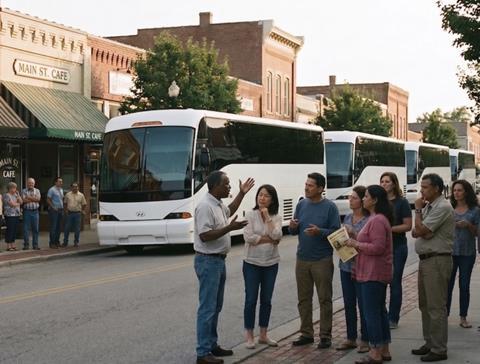
By late afternoon, this town had already lived a full day.
The streets of Old Town had been closed early that morning for a 5K run. Families lined the sidewalks. Runners passed in steady rhythm. There was the kind of shared energy that makes a place feel connected, if only for a few hours.
By noon, that energy had shifted.
A scheduled political rally gathered at the head of Main Street. Signs rose. Voices carried. Some came to support, others came to observe and a few came ready to argue. Most simply tried to move through their day as usual, navigating around it.
Nothing about the day felt unusual. Not yet.
Then, a few hours later, came a simple question that changed everything.:
“Did anyone else see four identical coach buses parked just off Main Street?”
It was an ordinary question.
It did not stay that way.
Within minutes, the answers began to form. Not from knowledge, but from assumption.
“They were bused in.”
“Paid protesters.”
“Not from here.”
People were no longer asking what was happening. They were explaining it.
The comments multiplied. Each one more certain than the last. Certainty spread quickly. Faster than any effort to understand.
No one asked if anyone had spoken to the people on the buses.
No one paused to consider another explanation.
No one said, “we don’t know yet.”
Certainty arrived before curiosity ever had the chance.”
Certainty arrived before curiosity ever had the chance.
And with it, something else arrived.
Tone shifted.
The same neighbours who had cheered runners that morning were now questioning each other’s motives by the evening. The word ‘local’ started to carry weight and lines formed that had not existed just hours earlier.
It was not the buses that divided them.
It was what people chose to believe about them.
This is how it begins. Not with conflict, but with interpretation. Not with evidence, but with urgency to explain.
And once that explanation takes hold, it rarely loosens its grip.
In other settings, moments like this do not stay contained – they escalate. Decisions follow assumptions. Actions follow decisions. And by the time questions are finally asked, the consequences are already in motion.
Hours passed before a different kind of voice entered the thread.
Calm. Unhurried. Almost easy to miss.
Someone had walked over. Asked a question. Waited for an answer.
The passengers, they wrote, were a high school choir from out of state. Students and chaperones. They were in town for a music festival at a nearby school.
That was it.
No conspiracy. No payments. No hidden agenda.
Just young people, travelling together, carrying sheet music instead of signs.
The truth was simple. Almost quiet.
And that was the problem.
It did not spread the way the earlier assumptions had, with the same urgency.
It did not satisfy the same need.
It did not move with the same urgency.
A few acknowledged it. Briefly. Quietly.
Others ignored it.
Many adjusted their original claims just enough to preserve them.
The buses left that evening.
What remained did not.
No one apologised. or corrected the record. The story simply hardened.
The damaging pattern had played out completely.
A moment of uncertainty had been filled, not with questions, but with suspicion. And once shared, that suspicion did what it has always done.
It reshaped reality.
There were no monsters on Main Street.
Only people, certain they had found them.
And somewhere in that certainty sits a deeper risk. Because this moment, as small as it seems, is not isolated. It is not unique to one town, one country, or one platform.
It is a human tendency – and it repeats.
Once shared, suspicion rarely needs evidence to survive.”
The pattern we keep repeating
What unfolded on Main Street is not confined to social media or small towns. The same pattern can be observed within organisations, across industries, and throughout global food systems. These are the moments when pressure builds and the instinct to explain overtakes the discipline to understand. In food safety, such moments are far from abstract, as they carry significant consequences. Early assumptions about a contamination source can take hold before verification is complete. Processes may be blamed prematurely, and narratives begin to form before evidence is fully established, shaping decisions, directing resources, and consuming valuable time. By the time the truth emerges, it is often too late to prevent harm.
Across borders and supply chains, and within complex, multi-country investigations (where traceability must move faster than contamination) the same dynamic plays out. Early certainty travels quickly, while corrections move slowly. Once a narrative takes hold, even strong contrary evidence can struggle to displace it. This is not a failure of intelligence or expertise, but of discipline. And importantly, it is one that can be addressed. Across the global food industry, there are growing examples of organisations strengthening traceability systems, improving data transparency, and reinforcing decision-making processes that prioritise evidence over assumption. The pattern may be familiar, but it is not unchangeable.
The leadership standard
The most dangerous moment in food safety is not when we don’t know, but when we believe we do. Under pressure, speed can feel like leadership. It feels decisive, responsive, and necessary. But in moments of uncertainty, the first answer is rarely the right one; it is simply the fastest. When speed is not matched with discipline, it introduces risk rather than reducing it.
Information in food safety must be treated with the same rigour as any critical control point; it must be verified, cross-checked, and, when necessary, challenged. Acting quickly may feel effective in the moment, but acting accurately is what ultimately protects people and sustains trust. Leadership in this space is not really about being first to answer. It is about being responsible for the answer.
Encouragingly, many leaders across the food industry are already demonstrating this standard. They are building systems that allow teams to pause, validate, and align before acting. They are reinforcing that urgency does not excuse inaccuracy, and that disciplined decision-making is not a delay - but a safeguard. In doing so, they are showing that strong leadership is not defined by speed alone, but by the ability to balance urgency with responsibility.
The culture that prevents harm
The people in that town were not reckless; they merely wanted answers, clarity, and a way to make sense of what they were experiencing. That same instinct exists in every organisation. The responsibility of leadership is not to eliminate that instinct, but to shape how it is expressed.
Strong food safety cultures are built intentionally on discipline and trust. Leadership should create environments where it is safe to say, “we don’t know yet,” and where questions are valued more than quick conclusions. In these cultures, curiosity is not treated as hesitation - it is recognised as a form of protection. Over time, what leaders tolerate becomes what systems reinforce. If assumptions go unchallenged, they become embedded. If inquiry is encouraged, it becomes standard practice.
There is meaningful progress in this area. Many organisations are investing in training, strengthening internal communication, and embedding food safety into their core values rather than treating it as a compliance exercise. These efforts are shaping cultures where teams are more likely to pause, question, and verify. And in doing so, they are not slowing the system down…they are making it more resilient.
What leaders must choose
Every leader will face this moment. Uncertainty emerges, pressure builds, and people look for answers. In that moment, there is a choice: allow certainty without evidence to take hold, or insist on discipline in the pursuit of truth. One path feels faster. The other prevents harm.
The pattern seen on Main Street will happen again: somewhere, in some form, within another organisation or system. The question is not whether it will repeat, but whether leadership will interrupt it. Leaders across the global food system are strengthening traceability, improving outbreak response coordination, and fostering cultures where speaking up and slowing down (when necessary) are recognised as acts of responsibility, not resistance.
Because the real hazard is not just contamination, but the quiet moment when a team becomes certain before becoming curious. In food safety, such moments do not remain theoretical. Too often, they lead to delayed recalls, missed signals, or products remaining on shelves one day too long. Yet these outcomes are not inevitable. When leaders choose discipline over assumption, and culture reinforces curiosity over certainty, those same moments can become points of prevention rather than failure.
Author’s Note
In March of 1960, The Twilight Zone aired an episode titled “The Monsters Are Due on Maple Street.” On its surface, it is a story about the fear of something not of this world. The power goes out in a quiet neighbourhood. Strange things begin to happen. No one understands why. And in that uncertainty, the idea takes hold that an unseen, otherworldly force may be responsible.
But the suspected alien creatures never arrive.
What unfolds instead is far more revealing.
Neighbours begin to question each other. Small differences become evidence. Fear replaces trust. Ordinary behaviours are reinterpreted as threats. By the end, the greatest danger is no longer extraterrestrials, but the certainty people place in their suspicions of one another.
The episode was never really about beings from another world.
It was about how quickly we create them.
What makes that story endure is not its science fiction premise, but its accuracy. It captures something deeply human about how we respond when we lack information but feel pressure to explain what we are experiencing.
More than six decades later, the setting has changed. The platforms are different. The speed is faster. But the pattern remains the same. When uncertainty meets urgency, we often trade curiosity for certainty. And once that certainty spreads, it reshapes how we see each other and the world around us.
The story on Main Street is not a retelling of that episode.
It is a reminder that we are not just watching that story. We are still choosing it.
















No comments yet