



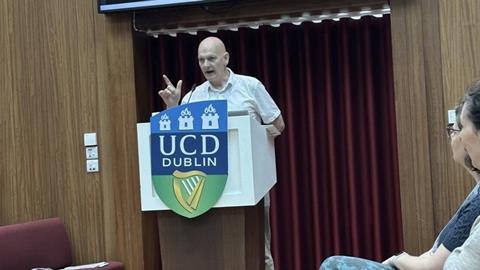

Taking a novel approach to engaging the brains and imagination of its participants, Chris Elliott reflects on the success of the Food Fraud Festival and why this strategy is what we need to tackle tenacious fraudsters.
Over the years I have attended more food fraud conferences than I care to remember. Most have been informative, many have been enjoyable and some have played an important role in advancing our understanding of one of the most significant threats facing modern food systems. Yet, in all honesty, many conferences tend to follow a predictable pattern: experts present their latest findings, panels discuss current challenges, audiences ask a few questions, and most participants return home with a notebook containing a few ideas and some new contacts. To be brutally honest, if we continue to confront increasingly sophisticated food fraud challenges with the same thinking, the same procedures and the same networks that we have relied upon for years, we shouldn’t really expect to achieve dramatically different outcomes. The Food Fraud Festival held in Dublin in late May 2026 was refreshingly very different.
Almost immediately it was clear that this was not intended to be another conventional conference. Organised by the European Food Fraud Community of Practice (EFF-CoP), under the leadership of Professor Saskia van Ruth, the festival sought to challenge not only our understanding of food fraud but also the way we engage with and tackle the subject itself. The event captured something that many of us have been discussing for years. Food fraud isn’t just a regulatory or scientific challenge; it’s a societal challenge, a criminal challenge, a behavioural challenge and increasingly a geopolitical challenge. If we are serious about protecting food systems from organised criminal activity, then we need to broaden both the conversation and the community involved in tackling it.
Criminals actively adapt to changing circumstances; they innovate, they exploit weaknesses and they learn from their mistakes. If those of us who carry some responsibility for protecting food systems are to remain effective, we must be equally innovative and adaptable.”
One of the greatest successes of the festival was the attendees. Rather than bringing together only a collection of food scientists, laboratory experts and regulators, the event attracted an incredibly diverse audience. Behavioural scientists, economists, communication specialists, law enforcement professionals, technology developers, students, policymakers and food industry representatives all came together to discuss this most complex and shared challenge. The result was a level of interaction and creativity that is extremely difficult to achieve in more traditional settings. I certainly returned home with some novel thoughts, ideas and new connections.
What struck me most was how quickly barriers between disciplines disappeared. Like all delegates, I participated in conversations that wouldn’t usually take place yet seemed to happen quite naturally. As an analytical chemist I found myself discussing criminal psychology and the role of neuroscience as just one example. Young researchers felt able to challenge experienced professionals with questions that pushed us well outside of our comfort zones. These exchanges highlighted an important reality: criminals do not operate within disciplinary boundaries and therefore neither should those seeking to stop them.
One of the most memorable aspects of the festival was a format that moved beyond traditional presentations and embraced highly interactive forms of engagement. Throughout the event participants were encouraged not simply to listen but to actively engage. Serious gaming exercises, practical workshops and scientific demonstrations helped create an atmosphere that was both intellectually stimulating and thoroughly enjoyable.
Among the highlights for me was the now famous ‘Food Fraudsters versus Fighters’ debate. Far more than a panel discussion, here participants were challenged to examine food fraud through the eyes of both the criminals perpetrating the fraud and the organisations attempting to prevent it. Several debaters argued the fraudsters’ case with such conviction and attention to detail that I briefly found myself wondering whether we should be checking their backgrounds a little more carefully – one Norwegian in particular comes to mind!
Too often we focus exclusively on how to detect fraud after it has occurred. We invest in sophisticated analytical technologies, develop surveillance systems and try to establish increasingly robust regulatory frameworks –all of which are of course critically important. However, the debate highlighted the importance of understanding criminal behaviour itself. Why do criminals target certain commodities? What market conditions create opportunities for fraud? How do they identify weaknesses within supply chains? What factors influence their decision making?
These questions may sound relatively obvious, yet they are not always given sufficient attention. The exercise reminded participants that food fraud is fundamentally different from many traditional food safety challenges because it involves intent. Criminals actively adapt to changing circumstances; they innovate, they exploit weaknesses and they learn from their mistakes. If those of us who carry some responsibility for protecting food systems are to remain effective, we must be equally innovative and adaptable.
Another particularly inventive feature of the festival was the use of immersive learning experiences. Escape room-style challenges required participants to solve food fraud-related problems under time pressure, while practical exercises encouraged attendees to work together to identify vulnerabilities and develop mitigation strategies. These activities may initially have appeared a little unconventional, but they served an important purpose. Participants were not simply discussing food fraud risks in theory; they were experiencing the complexities, uncertainties and decision-making pressures associated with identifying and preventing them. I think this approach created a deeper understanding of the real-world challenges involved and encouraged a level of engagement rarely achieved through presentations alone.
The festival also showcased how innovation in food fraud prevention extends far beyond laboratory-based testing. There was certainly considerable discussion around advances in analytical science, artificial intelligence, data analytics, traceability systems and emerging detection methods. These technologies are transforming our ability to identify fraudulent activity and will undoubtedly play an increasingly important role in the future. It was particularly pleasing for me to see BIA-analytical collect the coveted prize of ‘Best Counter Fraudster’ – an award that recognises excellence in the fight against food fraud and celebrates evidence‑based, practical approaches to protecting food integrity.
On reflection, I think one of the strongest messages to emerge from the event was that innovation is not only technology-driven but also people-driven. It involves finding new ways to collaborate, new ways to share intelligence, new ways to build trust and new ways to engage with the wide range of stakeholders. The festival created an environment that encouraged interaction and creativity and took us outside our normal professional comfort zones.
I think one of the strongest messages to emerge from the event was that innovation is not only technology-driven but also people-driven.”
The threats facing our food systems are becoming more complex every year. Climate change, geopolitical instability, supply chain disruptions and economic uncertainty are all creating new vulnerabilities that criminals can exploit. Addressing these challenges will require highly skilled professionals with diverse expertise and fresh perspectives. The festival repeatedly emphasised the importance of collaboration, intelligence sharing and collective action. Participants recognised that no single organisation, company or government can tackle food fraud alone. The increasingly global nature of food supply chains means that effective prevention requires strong networks and trusted partnerships that extend across borders and sectors.
Looking back on the event, what impressed me most was not any single presentation or workshop. Rather, it was the atmosphere of openness, curiosity and creativity that permeated the entire festival. It successfully created an environment where participants felt comfortable sharing ideas, challenging assumptions and exploring unconventional solutions. The challenges ahead are undoubtedly significant, but events such as this remind us that a community which is growing, very active and dedicated to protecting our food systems will take on these challenges head on. The more people that join us the more good work we can do together. I would highly encourage everyone with a passion for food integrity to join us and become one of the famous food fraud fighters!















No comments yet