



Demands for clean-label, delicious products that also meet HFSS requirements may seem contradictory, but there is a solution – and it’s nuanced. This article addresses the crucial factors that lead to a successful product for reduced-fat formulations.
As the UK’s 2026 HFSS regulations push the bakery industry towards healthier formulations, fat reduction has become one of the most technically challenging objectives. For pastry margarines used in laminated doughs and industrial margarines for cakes and other baked goods, fat is more than flavour; it is a structural and functional ingredient. It defines layers, stabilises air, controls plasticity and contributes to mouthfeel and shelf life. Simply replacing saturated fats with liquid oils may meet nutrition targets but often leads to smeared layers, collapsed pastries or soft, unstable cake batters.
The question for technical decision-makers is: how can we engineer fat systems that reduce saturated fat while maintaining performance, process robustness and sensory appeal?
Why is fat more than just calories?
In laminated doughs like croissants, puff pastry and Danish pastries, fat is the mechanical backbone. It must hold layers together during folding and sheeting, resist smearing and melt cleanly in the oven to create the characteristic lift and flakiness. In industrial margarines, fat stabilises air bubbles during mixing, maintains volume and controls crumb structure. Across all bakery products, fat also helps to retain moisture, slow staling and lower oxidation. Reducing saturated fat without compensating for these mechanical and functional roles often produces undesirable product characteristics.
Unlike sugar or salt, fat cannot be reduced through simple ingredient swaps. Its contribution is temperature-dependent, linked to solid fat content (SFC) and melting behaviour. Pastry margarine, used for laminated doughs, requires a high SFC at low temperatures with a gentle decline over the working range to maintain sheet integrity during repeated rolling and folding. Typically, it has around 50–70 percent solids at 10–20°C, decreasing gradually to 10–16 percent at 35–40°C. This broad plastic range ensures the fat is firm enough at cooler temperatures to form distinct layers while remaining sufficiently soft and pliable at higher temperatures to resist cracking during sheeting. It also ensures clean melting during baking to produce flaky, well-lifted pastries.
Without a carefully engineered SFC profile, reduced-saturated-fat margarines are prone to smearing, tearing and poor lift.
What happens when you simply replace saturates with oils?
Removing the crystalline framework that saturated fatty acids provide in bakery fats weakens structure, since liquid oils cannot replicate the requisite mechanical properties for lamination or aeration. Consequently, cakes with insufficient solid fat trap less air and achieve lower volume, bread dough may become sticky and lose crumb resilience, biscuits can spread excessively and feel greasy, and laminated dough layers risk collapsing. This underscores that fat reduction is not simply about substituting ingredients, but about strategically redistributing fat structure across the temperature range of mixing, processing and baking to preserve functionality.
How to engineer a functional fat system
The solution is structured fat blends carefully engineered for both pastry and industrial margarines. These blends combine crystalline fats to provide network strength, liquid oils to lower saturated fat content and functional microcomponents to stabilise the system.
In laminated doughs, the β′ crystal form is the gold standard, delivering a smooth, spreadable texture, strong oil-binding capacity and mechanical resilience under the stresses of lamination.
In industrial margarines, a fine and evenly distributed fat crystal network traps and stabilises air during mixing, ensuring consistent batter aeration and reliable cake volume and texture during baking.
Equally important are processing parameters – cooling rate, crystallisation temperature, mechanical working and tempering schedule, which shape crystal formation and network integrity. Even the most carefully designed formulation can fail if these factors are not tightly controlled, highlighting that fat engineering relates as much to structure and processing as composition.
How to match plasticity to lamination conditions
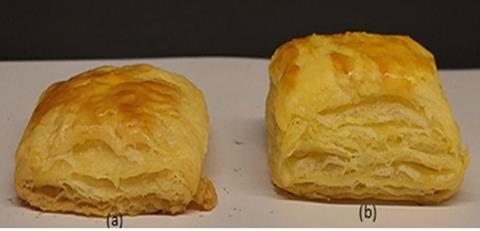
Reduced‑saturated‑fat margarines are more heat sensitive than conventional fats and therefore require tighter process control during lamination. Typical target ranges are 16–20°C for fat temperature and 18–22°C for dough temperature to maintain adequate plasticity.1 When the fat is too cold and hard, it tends to crack during sheeting, disrupting layer continuity and resulting in compact, underdeveloped structures with poor lift (Figure 1). Conversely, when the fat is too warm and soft, it smears into the dough, causing layer collapse and similarly limiting expansion. Maintaining the fat within its optimal temperature range allows clean layer separation and expansion during baking, producing well‑defined, flaky layers and good lift (Figure 1b). Minor adjustments in fat tempering or storage conditions are therefore often necessary to achieve consistent lamination performance.
How to validate fat performance beyond the lab
Solid fat content, melting profile and hardness provide useful indicators of fat structure and behaviour. However, these parameters alone cannot fully predict performance in bakery processing.
Application trials remain essential since they reveal how fat behaves under real manufacturing conditions. In laminated dough systems, the fat must maintain sufficient plasticity during sheeting to prevent cracking or smearing while allowing dough layers to remain distinct. During baking, the fat must support layer separation and steam expansion to produce the desired lift and flakiness while limiting oil migration.
Sensory quality is also important, including flakiness, clean mouthfeel and balanced melting in the mouth. When properly designed, low saturated fat systems can perform almost as well as conventional pastry margarines, while industrial margarines can still provide good aeration and volume under commercial processing conditions.
How does processing influence fat functionality?
Processing plays a major role in improving the performance of reduced‑saturated‑fat systems. During fat production, controlled cooling supports stable crystal formation, while suitable mechanical working ensures uniform crystal distribution. Proper storage and handling, including correct tempering and avoiding temperature fluctuations, help maintain this crystal structure. Without proper processing, reduced‑fat systems can lose plasticity, leading to cracking, smearing, oil leakage, poor layer separation, reduced lift and lower product volume. Finished bakery products may become dense, less flaky, greasy or inconsistent in quality. Optimised processing, however, allows greater fat reduction without compromising functionality, which is especially important in hot climates or on high‑speed industrial production lines.
Clean label and HFSS compliance can coexist
Meeting high fat, salt and sugar (HFSS) requirements while responding to consumer demand for simple, minimally processed ingredients requires a structural and processing‑led approach rather than heavy reliance on additives. Fat reduction must be achieved by optimising fat blend design, controlling crystallisation and crystal form, and applying precise tempering and handling throughout production. By building functionality into the fat structure itself, manufacturers can reduce saturated fat while still maintaining key performance attributes such as lift, flakiness, air stability and acceptable shelf life. This strategy supports cleaner labels and enables both pastry and industrial margarines to meet HFSS targets without compromising product quality or processing robustness.
What does success look like in practice?
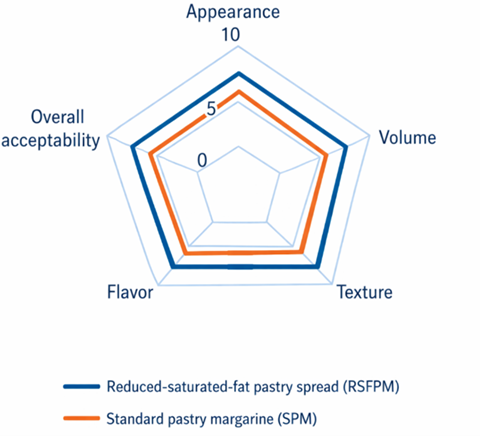
In a trial of 20 percent reduced-saturated-fat pastry margarine, initial attempts at lamination produced soft, collapsing layers that compromised the pastry’s delicate structure. Through careful adjustments to the fat blend, fine-tuned crystallisation and precise process control, the team transformed the margarine into a product that baked beautifully, with strong, flaky layers and the texture and performance of a traditional pastry. Sensory evaluation highlighted a clean melt, soft flake texture and no greasiness, showing that healthier fats can achieve the same delightful quality and enjoyment as conventional pastries (Figure 2).
In industrial margarine trials, the reduced fat blend delivered standout performance, proving that healthier and more nutritious can still be high performing. Cakes formulated with the blend showed a noticeably softer, fresher tasting crumb and achieved higher specific volume, signalling superior aeration and gas retention during baking. Just as importantly, the cakes maintained excellent stability at ambient conditions, with no unwanted oiling or softening throughout preparation.
These results reinforce a clear message for manufacturers: with smart structuring and process optimisation, it’s entirely possible to cut fat without compromising on quality, functionality or consumer‑pleasing sensory appeal across a broad range of baked goods. This low-fat-margarine success story shows how choosing the right fat replacer can make all the difference. The selected ingredient not only acts as an effective fat substitute but also supports volume development in products like cakes, delivering impressive lift without compromising the final sensory experience.
What should technical decision-makers take away?
Reducing saturated fat in bakery products is a structural engineering challenge, not just a nutritional exercise. Key principles for success in pastry and industrial margarines include:
- Define functional priorities by application: lift, aeration, tenderness, shelf life
- Target performance across temperature, not just ingredient composition
- Design for process robustness: tolerate temperature, shear and speed variations
- Evaluate interactions, not ingredients in isolation: flour, water, emulsifiers, process
- Validate under industrial conditions: lab success must translate to factory reliability.
By combining blend design, crystal engineering and process optimisation, manufacturers can meet HFSS targets, support clean-label goals and deliver indulgent, high-quality baked goods. HFSS reformulation is not a compromise – it is an opportunity to innovate smarter, more resilient bakery fats.
Reference
1. Cauvain SP, Young LS. (2007). Technology of Bakery Products (2nd ed.). Springer












No comments yet