



Major global retailers remain far behind on methane reduction and disclosure despite livestock emissions dominating food supply chains.
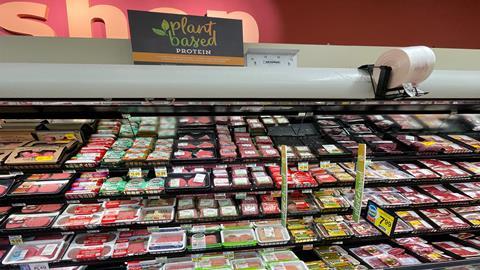
Global supermarket giants are still failing to take meaningful action on methane emissions linked to meat and dairy supply chains, according to a new report from the Changing Markets Foundation and Mighty Earth.
The report, Shelved Again: Supermarkets’ Missing Action on Methane, assessed 20 leading food retailers across six countries and found that none have set methane reduction targets, while methane emissions remain largely undisclosed across the sector. Together generating an estimated $2 trillion in annual revenue – comparable to the GDP of Brazil – these companies remain far off track on methane action.
Methane makes up a significant share of retailers’ Scope 3 emissions, primarily driven by livestock agriculture linked to the meat and dairy products they sell.
Leaders still falling short
Among the companies analysed, Tesco, Lidl and Ahold Delhaize ranked highest overall. Each scored above 40 per cent and has taken steps to improve greenhouse gas reporting, adopt science-based targets and expand plant-based alternatives.
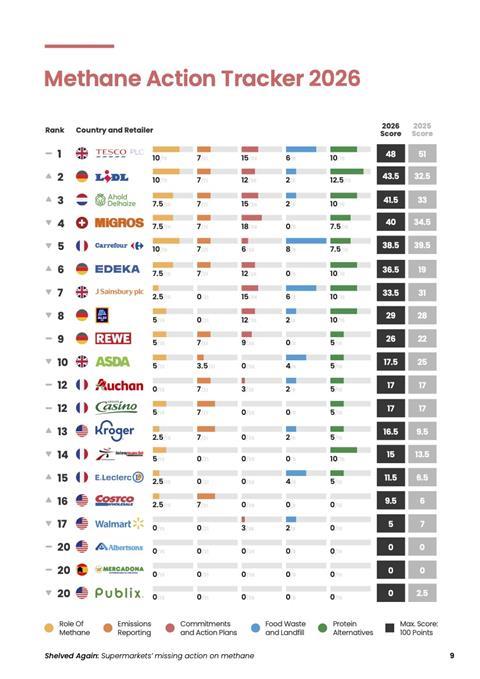
However, the report stresses that even the sector’s highest performers still fall short of decisive methane action.
Elsewhere, Asda recorded the steepest drop in the rankings, losing 7.5 points compared with last year, while Germany’s Edeka-Verbund made the biggest improvement with a 17.5-point gain.
US retailers lagged behind their European counterparts. Costco and Walmart scored below 10 points, while Albertsons and Publix received no points at all.
The findings build on the organisations’ 2025 benchmark report, Clean Up On Aisle 3, which first evaluated major retailers on methane action. While some companies have made incremental improvements, campaigners say progress remains far too slow.
For a second year running supermarkets have shelved ambition to tackle superheating methane embedded in meat and dairy supply chains. Methane emissions from livestock agriculture, primarily cattle, are a key driver of climate change. Rapidly cutting methane is one of the fastest ways to put the brakes on global warming. Supermarkets are uniquely positioned to support a shift to diets with less meat and more plants, a key solution for tackling methane.”
Jurjen de Waal, Senior Director at Mighty Earth
Transparency and slow progress
A key gap identified in the report is transparency. Only Albert Heijn – part of the Ahold Delhaize group – currently reports its methane emissions.
This is despite 11 retailers already disclosing emissions data in line with the Greenhouse Gas Protocol.
According to the report, this suggests the underlying data exists, meaning the lack of methane disclosure reflects a reporting gap rather than a lack of capability.
Rapidly tackling methane is a quick win to halt global heating. The 20 retailers in this report are headquartered in countries signed to the Global Methane Pledge, but all remain far off track to deliver the reduction of at least 30 per cent by 2030 from 2020 levels. These retailers hold a unique and powerful position to influence the global food system. Yet their failure to act has created a leadership vacuum that must urgently be addressed.”
Izzy Howden, Senior Campaigner at the Changing Markets Foundation
While the overall picture remains one of stagnation, 11 retailers improved their scores compared with last year. However, most gains came from incremental measures such as reporting greenhouse gas emissions or publishing alternative protein sales data rather than comprehensive methane strategies.
Plant-based offerings are one area where retailers perform better. Around 75 per cent achieved full marks for broad own-brand ranges, while 70 per cent acknowledged methane from livestock as a climate issue.
Yet only three retailers – Casino Group, Lidl and Tesco – explicitly support reducing meat and dairy consumption as part of their climate strategies.
The report also highlights the Planetary Health Diet, developed by the EAT-Lancet Commission, as a benchmark for reducing food system emissions. The diet prioritises plant proteins such as legumes and nuts, with limited red meat and dairy.
However, none of the retailers assessed have committed to increasing plant-based proteins to at least 60 per cent of sales while reducing animal-based proteins to 40 per cent by 2030.
Pressure mounting on retailers
Agriculture accounts for around 42 per cent of human-made methane emissions, largely driven by meat and dairy production. Methane is around 80 times more potent than carbon dioxide and responsible for roughly one-third of global warming since pre-industrial times. Because methane is relatively short-lived in the atmosphere, rapid cuts could play a critical role in limiting warming to 1.5°C.
The report calls on retailers to adopt science-based methane reduction targets of at least 30 per cent by 2030 and increase plant-based protein sales as part of wider climate strategies.
With supermarkets sitting at the centre of global food supply chains, their decisions on sourcing, product mix and promotions can influence emissions across the entire food system.
As pressure grows to decarbonise agriculture, the report suggests the retail sector will face increasing expectations to move from commitments to concrete methane reductions.





![EcoTrophelia_009[1]](https://d1qyip7ii4bpjm.cloudfront.net/Pictures/380x253/2/2/4/14224_EcoTrophelia_0091.jpg)


No comments yet