




With food fraud on the rise, verification is shifting from paperwork to proof. At GFSI 2026, leaders made the case for DNA traceability to protect value, pricing, and consumer trust.
At GFSI 2026 in Vancouver, a familiar message is being heard but with greater urgency. As supply chains grow more complex and fraud risks rise, the limits of compliance are becoming harder to ignore, particularly for premium or welfare-led systems.
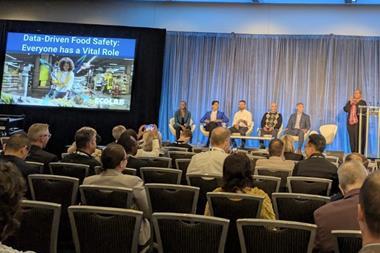
In a plenary session on the future of traceability, speakers from production, certification and technology backgrounds converged on a shared concern. The risk of fraud and mislabelling is rising fast enough to undermine the very claims companies are investing in.
For Dr Veronika Weber, Chief Sustainability Officer at Vion Food Group, the issue is already material. Citing European Commission data, she pointed to roughly 1.8 cases of animal protein fraud per week, a 57 percent increase year-on-year.
The commercial pressures are immediate for producers operating higher welfare or sustainability models. “Farmers invest significantly in higher standards,” she said. “Without strong verification, those investments risk dilution or unfair competition.”
Documentation can sometimes be adjusted; biology cannot.” — Susanne Maassen, Managing Director, Stichting Beter Leven keurmerk
From paperwork to biological proof
While compliance systems remain essential, panellists repeatedly questioned whether documentation alone can withstand the pressures now facing global supply chains.
Susanne Maassen, Managing Director of the Stichting Beter Leven keurmerk, an animal welfare certification body in the Netherlands, put it bluntly:
“Documentation can sometimes be adjusted; biology cannot.”
For schemes built on ethical claims such as animal welfare, that distinction is critical. “Animal welfare is not just a technical specification. It is an ethical claim,” she said. “That means it has to hold under pressure.”
Her organisation has already moved beyond periodic auditing to continuous verification, using routine DNA sampling to ensure prohibited poultry breeds do not enter certified supply chains. When deviations are detected, they trigger deeper investigation across the chain, including financial and data checks.
The aim is not marketing, she stressed, but system stability. “Transparency is about protecting fairness, trust and the overall resilience of the system.”
Why traceability breaks down
The case for biological verification becomes clearer when looking at where traditional traceability systems struggle.
Aurélie Mansord Billiez, who leads DNA TraceBack solutions at Merck Animal Health in Europe, highlighted a key asymmetry. Tracking products forwards through the supply chain is relatively well digitalised, but tracing them back is far more complex.
A single processed product may involve multiple transformations, sites and batch aggregations, often with manual handling and legacy systems still in place. “What you see in the system is an aggregation of multiple batches from a very fragmented situation,” she explained.
That fragmentation creates blind spots. This is where mislabelling or substitution can occur.
DNA verification, by contrast, offers a level of granularity that documentation cannot. By linking end products back to individual animals, it provides a way to test whether the system is actually working as intended.
From cost centre to value driver
Crucially, the panel pushed back on the idea that enhanced verification is simply an added cost.
Instead, speakers framed it as a mechanism for protecting and even enhancing commercial performance.
Weber linked stronger verification directly to market positioning, arguing that it allows producers to defend premium concepts and maintain a level playing field. “Consumers are willing to pay for higher quality and ethically produced products, but only if transparency is credible,” she said. “What’s on the label must be in the package.”
Mansord Billiez pointed to a dairy case study in Europe, where inflation of around 30 percent over five years put significant pressure on consumer spending. Rather than competing on price, one brand doubled down on transparency, making farm-to-fork traceability a visible part of its proposition.
The result was maintained loyalty, preserved pricing and performance ahead of competitors in a contracting category.
A shift in how verification is valued
Across the session, a consistent conclusion emerged. Verification is moving from a compliance requirement to a strategic tool.
As moderator Catherine Dorfman put it, “Verification is often perceived as a cost centre, but it can become a stability driver.”
That shift matters. In increasingly complex and scrutinised supply chains, credibility is no longer built on processes alone, but on the ability to prove, consistently and objectively, that those processes deliver what they claim.








No comments yet